Cleaning a roof isn’t the easiest weekend chore. But the right product can make it a lot more feasible!
Check out this list of 10 of the best roof cleaners on the market. I created this list based on real customer reviews, expert advice, and research into dozens of products. Whether you’ve got a rubber roof or are dealing with mold, there should be something for you on this list.
With one of these cleaners, you just may end up with the cleanest roof on the block.
- Cleans & degreases all washable surface
- Orally non-toxic & biodegradable
- Deodorizes surfaces & upholstery
- No scrubbing required
- Removes mold stains from most surfaces
- Works within seconds of application
- Cost-efficient
- Cleans mold, mildew, & algae stains
- Potent product requires no scrubbing
- Concentrated formula
- Can be used manually or with machine
- Non-corrosive for metal roofs

- Easy to use, no rinsing necessary
- Non-toxic & biodegradable formula
- Safe for all EPDM rubber roofs
- Professional strength
- Works on upholstery, grout, awnings, etc
- Unique triple-action formula

- Works with wind and rain
- Works on almost all outdoor surfaces
- Less toxic with no bleach
- No scrubbing necessary
- Non-acidic and non-bleach
- Safe for most surfaces
- Cleans moss, mildew, mold, algae stain
- Apply to surface and leave
- Bleach-free formula
- Gentle without staining or bleaching
- Up to 10,000 square feet coverage
- Biodegradable, effective & fast-action
Review Methodology: At Oh So Spotless, our mission is to provide you with a comprehensive analysis of the best roof cleaners based on our extensive research, hands-on experience, and performance evaluation. Our team of professionals examines each product through strict criteria, comparing key decision-making factors such as effectiveness, safety, and ease of use. We measure and rank them based on empirical data, first-hand findings, and user feedback. By assessing each roof cleaner’s design choices and their effect on users, we can identify what sets a product apart from its competitors. Our in-depth reviews, combined with our expertise in roof cleaning, ensure that you receive trustworthy recommendations based on solid evidence and facts. Trust us to guide you in making the best decision for your roof cleaning needs.
The Best Roof Cleaners of 2024
It’s important to have a clean roof. Not only is this more aesthetically pleasing, but cleaning your roof can prevent rot and mold.
After researching genuine customer reviews and expert advice, I compiled 10 incredible roof cleaners. To simplify your shopping experience, I’ve written in-depth reviews of each cleaner, complete with pros, cons, and essential specs to note.
Here are 10 roof cleaners that will take your home to the next level of cleanliness.
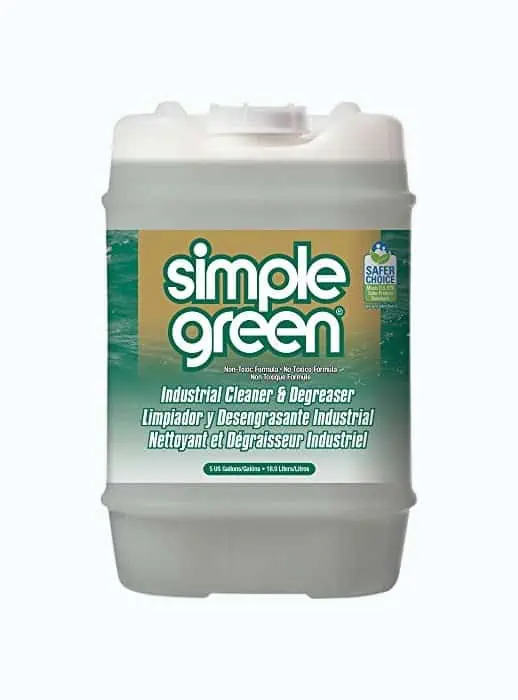
Simple Green Industrial Cleaner/Degreaser
Best Eco-Friendly Cleaner
I love when my research takes me upon an eco-friendly cleaner that’s this effective. Hundreds of satisfied customers love the Simple Green Industrial Cleaner.
One of the greatest features of the cleaner is, of course, the non-toxic and biodegradable formula. It’s safe on multiple surfaces, especially compared to chemical-based cleaners. It’s non-abrasive, non-corrosive, and it’s also not flammable.
What surfaces, you ask? Any washable surface. Seriously.
You can use this on countertops, roofs, floors, upholstery, sinks, carpets, and much more! You can even put it into cleaning machines like carpet extractors, pressure washers, steamers, floor scrubbers, and foamers.
This is a super versatile and handy product to have in the house.
What can it clean? Oils, grease, fluids, grime, residue, and more. It cleans, deodorizes, and degreases — all with eco-friendly ingredients.
Last but not least, a little goes a long way. It’s a cost-effective purchase. The price per fluid ounce is already really low.
Plus, you can use this for most of your household cleaning, meaning you can cut back on buying many different products. Win-win!
Pros
- Cleans and degreases all washable surfaces.
- You can use this by hand or put it into cleaning machines.
- Orally non-toxic and biodegradable.
- Deodorizes surfaces and upholstery.
- Non-abrasive, making it safe for most surfaces.
Cons
- Doesn’t clean as well as some chemical-based cleaners.
- May still irritate eyes and skin.
Product Specs
| Roof Type | All washable surfaces |
| Formula | Non-toxic and biodegradable |
| Coverage | Not specified |
| Ease of Use | Heavy bottle, but can be used in machines |
| Quantity | Five gallons |
Our Ratings
User Experience
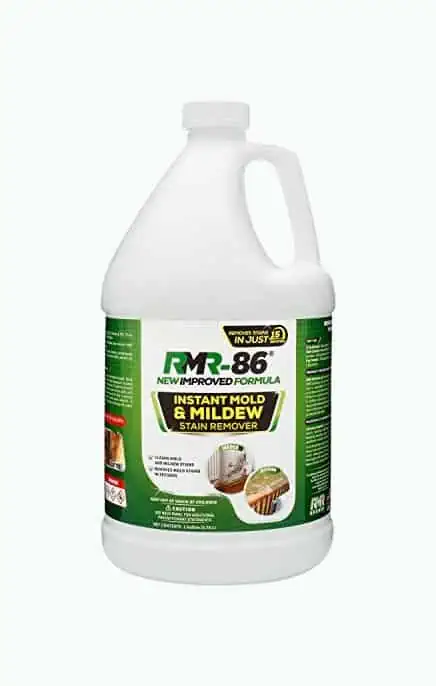
RMR-86 Instant Mold and Mildew Stain Remover
Most Versatile
When you find a product that works for multiple purposes, it’s a happy day. This stain remover from RMR can be used indoors and outdoors, making it very versatile.
You can use it on pretty much all types of roofs except metal. Plus, you can also use it on a huge variety of other surfaces, including bathrooms, concrete floors, decking, brick walls, grout, tiles, and much more.
Its main purpose is to remove mold and mildew stains. So wherever you find those, you can put this product to good use.
It also deodorizes surfaces. When you use this to clean shower curtains, kitchens, bathrooms, and other places that cling to bad smells, you’ll notice a massive difference in the musty, damp scents.
Customers love how fast this works. It instantly works on mold, mildew, and other stains. Give this a try if you want instant results.
Pros
- No scrubbing required.
- Removes mold and mildew stains from most surfaces.
- Starts working within seconds of application.
- Deodorizes surfaces, too.
- Ready-to-use formula.
- Works on decks, concrete, roofs, kitchen surfaces, and more.
Cons
- Emits harsh fumes that many customers found irritating.
- Can leave streaks or strip paint if not washed off well.
Product Specs
| Roof Type | All except metal |
| Formula | Bleach-based |
| Coverage | Not specified |
| Ease of Use | No scrubbing required; works in seconds |
| Quantity | One gallon |
Our Ratings
Personal Perspective
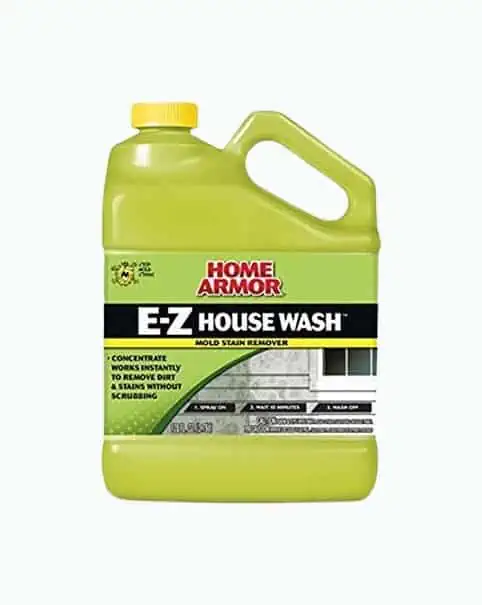
Mold Armor E-Z House Wash Cleaner
Best Bleach Based Roof Cleaner
If you’ve tried various products to get rid of those tough stains on your roof, and nothing works, I have a recommendation for you. This tough formula has been specially designed to clean mold, mildew, and algae and its stains with absolutely no scrubbing.
This bleach-based formula is suitable for vinyl, wood, aluminum, and concrete roofs. It’s also safe for painted decks, fences, and more! Due to the chemicals used in the formula, it is great for heavy and stubborn stains and your general dirt.
You can easily apply this to your roof with a roller, sponge, or sprayer. This makes it very easy to use, depending on what tools you already have in your garage.
You can dilute the cleaner with water so that a little bit goes further. Or you can use it at full strength, which is recommended for extreme stains and dirt. Whatever you choose to do, no scrubbing is necessary.
Pros
- Cost-efficient.
- Cleans mold, mildew, and algae stains.
- Suitable for a range of roof materials.
- Potent product requires no scrubbing.
- Low price per fluid ounce.
- You can apply with a garden sprayer, sponge, roller, and more.
Cons
- Some customers found using bleach worked just as well.
- May require a second application on tough stains.
Product Specs
| Roof Type | Vinyl, wood, aluminum, concrete, and wood |
| Formula | Bleach-based |
| Coverage | Not specified |
| Ease of Use | No scrubbing required |
| Quantity | Two one gallon bottles— can be diluted |
Our Ratings
Community Feedback
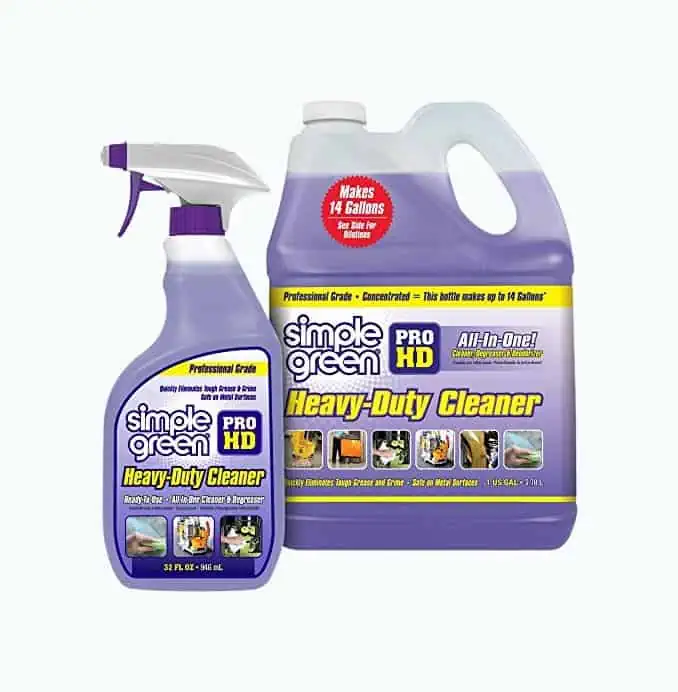
Pro Purple Concentrated Cleaner & Degreaser
Easiest To Use
Lots of my recommendations are easy to use, but this one goes the extra mile. It comes with a spray bottle, so you can easily apply this to dirty areas. It also includes a one-gallon refill so you can top up the spray bottle when it runs out.
This is a professional-grade cleaner that also degreases. So you can finally watch tough grease, stubborn grime, and other nasty stains fade away. It also works on various surfaces, including roofs, floors, walls, cars, machines, and more.
Good news for those with metal surfaces: it’s non-corrosive to metals! It’s also safe for use on plastic surfaces without degrading down the material.
I also love that you can use this manually or put it in a pressure washer, floor scrubber, dip tank, and other cleaning equipment. It’s a water-based cleaner without harsh solvents and chemicals, so it’s safe for these machines and various surfaces.
Pros
- Concentrated formula, so a little goes a long way.
- Can be used manually or in a cleaning machine.
- Great for tough grease and grime.
- Non-corrosive, perfect for metal roofs.
- Professional-grade product.
- Works on floors, walls, appliances, roofs, cars, and more.
Cons
- Strong odor; you may want to wear a mask.
- May contain diethanolamine, which may be cancerous (1).
Product Specs
| Roof Type | Most surfaces |
| Formula | Water-based, without harsh chemicals, but may contain a carcinogenic ingredient |
| Coverage | Not specified |
| Ease of Use | Yes, comes with spray bottle |
| Quantity | One gallon concentrated |
Our Ratings
First-Hand Impression
Protect All Rubber Roof Cleaner
Best for Rubber Roofs
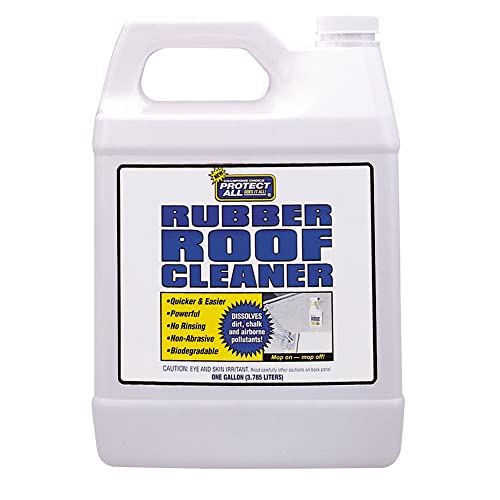
It’s important to clean rubber roofs with products specific to this vulnerable surface. This Protect All Store cleaner is free of soapy surfactants and abrasive ingredients. Therefore, it completely protects your rubber roof and makes cleaning easy. In fact, it also degreases!
All you need is water and a sponge mop, as well as this cleaner, and you’ll have a clean roof in as little as three easy steps. The recommended cleaning process is included with the product so you can get to work as soon as it arrives with no confusion.
This cleaner is specifically designed for all EPDM (ethylene propylene diene terpolymer) rubber roofs, so keep that in mind before purchasing. That being said, it’s wonderful for grime and chalk build-up on roofs. Finally, say goodbye to that unsightly mess!
One more bit of good news: this formula is biodegradable!
Manufacturer Tip
Don’t let the cleaner run off the side of your roof; otherwise, you might get white streaks down the side of your house or RV.
Pros
- Easy to use, no rinsing necessary.
- Non-toxic and biodegradable formula.
- Safe for all EPDM rubber roofs.
- Removes grime and chalk build-up.
- Non-abrasive formula.
Cons
- Residue can leave streaks on other surfaces.
- Customers found it time-consuming to use since you still need to scrub.
Product Specs
| Roof Type | EPDM Rubber |
| Formula | Non-toxic and biodegradable |
| Coverage | Not specified |
| Ease of Use | Three steps, no rinsing required |
| Quantity | One gallon |
Our Ratings
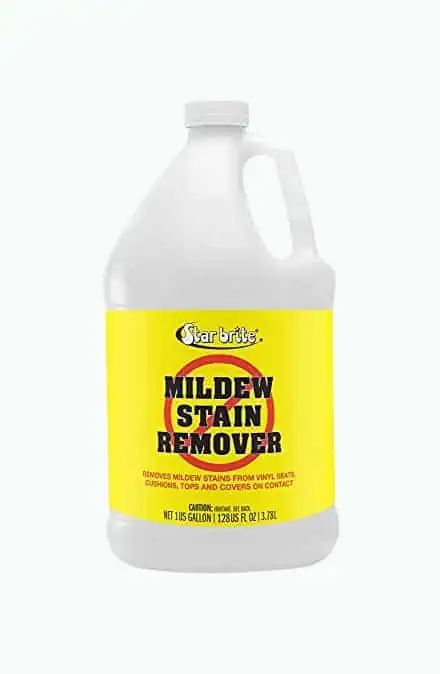
Star Brite Mold Stain & Mildew Stain Remover
Best for Mold and Mildew
Mold and mildew can leave unsightly stains. They often seem impossible to remove. That’s where Star Brite comes in.
This formula has been created to quickly blast away mold and mildew stains without the stress of intense scrubbing. Simply spray it on, wait for the stain to lift, then rinse the surface.
This product is made with a high-alkaline, triple-action formula, and buffered bleach to remove mold and mildew stains. It also has chelating agents that lift old dirt. The surfactants then work to clean general grime and grease.
I appreciate how versatile this product is. Whether you have fiberglass, wood, concrete, plastic, vinyl, or tile surfaces — this product is suitable. Basically, wherever you find mold and mildew, you can put Star Brite to the test.
Try it out on vinyl cushions and upholstery. It also works on grout and tile. Use it for cleaning showers and baths.
Put it to the test on gutters, awnings, and sidings. It even works on boats and RVs!
Pros
- Professional strength for quick and effective cleaning.
- Works on upholstery, grout, awnings, and more surfaces.
- Unique triple-action formula for effectiveness.
- Works without intense scrubbing.
- Fast acting and easy to use.
- Made in the USA.
Cons
- Strong, unpleasant odor.
- Made from sodium hypochlorite, a hazardous chemical.
- Not suitable for wood or painted surfaces.
Product Specs
| Roof Type | Fiberglass, wood, concrete, plastic, vinyl, or tile |
| Formula | Chemical, bleach-based |
| Coverage | Not specified |
| Ease of Use | No scrubbing, but lots of rinsing required |
| Quantity | One gallon |
Our Ratings
Personal Perspective
Wet & Forget Stain Remover
Best Value

This roof cleaner from Wet and Forget provides incredible value for money.
First of all, it’s a two-pack of 0.5 gallons each. This one-gallon total actually makes six gallons once diluted, all for a seriously fair price! The cost per fluid ounce is enough to make your bank account very happy.
The product also has an unlimited shelf life. So you don’t need to rush to use it by a specific date.
It also covers up to 1,125 square feet per bottle. So these two bottles will go up to 2,250!
You can use this product on any outdoor surface. This includes roofs, patios, pool surrounds, driveways, sidewalks, astroturf, and much more. It’s suitable for various materials such as fiberglass, painted surfaces, ceramic, brick, stone, decks, canvas, asphalt, steel, shake, tile, clay, and more.
It’s been specially designed to remove tough stains without any rinsing required. Say goodbye to moss, mildew, algae, and mold stains, all thanks to a bleach-free formula. It can even protect your surface from future stains for up to one year!
Pros
- Works with wind and rain — simply wet the surface and walk away!
- Suitable for almost all outdoor surfaces.
- Works even on stubborn green and black stains.
- Less toxic, with no bleach in the formula.
- Low cost per fluid ounce once diluted.
- Removes mold, mildew, moss, and algae.
Cons
- Should not be used near water and lakes.
- You don’t get immediate results; it works over time.
Product Specs
| Roof Type | Asphalt, steel, shake, tile, clay, and more |
| Formula | Not bleach-based |
| Coverage | 1,125 sq feet per bottle |
| Ease of Use | Yes, wet surface and leave it |
| Quantity | One gallon — makes 6 gallons |
Our Ratings
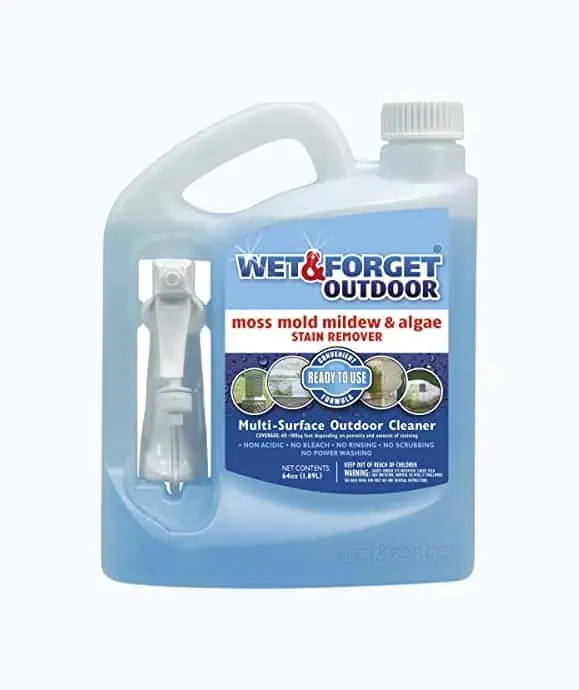
Wet & Forget Outdoor Moss, Mold, Mildew, & Algae Stain Remover
Most Effective
Looking for something that can blast away all kinds of stubborn stains? Check out this cleaner from Wet & Forget.
This potent formula removes mold, mildew, and algae stains in just a few hours. And without any scrubbing! So not only is it super speedy to use, but it’s also super easy.
You can use this on roofs, kitchens, basements, attics, boats, and gutters. Think a spotless sink, shower, RV’s, tiles, driveways, and more. It works on basically any surface!
All you need to do is apply the solution to the surface and let it dry. No rinsing is necessary!
Just make sure that the temperature outside is above 32 degrees Celcius. If mold is weighing you down, this is a much cheaper option than getting a professional to remove the mold stains.
Keep in mind that despite the word “eco” being in the product name, this is not an eco product. However, it’s a heavy-duty cleaner that does its job.
Pros
- No scrubbing necessary.
- Non-acidic and non-bleach solution.
- Safe for most surfaces.
- Sprayer head included.
- REmoves moss, mold, algae, and mildew stains.
- Unlimited shelf life.
Cons
- Temperature is a determinant of product effectiveness.
- Maximum coverage of 180 square feet.
- May take between one week and six months to see results.
Product Specs
| Roof Type | Asphalt and fiberglass, steel, clay, shake and tile |
| Formula | Bleach-free |
| Coverage | Up to 180 square feet |
| Ease of Use | Yes, spray, wait, then forget |
| Quantity | 0.5 gallon |
Our Ratings
First-Hand Impression
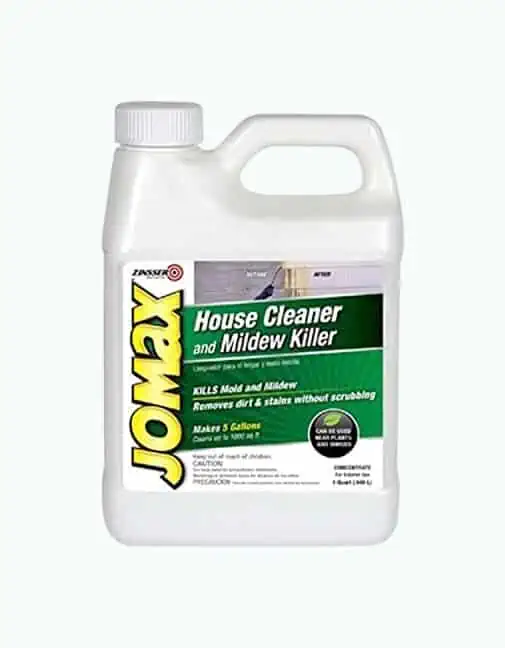
Rust-Oleum Jomax House Cleaner
Best Budget Roof Cleaner
If you’re on a budget, don’t sacrifice a sparkling clean roof. The Rust-Oleum Jomax is less than the average roof cleaner but still cheap per fluid ounce. So you’re saving money upfront but also in the long run!
Despite it being a budget option, it’s still an awesome cleaner. It’s formulated with a bleach-free recipe yet very powerful for removing tough stains.
Simply spray it onto your chosen surface with a pump-up garden sprayer and leave it. Over time, natural weather conditions like wind and rain will work with the formula to clean the stains on your surface.
You heard that right! No scrubbing or rinsing is required. Just spray the surface and go about your business.
This is suitable for roofs, as well as decks, fences, siding, patios, and much more. Customers love that this super-concentrated formula makes up to five gallons of cleaner. This is enough to stretch up to 1,000 square feet.
Pros
- Removes moss, mildew, mold, and algae stains.
- Apply to surface and leave; no scrubbing or rinsing required.
- Bleach-free formula.
- Suitable for use on various outdoor surfaces.
- Concentrated formula, so a little goes a long way.
Cons
- Pump-up garden sprayer required.
- It doesn’t deliver immediate results.
Product Specs
| Roof Type | Not specified — just claims “roofs” |
| Formula | Not bleach-based |
| Coverage | 1000 square feet |
| Ease of Use | Yes, wet surface and leave it |
| Quantity | 1 gallon — makes 5 gallons |
Our Ratings
User Experience
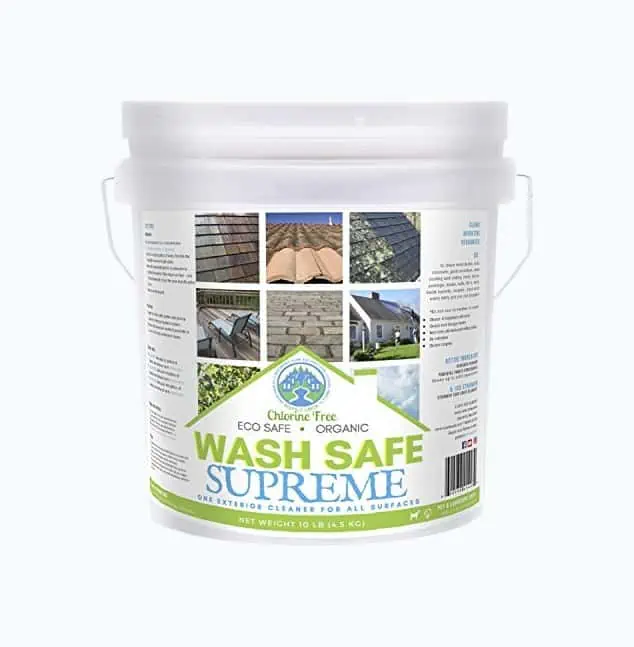
Wash Safe Industries Exterior Surface Cleaner
Best Without Harsh Chemicals
Many roof cleaners are formulated with harsh chemicals, like bleach because it’s effective on tough grease and grime. But if you don’t have mold, mildew, and other stubborn stains and want to avoid harsh chemicals, check out this roof cleaner.
It’s made without harsh chemicals or toxic ingredients. The main active ingredient is hydrogen peroxide, which is safer to use. Your surrounding greenery, grass, and plants will be much happier since this formula will not damage them.
If you’re a fan of oxygen bleach, this functions quite similarly. Another great thing is that it’s biodegradable. In fact, after 4-6 hours of being in contact with a surface, it already begins this biodegrading process!
Combine this product with pressure washing, and you’re in for a super-powerful clean with impressive results! Simply spray on the cleaner and rinse off.
Use it on asphalt, cedar, slate, tile, vinyl, and brick roofs. So, if that sounds like your roof, you’re in luck!
Pros
- Gentle on surfaces without staining or bleaching.
- Up to 10,000 square feet coverage.
- Biodegradable, starts breaking down hours after application.
- Works for asphalt, cedar, slate, tile, and vinyl roofs.
- Safe for surrounding landscaping.
- Safe to use over and around water.
Cons
- Leaves behind a hard-to-remove film on windows.
- Some customers weren’t impressed with the effectiveness.
Product Specs
| Roof Type | Slate, wood, vinyl, tile, brick, and cedar |
| Formula | Non-toxic |
| Coverage | 10,000 square feet |
| Ease of Use | Use with a pump sprayer or pressure washer |
| Quantity | 10-pound container |
Our Ratings
Personal Perspective
| Product | Best | Roof Type | Formula | Coverage (square ft) | Ease of Use |
|---|---|---|---|---|---|
| Simple Green Industrial Cleaner | Eco-Friendly Cleaner | All washable surfaces | Non-toxic & biodegradable | N/A | Can be used in machines |
| RMR-86 Instant Remover | Versatile | All except metal | Bleach-based | N/A | No scrubbing, works in seconds |
| Mold Armor E-Z House Wash | Bleach Based Roof Cleaner | Vinyl, wood, aluminum, concrete, & wood | Bleach-based | N/A | No scrubbing required |
| Pro Purple Concentrated | Easiest To Use | Most surfaces | Water-based, may contain carcinogenic ingredient | N/A | Yes, comes with spray bottle |
| Thetford Rubber Roof Cleaner | For Rubber Roofs | EPDM Rubber | Non-toxic & biodegradable | N/A | Three steps, no rinsing required |
| Star Brite Mold & Mildew Remover | For Mold & Mildew | Fiberglass, wood, concrete, plastic, vinyl, or tile | Chemical, bleach-based | N/A | No scrubbing but lots of rinsing |
| Wet and Forget Stain Remover | Value | Asphalt, steel, shake, tile, clay | Not bleach-based | 1,125 | Yes, wet surface & leave it |
| Wet & Forget Outdoor | Most Effective | Asphalt and fiberglass, steel, clay, shake and tile | Bleach-free | 180 | Yes, spray, wait, then forget |
| Rust-Oleum Jomax | Budget Roof Cleaner | Not specified — just claims “roofs” | Not bleach-based | 1000 | Yes, wet surface & leave it |
| Wash Safe Exterior Surface Cleaner | Without Harsh Chemicals | Slate, wood, vinyl, tile, brick, cedar | Non-toxic | 10,000 | Use pump-sprayer/pressure washer |
How To Choose the Best Roof Cleaners
There are dozens of roof cleaners available on the market. Here’s how to decide which is right for you.

Roof Type
First of all, make sure the cleaner you’re buying is suitable for your roof type. Not all cleaners are suitable for all material types.
For instance, vinyl and rubber roofs are more vulnerable and aren’t usually compatible with heavy-duty chemical-based cleaners. Instead, you may want to look for an eco-friendly option with more natural ingredients.
However, other materials, like metal and slate, can usually handle stronger chemicals, including bleach. Always check the packaging description to ensure the cleaner is suitable for your roof’s material.

Formula
Next, you’ll want to check the product’s formula. Is it eco-friendly? Made with harsh cleaners? Bleach-based?
Eco-friendly cleaners are, of course, gentler and better for the environment. But bleach-based cleaners may be best for you if your roof is filthy.
In fact, if there is a build-up of mold or mildew, you might be led to a bleach-based or chemical-based cleaner. This is often the only formula that can really scrub that dirt away.

Value for Money
Consider how far a product is going to go. It’s all good buying a reasonably priced cleaner, but if a little doesn’t go a long way, you may not be getting good value for your money.
Check the coverage of the product and how many coats it takes to deep clean the roof.
Consider This
Concentrated formulas often go the furthest since you can dilute it and get more coverage.

Ease of Use
There are a few different factors that will determine how easy a product is to use.
First of all, if it comes in a spray bottle, you can use it directly from the packaging.
Secondly, some cleaners have no-scrub formulas, which require much less effort.
Lastly, consider how many steps it takes to use the product. The fewer the steps, the easier it will be to use overall.

Performance
One of the important factors is how well it works. The effectiveness can be measured by what the product is capable of doing. Many are general cleaners, while others specifically target tough stains like mold, mildew, discoloration, algae, and more.
Always check the customer reviews to decipher what real reviewers think of the product’s effectiveness.
Keep in mind that the most effective products might be the harshest. So, if you’re unhappy with chemical-based cleaners, you may be sacrificing some efficacy.

Budget
Lastly, consider your budget. Many roof cleaners have quite a high upfront cost, averaging between $25 and $50. Always check the cost per fluid ounce, as this tells you more about your value for money. It’s often better to buy in bulk, so the cost per fluid ounce is lower.
That being said, some great options under $25 still have a low cost per fluid ounce. That way, you’re still getting good value for money but not paying a ton upfront.
Roof Cleaning Tips
Now that you’ve chosen your preferred cleaner, here are some tips for cleaning your roof.
- Remove debris before using a cleaner: Once you’ve removed debris, you can access the roof’s material and better target stains and dirt.
- Avoid walking on roofs when possible: Always try to use ladders and hoses instead.
- Stay safe on roofs: If you are walking on the roof, use proper safety gear that will protect you if you happen to fall.
- Go from high to low: Start at the highest point when spraying a roof, working your way down to the lowest. This ensures that any dirt running down is cleaned at the end.
- Remove build-up first: Use a trowel or stiff brush to remove moss and other build-up before using a cleaner.
- Regular inspections: Regularly inspect your roof to check for damage and dirt. Clean when necessary, but at least yearly.
Roof Cleaner FAQs

Is Mold on Roofs Dangerous?
Yes. The mold on roofs can actually get through the roof spores and into your home. This is especially bad for family members with allergies or asthma.
Mold can also get washed off during rain and end up on driveways or walkways before being tracked into the house. If you have mold on your roof, I recommend dealing with it immediately.
Does Vinegar Kill Moss on Roofs?
Yes, vinegar is acidic and can kill moss (2). But be careful because it can also kill surrounding plants.

Is Pressure Washing a Roof Bad?
Pressure washing can certainly damage a roof if done incorrectly. Always check with the pressure washer manufacturer about what kinds of materials it’s suitable for. For instance, many aren’t compatible with tiles.
On the other hand, always use a wide spray nozzle and a low PSI to ensure the integrity of your roof.

What Happens if You Don’t Clean Your Roof?
Here are some persuasive reasons why you’ll want to keep your roof clean:
- Prevents animals and moisture: Algae, fungus, and moss will build up on your roof. This can attract bugs and other animals, as well as moisture.
- Prevents rot and damage: If you have a shingle or wood roof, neglecting your cleaning routine can easily lead to rot and damage.
- Prevents leaks: Mold and rot lead to excess moisture, which can result in a leaking roof.
- Prevents falling debris: If the roof and gutters aren’t working properly, dirt and debris will fall off your roof and onto your driveway, walkway, and front lawn.
When in doubt about roof cleaning, hire a professional.

What Is the Black Stuff on a Roof?
The black stuff on a roof is an algae called gloeocapsa magma. It feeds on limestone in asphalt shingles to degrade the shingles and cause roof failure.

Does Baking Soda Work for Roof Moss?
Baking soda works for roof moss as it works on mold and mildew inside your home. It’s 100 percent natural and one of the easiest and cheapest ways to kill roof moss.