Nothing is worse than opening your closet full of clothes and finding nothing to wear. Not because you don’t have clothing, but because you hate the clothes, they don’t fit or are uncomfortable.
You’d clean out your closet, but where do you start?
The trick is to know how to declutter your closet. So when you open your closet tomorrow morning you’ll only see clothing you love to wear.
Key Takeaways
- Declutter your closet by setting limits for each clothing category and sorting items into donate, wear, throw, and unsure piles.
- Benefits of decluttering include saving money, reducing stress, less time cleaning, and easier maintenance of your wardrobe.
- When decluttering, ask yourself questions like: Do I love it? Do I wear it? Does it project the image I want? Is it comfortable?
- Maximize storage space by minimizing clothing and getting rid of extra storage furniture.
7 Benefits of Decluttering Your Wardrobe
Save Money
One benefit of decluttering your wardrobe is that it will help you save money because you’re forced to face your past purchasing decisions. Why was purchasing this dress a good choice but buying these pants a bad one? So the next time you go shopping, you’ll have a better idea of what clothing you should buy.
Less Stress
You’ll find yourself less stressed after decluttering your wardrobe. Studies have shown that clutter increases stress levels. Where do you put the clothing? Do you have room to store it properly? What’s hiding in the far corners of your closet? Removing the excess clothing will reduce your stress levels.
Less Time Cleaning
Less clothing means less time cleaning. You won’t have as much clothing to wash even if you wait until you have no clothing to wear before you do your laundry. Instead of doing laundry, you’ll need to decide what you’re going to do with your extra time.
Fewer Decisions
Decision fatigue is real. If you have too much clothing, then you have to make more decisions about what you want to wear. By decluttering your closet, you’ll be able to focus your decision-making skills on more important things.
Easier to Maintain
It’s easier to stay on top of maintaining your clothing when you have fewer items to care for. You won’t end up needing to mend 10 blouses because you won’t have 10 blouses. It will be much easier to keep your clothing in good shape when you have fewer items.
More Space
Another benefit of decluttering your wardrobe is that you’ll have more space. You’ll have space for the clothing you love. You’ll have space to add another item or two. And you’ll have space to breathe.
Easier to Find Items
It’s easier to find items in a decluttered closet. When your closet is bursting, it’s hard to find that favorite shirt or dress. Everything is cluttered and it’s difficult to see what you have. But after you’ve decluttered your closet, you’ll find that it’s easier to find that special dress.
Questions to Ask When Decluttering Clothes
Your goal when cleaning out your closet is to only keep the items that you love, wear, and project the image you want. So use these questions as a guide to help you declutter your clothing. You can make a checklist to ensure that you keep the correct items.
Do I Love It?
One reason to declutter your closet is to reduce your clothing to the things you truly love. There’s nothing worse than opening up your closet doors to see nothing but the clothing you hate. By the same token, there’s nothing better than opening your closet doors to clothing you love.
So the first question to ask yourself is if you love the item.
If the answer is yes, continue to the next question in the series.
If the answer is no, why do you have this piece of clothing? Does it fill a hole in your closet or is it an item you keep tucked away so you never have to see it? Unless you truly need the item, like it’s your last pair of shoes, toss it onto the pile of discarded clothing.
If it’s something you need, plan to replace the piece of clothing with something you love as soon as you can. Life is too short to wear clothing you hate.
Do I Wear It?
The next question to ask about your piece of clothing is whether you wear the item. Everyone ends up with a few pieces of clothing cluttering up the closet that they never wear. These may even be an item you love, but it doesn’t fit your current lifestyle, it’s not the right size, or it’s uncomfortable.
If the answer is yes, by now you should be looking at an item you both love and wear. Move on to the next question.
If the answer is no, try it on and wear it for a while. You may find a hidden treasure that’s been hiding in your closet. On the other hand, it may be too tight, not your style, or something you’ve been holding onto from your teenage or college years.
If it’s the latter, why are you keeping this piece of clothing? Do you really need clothing to help you remember the fun times of the past? Pictures, friends, and music do a much better job of remembering the fun times and don’t prevent you from moving on to enjoying your present lifestyle.
Move the item to the discard pile and make room for new memories.
Sometimes we hang onto clothing because they represent a lifestyle we wish we had rather than the lifestyle we’re actually living. While there’s nothing wrong with keeping one outfit on hand for special occasions, you don’t need a closet full of clothing you never wear.
So take a good hard look at the piece of clothing. Is it truly something that you need cluttering up your closet and taking up space you need for clothing you actually wear?
Does It Project The Image I Want?
Now let’s look at whether or not the piece of clothing projects the image you want to portray to the world?
If the answer is yes, move on to the next question.
Otherwise think about why you have this item. If it’s an item from your teenage or college years it probably doesn’t reflect who you are today. We all change and grow through the years and our clothing needs to grow with us.
Another reason the item may not project the image you’d like to portray is that it was a gift or you purchased it at the urging of someone else. Everyone has a different style. If the item doesn’t portray you as you’d like to be seen, give it away to someone who will wear it.
Life is too short to wear clothing that doesn’t fit your sense of style.
Does It Itch Or Scratch?
Is the item of clothing you’re holding in your hands comfortable? Does it itch and scratch?
If the piece isn’t comfortable, then why do you want to keep it? After all, nothing is worse than going through the day with itchy or scratchy clothing. It will drive you mad! Put the item on the discard pile.
On the other hand, if the item is comfortable and doesn’t itch or scratch, it should be a piece you enjoy wearing. So move on to the next question.
Does It Pinch My Toes?
Try on each pair of shoes. Are the shoes comfortable or do they pinch your toes? Do they catch the back of your heel?
If the shoes hurt your feet, you’re going to end up limping by the end of the day. You’ll probably end up never wearing the shoes. Too often we buy shoes that look fabulous but are uncomfortable to wear. So if the pair of shoes you’re considering is uncomfortable, toss them onto the discard pile.
If the answer is no, the shoes don’t pinch my toes then move on to the next question in the series.
Are The Heels Too High To Walk?
Let’s consider if the heels of your shoes are too high to walk? No one enjoys struggling to walk and balance as you stagger through the day.
So if the heels are too high for you to walk in, then you need to toss the shoes onto your discard stack.
If the heels are a good height for you, keep the shoes and move on to the next question.
Is It Moldy? Smelly? Stained?
Check to see if this item is still in good shape. Or if it’s moldy, smelly, or stained? If the answer is yes, then you probably don’t want to keep it.
On the other hand, if the item is stained it may be a useful item to save for messy projects such as painting your house or yard work. This way you don’t risk destroying a nice outfit. Only plan on keeping one or two outfits for messy work.
If the answer is no, then move on to the final question in the series.
Does It Fit?
The last question to consider is if the item of clothing actually fits.
If the item does fit, then you’re now holding an item that’s comfortable and you love to wear. It also projects the image you wish to portray to the world. Keep the piece of clothing and return it to your wardrobe.
If the item doesn’t fit then why are you keeping it? If you’re planning on losing weight, you’ll want to purchase new items when you reach your desired weight. You won’t want to wear an old wardrobe from three years ago.
6 Steps to Decluttering Your Closet
- Time: 3 hours
- Difficulty: Beginner
1. Work on Your Mindset
Mindset is important when you’re decluttering your closet. You’ll want to be well-rested, fed, and ready to make decisions. Make yourself comfortable. Turn on your favorite inspiring tunes.
The goal is to inspire yourself to declutter your closet and be ready to let good things into your life. Because that’s what you’re doing. Get rid of the old so you can make room for the new.
2. Set a Limit for Each Category of Clothing
Decide before you start decluttering your closet just how much of each type of item you need and how much room you have. You may want to keep 20 shirts, but if you only have room for 10 then that’s the limit for the number of shirts you should keep.
So before you begin, give yourself a limit for each category of clothing. Decide exactly how many skirts, dresses, pants, shirts, shoes, etc. you will need before you start decluttering.
3. Gather All Your Clothes in One Place
In order to declutter your wardrobe efficiently, you need to be able to see all of your clothing at one time. At the very least, you’ll need to see each piece in every category to decide just what pieces you’ll be keeping and which ones you want to get rid of.
So empty out your drawers and your closet. At the same time, gather each type of clothing in one area. This way you can see all of your shirts at one time, and you can sort through your dresses at the same time. You won’t need to wade through a pile of jeans and shorts in order to find your blouses.
4. Sort Them
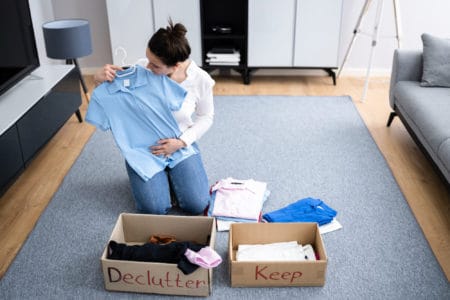
As you go through your clothing you’re going to sort them into four piles. The first pile consists of the items you plan to donate. The second pile should have the pieces you love and wear. The third pile holds the items that you need to toss out, and the fourth pile is things you don’t quite know whether you want to keep or toss yet.
Let’s go through the piles in more detail.
To Donate
This pile consists of clothing that might be too small, doesn’t portray the image you’d like to portray, or is too large. The clothing is in good shape, but it doesn’t fit your current lifestyle or is uncomfortable. Don’t try to hang onto the clothing.
Donate it and let it move on to someone who will love the piece.
To Wear
This pile of clothing consists of the items that passed all the questions. These are items you love, wear, and fit your lifestyle. They’re comfortable and portray the image you’d like to show to the world.
These items will be returned to your drawers and closet after you’re finished decluttering.
To Throw
The items that fall into this category are the pieces you’ve loved to death. They’re stained, torn, or moldy. They are not in good enough condition for you to donate or wear.
Throw them away.
Unsure
Put any clothing you’re not certain of into this last pile. This pile should have clothing that doesn’t know whether to keep or donate. Hopefully, each piece is an item you like and fits well.
Otherwise, make your life easy and put it into the to donate pile.
5. Maximize Storage Space
One of the best steps to maximizing your storage space is to minimize the clothing you’re storing there. This will allow you to store the clothing that means the most to you and not waste your storage space on items you hate or that don’t fit well.
So keep this in mind as you’re going through your wardrobe. The goal is to use your storage space wisely and only keep the clothing you love to wear. So when you open your closet in the morning, you know that each outfit will look good on you.
6. Get Rid of Extra Storage Furniture
If you have extra storage furniture, now is the time to get rid of it. The reason is that you’ll simply purchase more clothing to fit the amount of space you have and end up needing to declutter your closet again in a couple of months.
Also, you’ll make more room in your bedroom. This will give you space to breathe, read, and relax.
Why keep extra storage when you don’t need the space?
Wardrobe Decluttering Tips
Trust Your Gut
Sometimes you’ll pick up an item your gut is saying to get rid of, but your mind is giving you all sorts of reasons to hang on to it. Perhaps someone gave it to you. Maybe it was expensive. Perhaps you’re holding on to it just in case.
Trust your gut. Don’t hang onto an item just because you feel like you should. Save your wardrobe space for the items you truly love.
Give Yourself a Set Number of Hangers
Did you know that it’s not good for clothing to be packed tightly into the closet with no room to breathe? Clothing can develop mold or mildew. When this happens it will smell stale when you pull the item out.
So give yourself a set number of hangers for your closet and stick to it. Give your clothing the space it needs to breathe.
Wear Every Item You Own
Make certain that you wear every item you own. If you haven’t worn it in six months then do you really need it? The goal when you’re decluttering is to remove the items you don’t love and don’t wear.
A practical way to do this is to hang all your clothing on hangers that face the same way. Then, when you have worn the item, hang the hanger the other way. In six months look to see which hangers are still facing the way it was facing when you started. Discard these items.
Take Your Clothes Out Immediately
After you’ve finished decluttering, do not leave your clothing in bags around the house. Remove them instantly. Otherwise, you’re going to be second-guessing yourself. You’ll look at the clothing to be removed and feel guilty.
So clear your negative feelings and get ready to move on with your life. Put the clothing to be tossed into the garbage can and take the clothing to be donated to the donation center. If the donation center is closed, at least put the clothing in the car so you can drop them off the next time you’re running errands.
Keep Clutter at Bay
Avoid having to declutter your closet again by keeping clutter at bay. Every time you purchase a pair of shoes, remove a pair of shoes. If you purchase a shirt, remove a shirt. It’s the one-in, one-out approach.
If you follow it religiously, then you may never need to declutter your wardrobe again.
FAQs

How Often Should You Declutter Your Closet?
You should go through your closet every six months. Check to see that you don’t have clothing that’s out of style or no longer fits your lifestyle. Double-check that you’re wearing all your clothing.
It’s also a great time to ensure that you have the clothing available that you will need for the upcoming season: cool clothing for summer and warm clothing for winter.

Why Is It So Hard to Declutter Clothes?
Decluttering clothing is hard because we become attached to our clothing. Some outfits bring back fun memories. Other outfits are expensive or fancy so we never wear them.
We have strong feelings about our clothing. Decluttering makes us confront them and make some hard decisions about what stays and what goes.
How Do You Organize Your Clothes With Too Many Closets?
The first step when you need to organize your clothes is to determine if you need to use all the closets for your clothing. Can you cut back to only one closet? Then you can use the other closets to store linens, board games, or supplies for your favorite hobby.
Then follow the steps we’ve listed here to determine exactly what pieces of clothing you’d like to keep. Reduce your clothing until you’re able to fit everything into one closet.
How Do You Know If You Have Too Many Clothes?
Are you running out of hangers? Do you have clothing stuffed into random corners? Can you wear a new outfit for a year and never need to do laundry?
If you answer yes to one of these questions, it’s likely you have too many clothes. Consider decluttering your wardrobe so you can fit your clothing neatly into your closet. Just think, you’ll never wear clothing that’s creased from being shoved into a corner again!

Is it Better to Organize a Closet by Color or Style?
Knowing whether it’s better to organize your closet by color or style is a matter of taste. Some people arrange by style (work, casual, sports), while others work by season (warm or cold). Some prefer hanging by color, but there are no rules about how you categorize your closet.
How Many Pair of Pants Should I Own?
Knowing how many pairs of pants you should own is a matter of preference. On average, you should have five to six pairs of pants to cover different occasions like work, casual, and fitness.