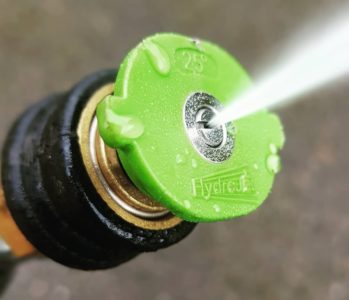
When you unbox your pressure washer, you’re likely to find a few nozzles are included with your pressure washer.
At first, it can be quite confusing as to which nozzle does what. But with our breakdown of the different types of pressure washer nozzles and how to use them, you’ll be clueless no more!
Key Takeaways
- Pressure washer nozzles come in various types: 0-degree (red), 15-degree (yellow), 25-degree (green), 40-degree (white), 65-degree (black), turbo, and adjustable.
- The 25-degree (green) nozzle is best for general cleaning tasks like cars, patio furniture, driveways, and sidewalks.
- The 40-degree (white) nozzle is ideal for fragile surfaces, such as windows and custom-painted cars, while the 65-degree (black) nozzle is used for dispensing soap.
- Always start with a wider angle nozzle and test in an inconspicuous area to avoid damage to surfaces.
Types of Pressure Washer Nozzles
Let’s jump right in! We’ll break down the different types of nozzle attachments, their color codes, and the best uses for each nozzle. This will help you make sure that you are using your pressure washer properly, efficiently, and safely.
0-Degree
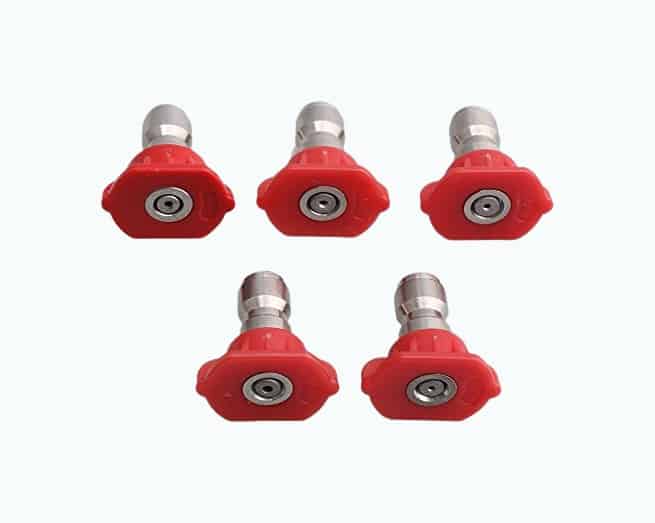
First up is the 0-degree nozzle which is red. This is not commonly used because it shoots a direct jet of water out and is, therefore, very forceful.
The 0-degree nozzle doesn’t have a wide spray coverage. Instead, it hits the surface with about the area of a quarter coin. Therefore, it’s not safe for most surfaces. Plus, it would take far too long to clean anything.
So when should you use it? It’s normally used for very tough and stuck-on dirt on super high strength concrete, to minimize damage. You may want to try it out when removing mud, rust, or other stains if other nozzle types aren’t working.
Expert Advice
15-Degree
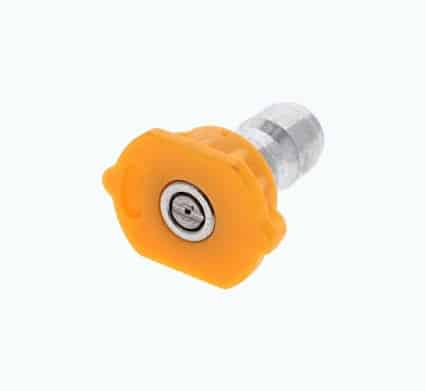
The 15-degree nozzle is color-coded as yellow. As suggested, it creates a 15 degree wide spray. Therefore, once it hits the surface, the pressure is less than with a 0-degree nozzle since it’s spread over a larger area.
When should you use this nozzle? It’s best for preparing surfaces for painting, staining, or resealing. Others use it for removing tough mud on high-strength materials like concrete or tires.
25-Degree
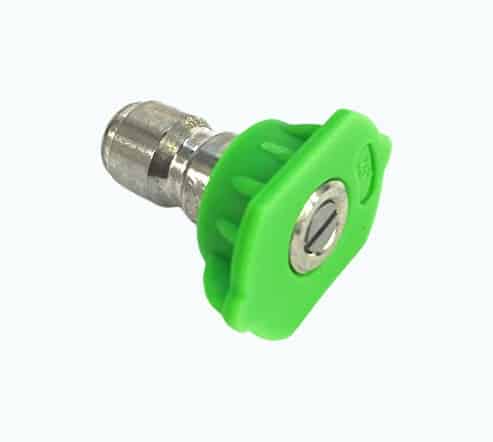
The 25-degree nozzle, or the green nozzle, is one you’ll get a lot of use from. It creates a 25-degree sheet of water, creating even less pressure on surfaces. Therefore, you can use this for most uses around the home.
This includes cleaning cars, cars, patio furniture, driveways, siding, sidewalks, and much more. It’s great for deep cleaning, but also sweeping away debris, mud, leaves, and other dirt that isn’t too embedded onto a surface. Last but not least, because of the wider spray area, it cleans surfaces quicker.
40-Degree
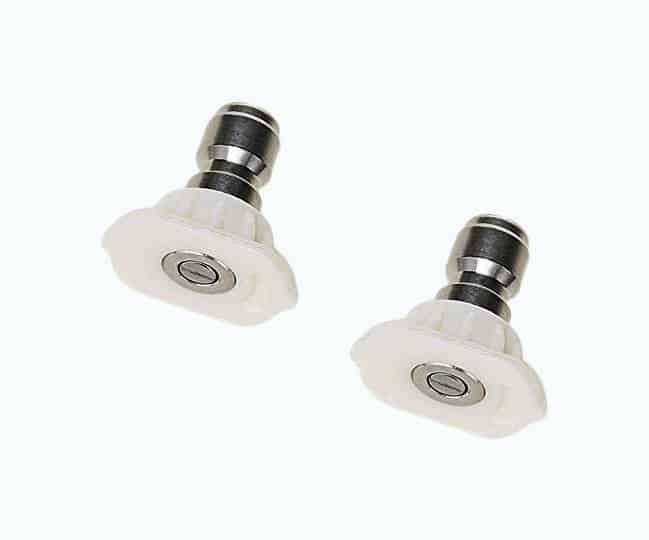
When in doubt, start with the 40-degree nozzle. It’s color-coded as white and provides a very gentle and minimal spray. We recommend using this on more fragile surfaces, such as windows, blinds, flower pots, and cars that have custom paintwork.
It creates a wide 40-degree spray area which is great for rinsing off detergent, soap, or even just dampening an area before cleaning.
65-Degree
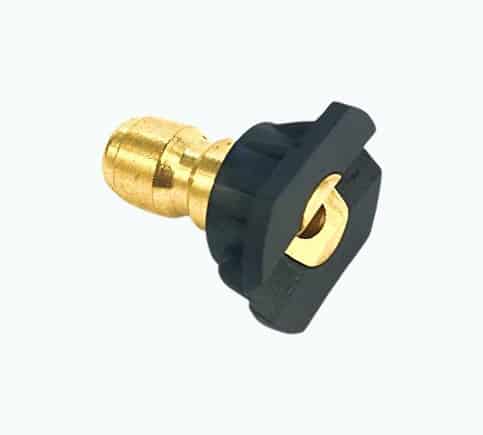
The 65-degree nozzle, which is normally black, is best for dispensing soap. It’s the lowest pressure nozzle you’ll find with the largest coverage. It works by decreasing water velocity which increases pressure in the hose to pull detergent from the tank and emit soap.
So if you’re applying pressure washer detergent or soap to surfaces such as cars, sidings, and driveways, this is the best way to do so.
Turbo
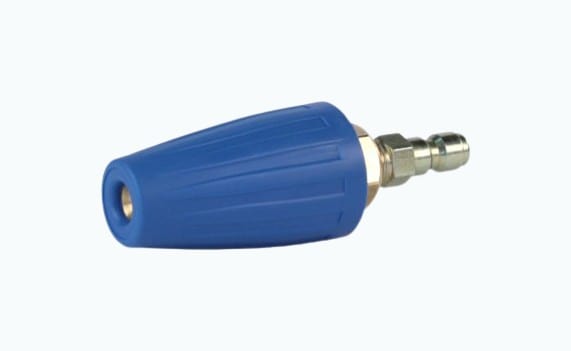
Another nozzle you may come across is a turbo nozzle. It doesn’t have a specific color code. Sometimes it’s black, sometimes it’s blue, sometimes it’s something else entirely. It’s easy to distinguish though because it’s much more narrow than the other nozzles.
What’s it for? Well, it’s a very useful nozzle because it combines the power of a 0-degree nozzle with the spray area of a 25-degree nozzle. Then it adds a pulsing action by rotating the water jet at between 1800 and 3000 rpm.
Therefore, when the water hits the surface, it creates a cone shape — a bit like a safety cone — to deep (but safely) clean surfaces.
These nozzles aren’t included with every pressure washer, so you may need to buy them separately, but it’s a handy nozzle to have nearby. It can quickly clean, provide a powerful spray, remove tough stains and strip paint, all while being more gentle than a 0-degree nozzle.
Adjustable
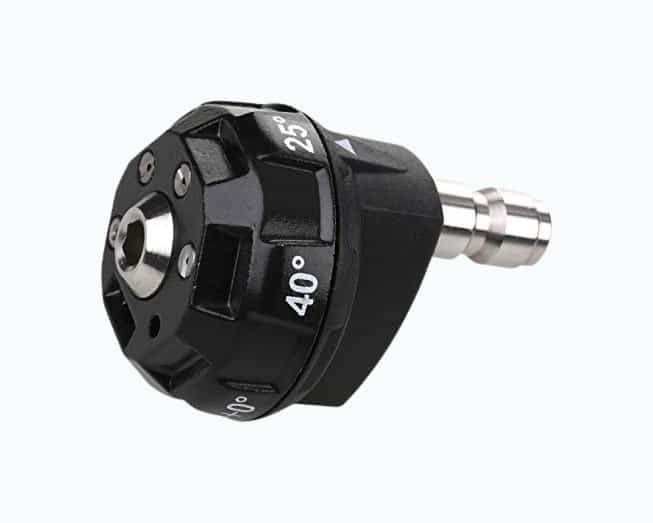
Adjustable nozzles, usually black but not specifically color-coded, are when you have all the different angles in one nozzle. To adjust them, just rotate the nozzle and the angle will change. These are practical, quick, and easy to use. You don’t have to remove the nozzle and change it over to use a new angle.
How to Choose the Right Pressure Washer Nozzle
With all these different nozzle options, how do you use the right one? We have some key advice, but we’ll also remind you which nozzle is best for what tasks.
- When in doubt, always start with a wider angle nozzle, like 40-degree, and work your way down.
- Always keep your distance when spraying first to make sure you don’t cause any damage to surfaces.
- Test in an inconspicuous area in case you cause any damage.
- Use the red nozzle on high-strength concrete only, for removing tough stains like caked-on mud or rust. You may never reach for this nozzle as it’s the most common one to cause damage.
- Use the yellow nozzle when preparing surfaces for painting, staining, or resurfacing. It’s also suitable for removing stains on high-strength concrete or tires.
- The green nozzle is the most common one and you’ll use this a lot. It’s great for general cleaning and it will get the jobs done faster. Use this for boats, cars, patio furniture, driveways, sidewalks, siding, and more.
- The white nozzle is best for fragile surfaces such as windows, blinds, flowerbeds, and custom-painted cars. You can also use this for rinsing off detergent.
- Next is the soap nozzle, or the 65-degree nozzle, which dispenses soap. You should only use this for soap, not water. If you are going to apply soap, this is much easier than doing it by hand so we do recommend getting one of these if it doesn’t come with your pressure washer.
- Then you have the turbo nozzle which combines the power of a 0-degree nozzle with the spray area of a 25-degree nozzle. If you want to use high pressure, and the other nozzles aren’t removing stains for you, this is the best thing to try over a 0-degree nozzle. It will minimize the risk of damage while still doing a great cleaning job for you.
- Lastly, you have adjustable nozzles which are all the degrees in one. You don’t have to take off the nozzles and reattach a new one. Just switch over the degrees in real time. This will save you time and make the task a little easier.
How to Maintain Pressure Washer Nozzles
Pressure washer nozzles are pretty cheap so if yours does wear down, it’s not a huge investment to have to buy replacements. But it’s always good to know a few handy tips for maintaining the nozzles and keeping them in good condition.
- Before every use of your nozzle, use a pin to clear the nozzle. This will remove blockages and keep the output hole in good condition.
- When replacing nozzles, make sure you know how to remove the attached nozzle. This may be a screw-off method, a quick fit, or something else. If you battle with it in the wrong direction, you could quickly wear down the nozzle.
- Always double-check that the new nozzle is on properly before using. If not, it could shoot or fall off which could cause damage to the nozzle.
- Store your nozzles properly. Don’t leave them rattling around a bag or a garage. Many pressure washers come with on board storage which we recommend using.
- Keep the nozzles clean. Wipe them down with a damp soapy cloth every now and then to remove dirt and debris.
FAQs

Does a Nozzle Increase Volume?
To answer whether a nozzle increases volume depends on the nozzle. Some increase water volume, while others restrict volume but increase pressure.

How Do You Read a Nozzle Size?
Knowing how to read a nozzle size is vital if you want the best results. 00 stands for 0 degrees, 15 is 15 degrees, 25 is 25 degrees, and so on. Some charts are color-coded with red meaning zero degrees, yellow 15 degrees, green 25 degrees, and white 40 degrees.

Why Do Nozzles Become Choked?
Nozzles become choked because of water pressure. Compression restricts the flow, making the nozzle choke.

Are Rotating Pressure Washer Nozzles Better?
Rotating pressure washer nozzles are better because they deliver 50 percent more cleaning power compared to standard nozzles.
Knowing Which Nozzle
Now that you know all about the different types of pressure washer nozzles, you’ll know exactly which one to attach when cleaning various surfaces.
To recap, the 0-degree nozzle is the most forceful and should rarely be used unless working with high-strength concrete. The 15-degree nozzle is best for cleaning tough stains on sturdy surfaces. The 25-degree nozzle will be super useful as it’s usually the best for general cleaning. Use the 40-degree nozzle for rinsing surfaces or clearing off detergent.
Then you also have the soap nozzle (for soap obviously!), the turbo nozzle for blasting away tough stains and dirt, or adjustable nozzles. These nozzles have all the degrees in one so you have one nozzle instead of five.
Choose the right one for the right job to clean safely and efficiently.