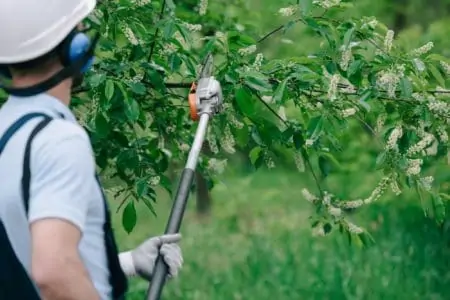
If you’re having trouble reaching high branches for pruning, consider using one of the best manual pole saws instead of climbing a ladder.
If you’re new to the world of pole saws, it can be overwhelming territory. But not to worry! I’ve done the hard work for you.
After researching genuine customer reviews and expert advice, I put together a list of the seven best options with in-depth reviews.
Whether you want something lightweight, budget-friendly, or extendable, I have personalized recommendations for various categories. Soon enough, you’ll find the right manual saw pole for you.
- Great for personal and professional use
- Double thick & durable blade
- Hooked saw head pulls stubborn branches down
- Great for palm trees and dense foliage
- Pole extends from 6-18 feet
- Long 16-inch blade
- Good for professional and personal use
- Super sharp blade for quick cuts
- Sturdy aluminum alloy handle
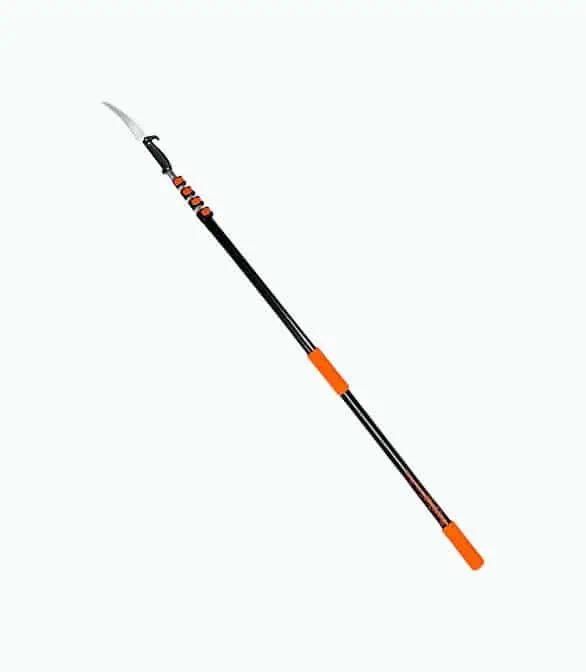
- 2-in-1 pole saw
- Anti-slip handle ensures safety
- Non-stick blade ensures smoother cutting

- Rust-resistant stainless steel pole
- Handheld and pole saw combination tool
- Adjust the length from 3.5 to 10 feet
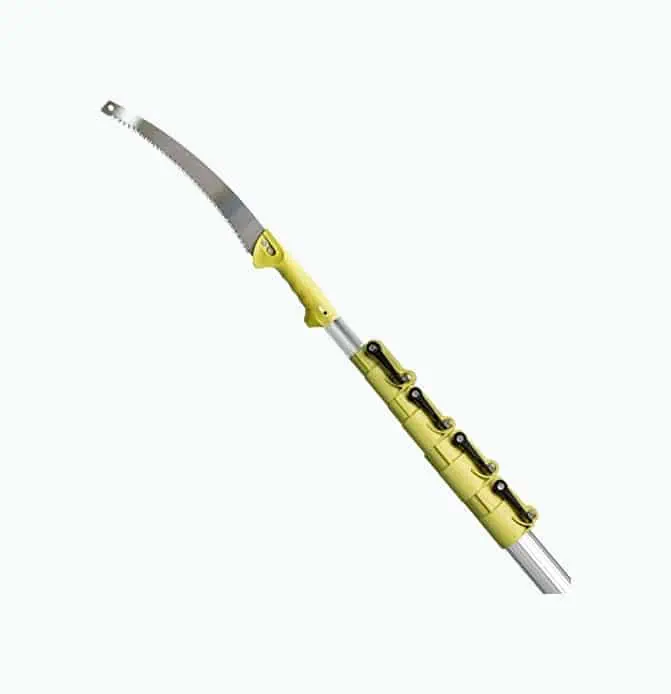
- Aluminum telescoping pole that spans 5-12 feet
- Easy to extend and retract pole length
- Foam padded grip on handle
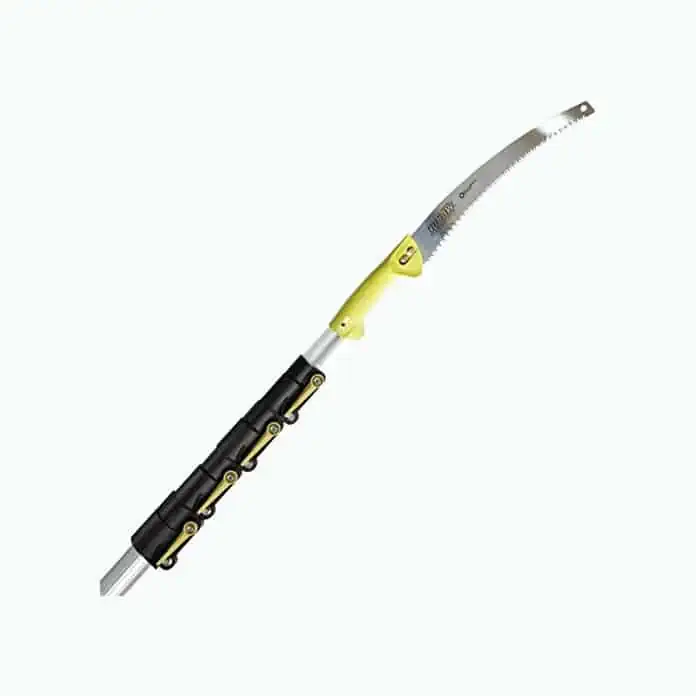
- Thumb-lever clasps
- Rubberized grips for handle security
- 7-30 feet extendable handle
Review Methodology: At Oh So Spotless, we understand the importance of providing reliable and trustworthy content for our readers. Our team of professionals conducts thorough research, analysis, and hands-on evaluations of the best manual pole saws available in the market. We carefully assess each product based on key criteria such as performance, durability, ease of use, and design. Our in-depth comparisons and rankings help you make informed decisions by highlighting the unique features that set each product apart from its competitors. By sharing our first-hand experience and data-driven results, we aim to empower you with the knowledge to choose the most suitable manual pole saw for your needs. Trust our expertise in identifying the best products based on factors like blade length, cutting capacity, pole length, and weight, all while keeping user experience in mind.
The Best Manual Pole Saws of 2024
Looking to get your trees in shape without hassle? Look no further than these seven manual pole saws that will spruce up your yard. Whether you’re after exceptional durability or an extended reach, my list has got you covered.
I’ve conducted extensive research, backed by expert guidance and genuine customer reviews, to bring you this comprehensive guide and reviews. So, let’s get started!
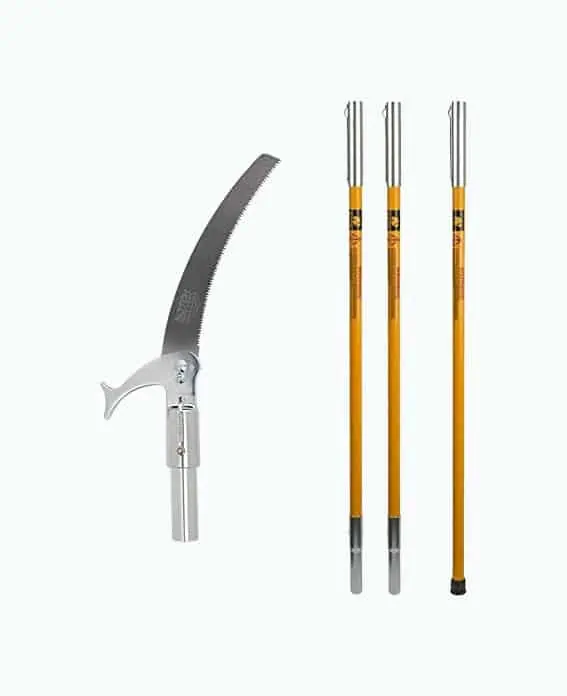
Notch Pole Saw Set
Most Durable
If you’re going to be using your manual pole saw often and are keen to spend a little extra for a high-quality option, this is a great recommendation.
Customers flock to the reviews of this manual pole saw to praise its durability. The extension is particularly durable, with some saying it’s the best they’ve seen. You can also expect a durable blade that stays sharp for a long time.
It’s made with interlocking fiberglass, which ensures that the extensions are screwed on tightly, super durable, and long-lasting. In fact, if you will use a manual pole saw professionally, this is a great choice. However, it still hits the spot for personal use.
I also love the tooth design on the blade. It helps with fast pull-cutting so you can get around your branches quicker and head back inside for that nice warm cup of tea with the family.
The blade’s teeth have been impulse hardened, ensuring they stay hard for a long time. This design is more effective than those that haven’t been treated. To top it off, the blade has a rust-resistant chrome finish for durability, too.
Pros
- Great for personal and professional use.
- Hooked saw head for pulling down stubborn branches.
- Blade is double thick, which helps with durability.
- Extendable handle that’s easy to use.
- Suitable for fast pull-cutting.
- Impulse-hardened blade teeth stay sharp for ages.
Cons
- Some customers found the 8-pound weight too heavy.
- Instruction manual is not always included, which makes setup difficult.
Product Specs
| Pole Height | 6-18 feet (extendable) |
| Weight | 8 pounds |
| Blade | Impulse hardened |
| Purpose | Professional & personal (palm trees too) |
| Budget | $$$ |
Our Ratings
User Experience
Jameson LS-Series Landscaper Pole Saw Kit
Best for Palm Trees
Check out the Jameson LS-Series pole saw kit if you need to prune and trim palm trees. Many customers found it worked great on palm trees, making quick, clean, and effective cuts. In fact, some described it as cutting through palm trees as easily as butter!
As well as palm trees, this pole saw was designed with dense foliage in mind. So you can definitely put it to the test with other types of trees and bushes, too.
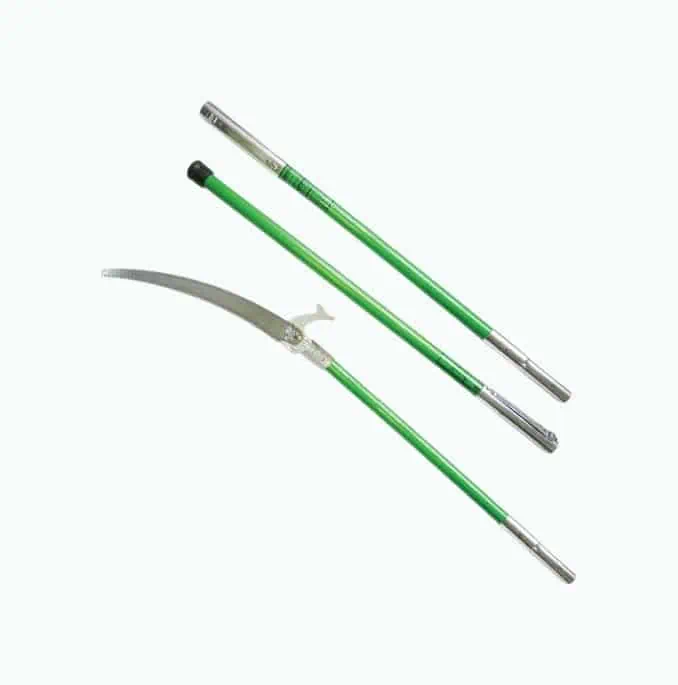
This pole is also extendable. There are three poles included, so you can switch up the height by removing or adding a pole. Overall, the pole extends from six feet to 18 feet, giving you generous flexibility.
As for the blade, it’s a long 16-inch one with tri-cutting teeth that make quick, clean cuts. In fact, this tool is great overall for easy cutting. Customers found it super simple to use, with minimal hassle, frustration, or fatigue.
Pros
- Great for palm trees and dense foliage.
- Pole extends from 6-18 feet.
- Long 16-inch blade
- Very easy to set up and use this pole.
- Makes quick, clean cuts.
Cons
- Some customers found it was quite flimsy when fully extended.
- Not the easiest for beginners.
Product Specs
| Pole Height | 6-18 feet (extendable) |
| Weight | 8 pounds |
| Blade | Triple-cut |
| Purpose | Dense foliage, including palm trees |
| Budget | $$ |
Our Ratings
Personal Perspective
HUNKENR Tree Pruner Pole Saw
Best Professional Manual Pole Saw
I have a few recommendations suitable for professional use, but here’s another to consider. This HUNKENR pole saw is a great professional option for a few reasons.
Firstly, you can increase power with an electric feature when manual use isn’t enough.
You may also appreciate the length of the pole. It starts at just over four feet and extends to 18 feet. This allows you to use it for lower branches and trees, but it also extends far enough for high trees and branches.
This is ideal for professional use as you’ll likely have customers who want different tasks done.
Let’s move on to the blade. It’s made of flexible and high-quality 65Mn material. The three-sided design makes for quick and easy cutting. But it’s also super simple to clean the blade, which professionals appreciate.
Note that the blade isn’t impulse-hardened. However, that’s actually good for professional use since you can easily sharpen the blade when necessary.
Keep In Mind
This product was made for small branches and vines, but customers have also reported good results on larger trees.
Pros
- A good option for professional and personal use.
- Suitable for multiple different types of branches and vines.
- Super sharp blade for quick and easy cutting.
- Sturdy aluminum alloy handle.
- Extends up to 18 feet.
- 24-hour customer service.
Cons
- Blade could be thicker and more sturdy.
- Some customers had trouble locking the handle extension into place.
Product Specs
| Pole Height | 4.3-18 feet (extendable) |
| Weight | 6.19 pounds |
| Blade | 65Mn with triple-sided edge |
| Purpose | Professional and personal use (good for various branch sizes) |
| Budget | $$ |
Our Ratings
Community Feedback
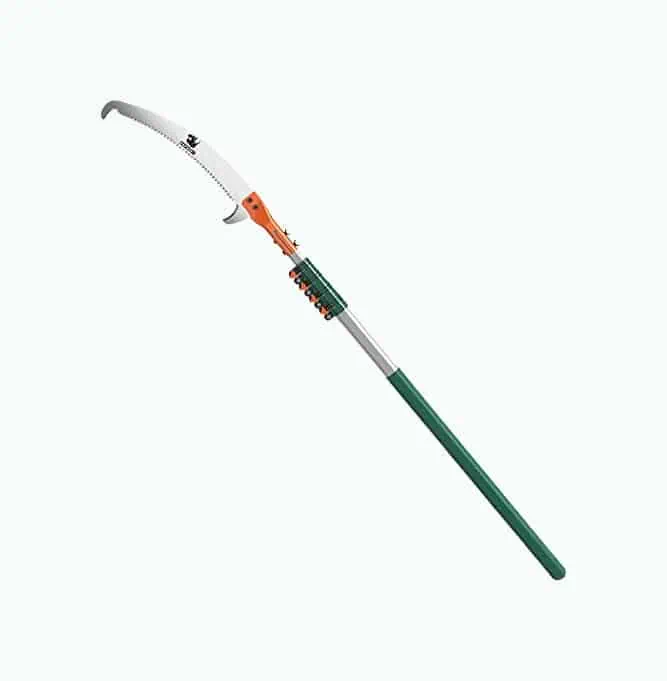
Buyplus Manual Pruning Pole Saw
Best Lightweight Manual Pole Saw
Pole saws can be heavy. This is a great recommendation if you’re looking for something on the lighter side that’s easier to move. It only weighs 4.94 pounds, about half the weight of the average manual pole saw.
This unit stretches from five to 20 feet, giving you much flexibility when tackling different types of tree trimming. The pole has four stops, so you can customize the length from three to 12 feet for maximum flexibility. Just use the handy flip tab locks to secure it in place.
Another versatile function of this pole is that it works as a handheld saw. You can take it off the pole and hold the handle, using it as a saw for low-down branches, bushes, and logs. So practical!
Pros
- 2-in-1 pole saw can be used handheld or with the extension pole.
- Non-stick blade ensures smoother cutting.
- Anti-slip handle makes this extra safe to use.
- Reinforcement screws included for added safety.
- Rust-resistant blade.
- Triple the sharpness and carbon steel blade.
Cons
- Blade is quite thin and, therefore, can be flimsy.
- Not the most durable pole saw on the market.
Product Specs
| Pole Height | 5-20 feet (extendable) |
| Weight | 4.94 pounds |
| Blade | Premium carbon steel with non-stick coating |
| Purpose | Thin trees, branches, bushes, and logs |
| Budget | $ |
Our Ratings
First-Hand Impression
Hosko Long Extension Pole Saw
Best Affordable Choice
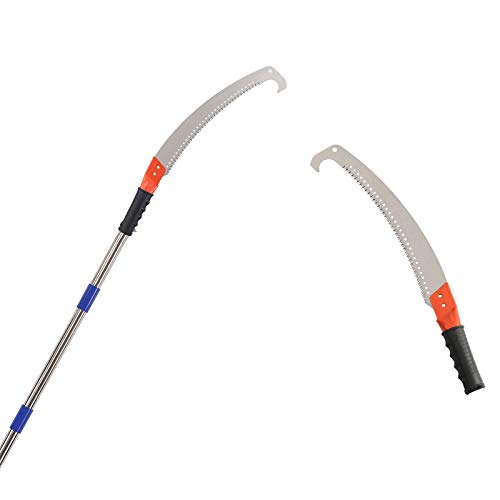
As mentioned earlier, manual pole saws can be expensive, averaging around $90. There are some cheaper options on our list, but they can still be over budget for some folks.
Thankfully, there is a super budget-friendly option in the shape of this HOSKO pole saw. This is a good quality but affordable option at about 1/3 of the average price.
And just because it’s cheap doesn’t mean it’s a knock-off. Nope, this pole saw has some seriously great features. Firstly, I noticed the hook on the saw head, which grips branches and pulls down the loosened limbs without much effort from you.
I also love the triple-sided sharpened edge, which provides a more effective and efficient cut.
Another thing to point out is that this can also be used as a handheld pruning saw as well as an extended pole saw.
Once extended, it reaches from 3.5 to 10 feet for great versatility. It is a bit shorter than some of my other recommendations, but for the price — it’s totally worth it.
Pros
- Rust-resistant stainless steel pole.
- Handheld and pole saw combination tool.
- Adjust the length from 3.5 to 10 feet.
- Suitable for forests, gardens, yards, lawns, and other areas.
- Available in a 14-feet option.
- Razor-sharp three-sided blade.
Cons
- The blade is quite thin, so it can be tricky to use.
- Handle is a bit flimsy.
- Not good for heavy-duty or hard branches.
Product Specs
| Pole Height | 3.5-10 feet (extendable) |
| Weight | 4 pounds |
| Blade | Triple-sided sharp edges |
| Purpose | Light-duty work across multiple areas |
| Budget | $ |
Our Ratings
DocaPole Pruning Saw
Best Extendable Manual Pole Saw
All of my recommendations feature extendable poles, but here’s one more for good measure.
I chose this one because it has a very versatile length. It starts at five feet, which is great for ground-level cutting. But it does extend to 12 feet, which is great for higher branches.
Customers also love the way this extends. Rather than taking poles apart and putting them back when you want to change the length, this comes with thumb lever clasps.
So you can easily tighten and loosen them with a screwdriver for maximum security. While the screwdriver may seem like an extra step, it makes things safer. It ensures the thumb lever clasps are tightly shut so your pole remains firm and sturdy.
This product was designed for pruning and higher reach, so if those are the tasks at hand, this might be right for you.
Now, let’s look at the blade. This comes with a double-strength pruning saw blade, compared to the original DocaPole model.
The blade has super sharp bi-directional movements with a triple teeth design. This allows you to have maximum control over high and low foliage while still being comfortable and lightweight to use.
Pros
- Aluminum telescoping pole that spans 5-12 feet.
- Easy to extend and retract pole length.
- Foam-padded grip on handle for your comfort.
- Can be used as a handheld saw, too.
- Safe thumb lever clasps for extending the pole.
- Razor-sharp blade with bi-directional cutting.
Cons
- You have to tighten screws with a screwdriver each time manually.
- Attachment isn’t the more secure.
- Can feel a bit brittle and cheap around the plastic parts.
Product Specs
| Pole Height | 5-12 feet (extendable) |
| Weight | 3 pounds |
| Blade | Bi-directional blade with 3x teeth |
| Purpose | High and low pruning |
| Budget | $ |
Our Ratings
Personal Perspective
DocaPole Light-Duty Pruning Saw
Longest Manual Pole Saw
Do you have high branches that you need to reach? A long pole saw that extends further than others on the market might just be what you need.
This DocaPole saw stretches up to 30 feet, which is super generous in height. Now, you can reach branches previously inaccessible without a ladder. You can now trim and prune by hand, safely on the ground, with this razor-sharp saw.
Despite its extended height, it’s not too heavy. It weighs six pounds, so it’s very manageable to use.
The good news is that it’s extendable, too. Thirty feet is very long and not always practical. Thankfully, this extends from seven feet to 30.
You can use the shorter version to lower branches. Or you can take advantage of its versatility and lengthen it with the five extending segments, which give you plentiful customization over the length.
Pros
- Thumb-lever clasps secure the height in place.
- Rubberized grips for handle security.
- Triple-sided taper ground teeth for quick and efficient sawing.
- 7-30 feet extendable handle.
- Not too pricey, considering the length.
- 2-4 inch cutting diameter.
Cons
- When fully extended, it’s a bit wobbly and flimsy.
- Poles bend and separate sometimes — some customers lost pieces in the tree!
Product Specs
| Pole Height | 7-30 feet (extendable) |
| Weight | 6 pounds |
| Blade | Bi-directional blade with triple-sided teeth (hard chrome plate finish) |
| Purpose | Light-duty pruning (good for palm trees) |
| Budget | $$ |
Our Ratings
Community Feedback
| Product | Best | Pole Height | Weight | Blade | Purpose | Budget |
|---|---|---|---|---|---|---|
| Notch Pole Saw Set | Durable | 6-18 feet (extendable) amps | 8 pounds | Impulse hardened | Professional & personal use | $$$ |
| Jameson LS-Series Landscaper Pole Saw Kit | For Palm Trees | 6-18 feet (extendable) | 8 pounds | Triple-cut | Dense foliage, including palm trees | $$ |
| HUNKENR Tree Pruner Pole Saw | Professional Manual Pole Saw | 4.3-18 feet (extendable) | 6.19 pounds | 65Mn with triple-sided edge | Various branch sizes & personal and professional use | $$ |
| Buyplus Manual Pruning Pole Saw | Lightweight Manual Pole Saw | 5-20 feet (extendable) | 4.94 pounds | Premium carbon steel | Thin trees, branches, bushes, logs | $ |
| Hosko Long Extension Pole Saw | Affordable Choice | 3.5-10 feet (extendable) | 4 pounds | Triple-sided sharp edges | For light-duty work | $ |
| DocaPole Pruning Saw | Extendable Manual Pole Saw | 5-12 feet (extendable) | 3 pounds | Bi-directional blade with 3x teeth | High and low pruning | $ |
| DocaPole Light-Duty Pruning Saw | Longest Manual Pole Saw | 7-30 feet (extendable) | 6 pounds | Bi-directional with 3x-sided teeth | Light duty pruning | $$ |
How To Choose the Best Manual Pole Saws
Don’t choose the first manual pole saw you see. Instead, look at important details, such as the pole height, weight, blade, and more, to make the right decision.

Pole Height
First up, take note of the pole height. These usually start around five feet, but they can span up to 30 feet long.
Most pole saws are extendable, so you can adjust the height accordingly, which is handy when you have various outdoor chores.

Weight
Manual pole saws aren’t the lightest contraptions. The weight varies, starting at around four pounds and going up to about 11 pounds for the sturdier options.
Some people don’t mind the heavier weights. But if you are looking for something a bit easier to maneuver, there are plenty of options at less than eight pounds.

Blade
The blades have a range of qualities that are worth considering.
First of all, take note of the teeth per inch on the blade (TPI). These are broken down into two categories: coarse and fine.
Coarse blades have around five or six TPI and are best for soft and green trees. Fine blades have more than 11 TPI and are suitable for hardwood.
Also, consider the length of the blade. This ranges from about 13 to 16 inches on average. The longer the blade, the more it can cut at once, but it doesn’t make a huge difference.
Lastly, you should consider whether the blade has been impulse hardened. This is done through a process of using wave impulses and high peak power to sharpen the teeth of the blade (1). The rest of the blade is unchanged, which means it is flexible, while the teeth are sharp, hard, and super durable.
Keep In Mind
If the blade has been impulse-hardened, you won’t be able to sharpen the teeth that easily. It’s often easier to just buy a replacement blade.

Purpose
One of the most important factors to any manual pole saw is its purpose. Not every pole saw can be used for the same tasks or all tasks.
Some pole saws are better for certain trees, whether softer or harder, taller or shorter. Always check what kind of trees the pole saw can handle. I’ll let you know, so you don’t have to go searching!
You should also consider whether the pole saw is suitable for personal, professional, or both. Professionals should aim to use an impulse-hardened blade with an extendable pole that suits various tasks.

Budget
Manual pole saws cost, on average, around $90. There are a few other options above and below that, with some costing as little as $35. So you can find pole saws on a budget, but remember that the majority are quite expensive.
How Do You Use a Manual Pole Saw?
Learning how to use a new tool to ensure safety and efficiency is crucial. Follow these steps for a better experience.
1. Clear the Area
Clear the area of people first and foremost. You don’t want anyone getting hurt. Remove other items that could potentially get damaged, like furniture or decorations.
Remove any trip hazards to keep yourself safe. If in a busy area, rope or cordon the area off.
2. Plan Your Cuts
Don’t go in blind. Step back, examine the tree, and plan where and how you will make the cuts.
3. Cut Lower Branches
To begin, start at the bottom. This will prevent higher branches from getting tangled in lower branches. Keep reading the following steps before making the first cut.
4. Get Into Position
Firstly, get yourself into position. Get to a place where you can hold the manual pole saw at chest level.
Make sure you’re off to the side of the branch rather than below it. You want the pole to be at an angle, not completely vertical or horizontal. This will prevent branches from falling onto you.
5. Adjust the Length
If necessary, now is the time to adjust the length of the pole saw since you’ll have a good idea of how long it should be.
6. Position the Saw
Now that you’re in position and the saw is the correct length use both hands to position the saw into the place you want to cut. Rest the weight of the pole on the branch.
7. Start the Cut
Now for the fun part: cutting!
Start with slow and controlled cuts, moving perpendicular to the branch. You’ll want to get the teeth in the branch for easier and effective cutting. This will allow you to make a groove so you can finish the cut quickly.
The first few cuts will require the saw to slip sideways slightly, especially if the branch is sloped. When this happens, stop and reposition the saw before continuing.
8. Finish the Cut
Now that you’ve made a groove secure the saw into it and pick up speed. Pull and push the saw, letting gravity help you. Once the branch looks like it’s about to fall, ensure that you are out of the danger zone while you continue cutting.
9. Clean Up
Remove the fallen branches so they’re not a tripping hazard.
10. Next Cut
Now repeat the above steps on the rest of the branches, moving higher up the tree as you go.
11. Clean Up Again
Clean up the area after every fallen branch and again at the end before letting people back into the zone.