If you have a new dishwasher and need to remove the old one, it can be a bit daunting. But we’re here to help!
Whether it’s plugged in at the wall or hard-wired, we’ll show you how to remove a dishwasher without damaging your floors, cabinet or drains.
Key Takeaways
- Turn off power and water supply before removing the dishwasher.
- Disconnect water supply tube and drain line, and remove mounting brackets.
- Lower dishwasher legs to create space between the appliance and the counter.
- Carefully slide dishwasher forward and out from underneath the counter.
Is It Easy to Disconnect a Dishwasher?
If you have DIY experience, disconnecting your dishwasher will be pretty easy. However, if you don’t have any DIY experience, it’s still possible to disconnect your dishwasher on your own.
You’ll need a few tools, and you’ll need to make sure you know which pipes are for your dishwasher. But once you’re equipped, it should be doable, if not a small challenge.
Why Can’t I Pull My Dishwasher Out?
If you’re struggling to pull your dishwasher out of place, it may just be because it’s heavy. It’s a good idea to get someone to help, especially for lifting the bottom. There may be an edge of flooring that you need to lift your dishwasher over slightly. So if someone lifts the bottom ever so slightly, while you pull, it can be easier.
The other reason may be because the water supply tube and drain hose are getting caught. It’s helpful if someone feeds those through the cabinet as you pull the dishwasher out from under the counter.
Also check if your dishwasher is screwed into place. Make sure to remove the brackets before attempting to pull the dishwasher out.
Lastly, if you have a kickboard that’s blocking the dishwasher, remove that so you can easily pull the dishwasher out.
How to Remove a Dishwasher
Removing a dishwasher isn’t too big of a challenge, as long as you have the right tools and follow these instructions.
What You Need
- Channel-lock pliers.
- Screwdrivers.
- Towels or bowl.
- Cloth or newspaper.
Step by Step Instructions
1. Turn the Power Off
The first thing you must do is turn the power off. We recommend turning it off at the plug, unplugging the socket and also turning it off at the breaker. This ensures you’re extra safe.
Something To Note
2. Turn the Water Off
Now, turn off your water. You must do this from the shutoff valve that controls the water line to the dishwasher. This is likely underneath your sink, attached to a hot water pipe. Otherwise, it will be a two-way shutoff valve that controls water to the kitchen faucet and the dishwasher.
If you can’t locate this, it may be necessary to turn off your home’s main water source before moving onto the next steps.
3. Disconnect the Water Supply
Lay down a towel or a bowl underneath the pipes to catch water drips.
The water supply tube usually looks like a small copper or plastic tube covered with wire mesh. It runs from the dishwasher to the shutoff valve. Using your channel-lock pliers, disconnect the supply tube from the outlet on the shutoff valve.
If your connection doesn’t have a shutoff valve, you may have to unhook the compression fitting or coupling nut that joins the dishwasher water supply tube to your hot water pipe.
4. Disconnect the Drain Line
Find the rubber hose that comes from the dishwasher and follow it to the end where it’s connected. It may run to a fitting mounted to the sink or countertop, or it may run to a garbage disposal. Lay a towel down beneath it to catch water drips.
If it’s connected to the sink or countertop via an air gap fitting, loosen the clip or clamp and detach the hose. If it’s connected to your garbage disposal or sink drain tailpiece, you will need to detach the hose at the nipple fitting.
5. Detach the Dishwasher
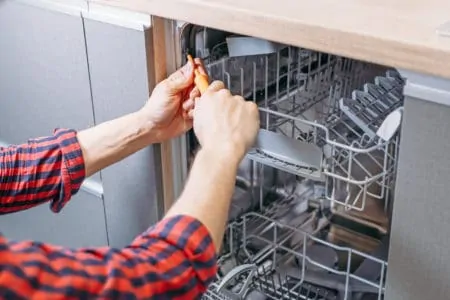
Open your dishwasher and check if it’s been secured with mounting brackets. You’ll notice them around the frame of the dishwasher. Use your screwdriver to unscrew these.
Once you’ve done this, you’ll now need to unscrew the dishwasher legs. This may require removing the kickboard, if you have one.
Twist the threaded legs clockwise to lower the dishwasher. Continue until the dishwasher is as low as possible to create enough space between the top of the dishwasher and the bottom of your counter. This will make it easier to pull out.
6. Remove the Dishwasher
Now it’s time to remove the dishwasher from underneath the counter. Carefully slide it forward, pulling it out from the cabinet. You may need help to lift it over the floor edge. You may also need help feeding the water supply tube and the drain hose through the hole in the cabinet’s side.
You should keep in mind to lift the dishwasher slightly as you remove it, to avoid damaging your floors. You could always lay down a cloth or newspaper to protect the floors even further.
Now that’s it removed, you can install your new dishwasher.
How Do You Remove a Hard-Wired Dishwasher
If your dishwasher has been hard-wired directly into the circuit, we recommend getting an electrician. Unless, of course, you have some experience with these types of appliances. If you want to give it a go on your own, follow these instructions:
- Disconnect the water supply and the drain lines, following the same instructions from above.
- Turn off the electricity at the breaker.
- Take off the front access cover — or the kickboard — at the bottom of the dashboard. You may need to unscrew this.
- Locate the metal junction box. You may need to remove the cover of the junction box by popping it off or unscrewing it. Use a voltage tester to make sure the power is off.
- Remove the wire nut that secures the two black wires together and do the same for the two white wires.
- Unscrew the bare ground wire from its tab.
- If necessary, remove the strain-relief plate. This will be located just above the junction box. Unscrew the two fasteners on the wire, remove the plate and pull the wires from the junction box.
- Remove the mounting screws on the dishwasher and lower the feet.
- Ease the dishwasher out of place.
How Long Should a Dishwasher Last?
A good dishwasher should last around 10 years. Your manufacturer may have a warranty to back up this claim. You may need to register your appliance to qualify for the warranty.
FAQs

How Heavy is the Average Dishwasher?
The average dishwasher weighs around 150 to 175 pounds. It is one of the heaviest appliances, so it’s advisable to get help when removing or installing a new model.

How Do You Remove a Dishwasher From a Kitchen Island?
The best way to remove a dishwasher from a kitchen island it to disconnect the power supply, ensure it is water-free, and remove the drain pipe. Next, disconnect the water supply and slide the dishwasher out.

Will Home Depot Uninstall an Old Dishwasher?
Home Depot will remove the old dishwasher and take it away, provided that you have disconnected and uninstalled it. They will only remove it, not uninstall it.

Where is the Shutoff Valve for Dishwasher?
The shutoff valve for a dishwasher is typically located close the water supply under the sink. You will have a lever, switch, or a nut that you turn with a screwdriver to cut the water supply.

How Do You Protect Hardwood Floors Under a Dishwasher?
The easiest way to protect hardwood floors under a dishwasher is to place soft furniture pads on the feet. Failing that, an offcut of carpet will do the same job.
Out With the Old
And in with the new! Now that you know how to remove a dishwasher — whether it’s plugged in at the wall or hard-wired — you can get rid of the old dishwasher. It’s always exciting getting a new appliance, and our instructions will help the process to go as smoothly as possible.
When in doubt, hire a plumber or an electrician. They’ll help you remove the old dishwasher, depending on how it’s wired into your electricity.