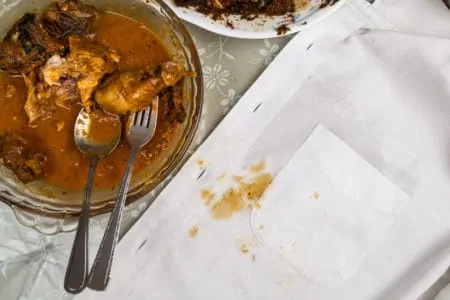
There’s nothing better than treating yourself to a takeaway or homemade curry on a Friday night after a long week at work. All those flavors, the coconut milk, naan if you’re lucky. Yum.
But it can all quickly go sour if you spill curry onto your clothes, surfaces, carpet or elsewhere. While curry is a tough stain to remove, it’s not impossible. We’ll teach you how to remove curry stains so you’ll never know they were there to begin with.
Key Takeaways
- Curry stains are stubborn due to spices like turmeric, which contains a yellow molecule called curcumin that can dye clothes.
- Products that can remove curry stains include stain remover, lemon, toothpaste, hydrogen peroxide, and white vinegar mixed with hand soap.
- For white clothing, use a mixture of 20% strength hydrogen peroxide and water to saturate the stain, then machine wash with regular detergent and air dry in the sun.
- To remove curry stains from carpet, use a cleaning solution like white vinegar and hand soap, apply it to the stain, and blot dry with a clean cloth.
- Why Does Curry Stain?
- Are Curry Stains Permanent?
- Products That Can Remove Curry Stains
- How to Remove Curry Stains From Clothing
- How to Remove Curry Stains From Carpet
- How to Remove Curry Stains From Countertop
- How to Remove Curry Stains From Plastic
- How to Remove Curry Stains From Cookware
- How to Remove Curry Stains From Fingernails
- FAQs About Removing Curry Stains
- Hurry With the Curry Stains
Why Does Curry Stain?
The same tasty spices that make a curry so delicious are also what make the stains so stubborn. Think saffron, turmeric, garam masala… all these things can stain your clothes.
Turmeric is a tough one, especially. It contains a yellow molecule called curcumin which is often used to dye clothes. So when you spill curry containing turmeric onto your clothes — well, act fast.
Are Curry Stains Permanent?
If you don’t remove the curry stain quickly, it can become permanent. We’ve been on both ends of the curry stain spectrum, able to quickly remove the stains for good, but also living with the reminder that we spilled curry on our favorite clothes some time ago.
Products That Can Remove Curry Stains
We’ll share some of our favorite and most effective ways to remove curry stains.
1. Stain Remover
Opting for a store-bought stain remover may be your best option. We’ve had the most luck with the Vanish Stain Remover. It’s designed to remove all sorts of stubborn stains, including but not limited to beetroot juice, cola and soy sauce.
There are lots of stain removers on the market, so feel free to shop around. We’re sure you’ll find one that is designed for food stains.
Caution
2. Lemon
Lemons are a natural cleanser, and can remove curry stains from clothing, carpets, upholstery, surfaces and more. It’s even a good way to remove spice stains from your chopping boards.
The citric acid in lemon juice is a natural bleaching agent, so this is especially effective on white fabrics (1).
3. Toothpaste
If you’re stuck in a rut, run to the bathroom and grab your toothpaste. Toothpaste is mildly abrasive, so it’s good at lifting stains. Plus, it usually contains baking soda which is a great stain remover (2).
This is a good tip for clothing, upholstery and carpets.
4. Baby Oil
If you have curry stains on your hands, and soap and water isn’t doing the trick, try baby oil. It’s a gentle cleanser, so you can use it on your skin. We don’t recommend using this on any other surfaces or fabrics though — you just might create a new stain.
5. Laundry Detergent
Sometimes, your laundry detergent is enough to remove stains. This is especially helpful if the detergent has an included stain remover ingredient. Perhaps it has oxygen bleach in it, which is useful on stains!
You can use laundry detergent for curry stains on clothes but always check the detergent is compatible with the stained fabric. We don’t recommend using laundry detergent on carpets, upholstery, or surfaces, unless the detergent specifically recommends it’s okay.
6. Glycerin
Glycerin is a water-soluble solvent, so it’s great for softening and removing stains. It will work even if you don’t get to the curry stain immediately (3).
It’s safe to use glycerin on fabrics, but check in an inconspicuous area first.
7. Hydrogen Peroxide
It’s a good idea to have a bottle of hydrogen peroxide in the cupboard to deal with all types of stains. The good news is, it’s safe to use hydrogen peroxide on clothes, upholstery and carpets!
Hydrogen peroxide breaks up the chemical bonds in a stain and removes the color (4). So it technically doesn’t remove the stain — it just makes it invisible.
8. White Vinegar and Hand Soap
Mix one teaspoon of hand soap, one tablespoon of white vinegar and two cups of cold water. You’ll have a solution that can clean curry stains off carpet and upholstery! The acetic acid in vinegar is what makes it a top choice for cleaning and removing stains (5).
9. Rubbing Alcohol
Rubbing alcohol acts as a solvent for stains (6). It can dissolve the chemicals and lift the satins. Rubbing alcohol is especially good on oily stains, and since curry usually contains olive or coconut oil — it’s perfect. Plus, it works well on clothing, upholstery and carpets.
10. Antibacterial Spray
What about those stained countertops? Antibacterial spray should do the trick.
If that doesn’t work, mix together water and baking soda to form a paste. Apply it to the stained area. Let it sit for about 10 minutes, then wipe it away with a wet cloth. This tip also works with clothes, upholstery and carpets.
How to Remove Curry Stains From Clothing
Removing curry stains from clothing is hard for two reasons:
- The curry embeds itself into the fibers.
- If the curry contains turmeric, it can begin to dye the clothing.
But we’ll share our most effective tips for removing curry stains. Keep in mind that these work best when carried out immediately after spilling the curry.
- Scrape off as much of the excess curry as possible using a butter knife or the back of a spoon.
- Turn the garment inside out and run cold water over the back of the stain, pushing the stain out of the fabric.
- Choose your preferred method. Whether that’s lemon, baking soda, laundry detergent or something else from our above list. For each method, just use a little bit of the product, but enough to saturate the stained area.
- Leave the stain treatment on the carpet, garment or upholstery for 30 minutes. If you use a store-bought product, follow the manufacturer’s advice because some formulas require a shorter leaving time.
- Soak a white cloth — to avoid color transference — in cold water. Blot the stain, lifting up the cleaning solution and the curry residue.
- Wash in cold water with detergent.
- Repeat if necessary.
- If the stain is gone, you can dry the garment in the tumble dryer. If it’s not gone, don’t do this, otherwise you could permanently set the stain.
White Clothing
Curry stains on white clothing are, by far, the most frustrating. But, if all else fails, you could always tackle them with bleach. However, we recommend hydrogen peroxide as a starting point since it’s less harsh on clothing.
- Fill a spray bottle with one part 20 percent strength hydrogen peroxide and nine parts water.
- Saturate the curry stain with the spray.
- Leave to soak for up to four hours.
- Machine wash the garment in cold water with regular detergent.
- Air dry in the sun, since the sun can naturally bleach white clothes.
If the stain remains, you can use bleach. Make sure to follow the manufacturer’s instructions, wear protective gloves and work in a well-ventilated area.
Dry Clean Only Clothing
If the care label says it’s a dry clean only fabric, follow these instructions:
- Remove excess curry with the back of a spoon or a butter knife.
- Mix together one tablespoon of Borax with two cups of lukewarm water.
- Dip a sponge in the solution.
- Blot the curry. Do not rub or scrub, as this could damage the fabrics and push the stain further into the garment.
- Blot the stain with a white paper towel as it’s loosening.
- Repeat blotting with the Borax and the paper towel until the stain is gone.
- Sponge the stained area with cool clean water, blotting gently.
- Air dry away from direct heat.
When In Doubt
How to Remove Curry Stains From Carpet
Spilling curry may ruin your date night, but it doesn’t need to ruin your carpets.
- Scrape off as much excess curry as possible.
- Use any of the above solutions, as long as it’s recommended for carpets. We recommend the White Vinegar and Hand Soap method in particular.
- Apply the solution to the stain using a clean cloth.
- Leave it for a few minutes.
- Blot dry with another clean cloth, rotating the cloth so you are always using a clean section.
- Repeat the above steps until the stain is gone.
- Soak a separate clean cloth in hot water to lift any cleaning solution from the carpet.
- Dry the carpet with towels.
- Let it air dry.
How to Remove Curry Stains From Countertop
Start by spritzing the countertops with an antibacterial spray. Leave it for a few minutes, then wipe it with a clean wet cloth. If this doesn’t work, try this method instead:
- Mix together a baking soda paste using baking soda and water.
- Apply the paste to the stains.
- Rub it in gently with a soft cloth.
- Rinse with a cold wet cloth.
- Repeat if necessary.
How to Remove Curry Stains From Plastic
What if you get curry stains on a plastic item, such as a toy, or tupperware or on plastic utensils? You can use the same tips as you would for cleaning the countertop with baking soda.
You can also rub lemon juice over the plastic item, let it sit for a few minutes, before rinsing it off with cold water.
Lastly, you can also try distilled white vinegar.
- Make a solution of one tablespoon of vinegar per cup of water.
- Soak the plastic item in the solution for two hours.
- Wash the plastic item with soapy water.
- Rinse and dry.
How to Remove Curry Stains From Cookware
Curry stains cramping your beautiful cookware? Don’t panic. The stain should fade over time as you wash it with warm soapy water. But using the baking soda paste method is also a really good way to lift curry stains from your cookware. Follow the same steps as above, but let the paste sit on the pots or pans for 30 minutes before rinsing off.
If that doesn’t work, try this lemon method:
- Mix two cups of hot water and one cup of lemon juice.
- Pour it into the stained cookware and let it soak overnight.
- In the morning, rinse the pan. The stains should be gone.
- Wash and dry normally.
How to Remove Curry Stains From Fingernails
Baby oil is a good tool for cleaning curry stains off your hands and fingernails. But what about acrylic and shellac nails?
Shellac Nails
- Place your hand on a towel.
- Use a cotton ball to lift off the excess curry.
- Spray the affected nails with hairspray. The alcohol will help to lift the stain.
- Use a cotton ball to wipe off the curry stain.
- Wash your hands with soap and water.
Acrylic Nails
- Wash your hands and nails with soapy water as soon as you notice the stain.
- If the stains persist, soak a cotton pad with rubbing alcohol or nail polish remover.
- Wipe the nails with the cotton pad.
- If this doesn’t work, put toothpaste on an old toothbrush.
- Start brushing the nails with the toothbrush to clean off the stains.
FAQs About Removing Curry Stains

Can Baking Soda Remove Curry Stains?
Yes — making a baking soda paste can help to absorb fresh curry stains. The abrasive texture is good at lifting up the excess stain, too. We find baking soda works particularly well on surfaces and carpets. But definitely try it out on fabrics and upholstery, too. Keep in mind that it’s most effective when you use it right away on a fresh curry stain.

Does Vanish Remove Curry Stains?
We use Vanish in our house for curry stains and it works a treat! Make sure to follow the manufacturer’s guidelines and always use it with cold water, as hot water can set the stains.
Always check the product you use works with your fabric type. Vanish can often not be used with wool, suede and leather.

Can You Remove Curry Stains From Paper?
If you spill curry stains on important paperwork or your favorite book, there’s not much you can do to remove it without damaging the paper. But here’s a method you can try:
- Use a paper towel to blot up as much of the excess stain as possible.
- Put the stained piece of paper between a few layers of paper towels, centering the stain in the middle.
- Put a heavy book on top of the paper towel stack to press the papers together. The paper towels should start to absorb the stain.
- After a few days, check out the stained paper. If the stain remains, move onto the next step.
- Sprinkle baking soda over the stain, covering the entire area.
- Leave it overnight.
- Brush off the baking soda and check the stain.
If the stain remains and it’s necessary for you to remove it, we recommend contacting a professional paper restorer.

Why Do Turmeric Stains Turn Red?
If you wash turmeric stains with soap, it will turn red (7). This is because turmeric is already yellow because of the curcumin. When this comes in contact with soap, which is a base, it reacts with the yellow, and it turns red. If you add lemon juice, it neutralizes this, and the stain returns to yellow.

Does Curry Stain Your Teeth?
Curry does stain your teeth because it contains pigmented ingredients. To counteract tooth discoloration, serve your curry with stain-resistant vegetables like cucumber, apples, and carrots.

How Do You Get Turmeric Stains Out of a White Sink?
The best way to get turmeric stains out of a white sink is to remove as much turmeric first, then add a couple of drops of detergent to a cup of warm water. Cover the stain and scrub it with a toothbrush to remove the blemish. Finally, dab it dry with a paper towel.
Hurry With the Curry Stains
The best way to remove curry stains is to act fast. After the initial, “Oh no!” it’s time to get to work. Thankfully there are a lot of products you can use to remove curry stains. Even if you’re out at a restaurant, you could ask for some lemons to tackle the stain immediately.
Always remember to use cold water and never tumble dry the garment unless the stain is 100 percent gone. If you act fast, and follow our tips, your curry stains will be completely gone and you’ll never know this accident happened.