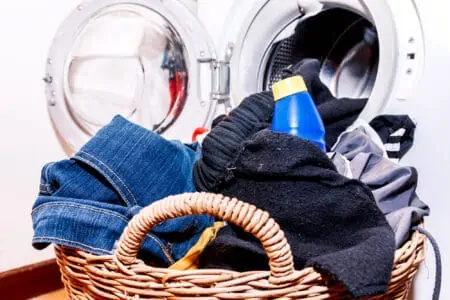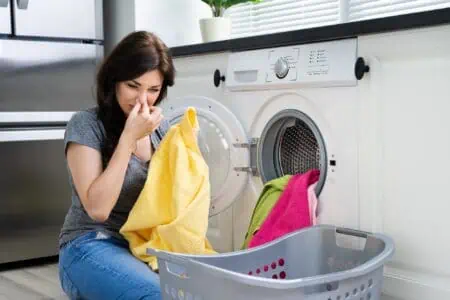
Do your clothes smell bad? Are they stinky even after going through the washing machine? We can help.
Certain factors can make clothes smell really bad. But don’t worry — you can eradicate these lingering scents.
Learn how to get smells out of clothes today. This includes sweat, body, and foot odor, as well as smoke, gasoline, mildew, and more. Before you know it, your clothes will smell fresh as a daisy!
Key Takeaways
- Air out clothes, then pre-soak in a 1:4 vinegar solution, wash with quality detergent, and air dry to remove sweat odor.
- Pre-treat gasoline-stained clothes with enzyme-based stain remover, soak in cold water with baking soda, and wash at the highest suitable temperature.
- Create a 1:1 vinegar and water spray with essential oils to deodorize clothes without washing, then air dry the garment.
- Prevent odors by washing clothes promptly, using suitable detergent, drying clothes well, and storing them correctly.
Why Do My Clothes Still Smell After Washing?
There are many reasons why clothes can still smell foul, even after spinning around in a washing machine for hours. This includes:
- Using the wrong detergent: When you use cheap or light-duty detergent, it isn’t always effective enough to remove strong odors.
- The odor is deep in the fibers: When you leave clothes in the hamper for a while, the bacteria and odors can multiply quickly. This can also happen if you leave the wet clothes in the washing machine for too long after the cycle.
- Your washing machine is dirty: You should clean your washing machine every month to remove detergent buildup, odors, and bacteria.
- Too much detergent: Using too much detergent or fabric softener can cause buildup on the clothes, trapping the bacteria so they can’t wash away.
- The machine was too full: When loading your washing machine, make sure only to fill it ¾ of the way. You need room for the detergent and water to swish around and effectively clean all the garments.
- The water is too cold: Some clothes need washing in hot water. While cold water is more eco-friendly, hot water is more effective for removing odors. If the clothes are really stinky, try a hot wash between 100 and 140 degrees.
How to Get Smells Out of Clothes
The good news is that just because your clothes smell bad, even after washing, this isn’t permanent. There are many ways you can remove all kinds of weird odors.
We’ll walk through the most common stenches, sharing our tried and tested hacks for removing them. These work for shirts, jeans, sweaters, underwear, socks, and more.
Sweat Odor
Sweat odor is super common, especially if you hit the gym often! We’ve found the best way to remove sweat odor from clothing is a combination of distilled white vinegar and warm or hot water.
- Air out your clothes: Before washing, air your sweaty clothes out for a few hours. Don’t leave them stuffed in a hamper or gym bag — this will make matters worse.
- Pre-soak: Pre-soak the clothing in a 1:4 solution of distilled white vinegar and water for 30 minutes to kill odors.
- Wash: Wash the clothing in the hottest water possible according to the care label. Use a quality detergent.
- Dry: If possible, tumble dry the clothes. If not, hang them in a warm breezy spot to air dry.
Body Odor
The above method works great for removing sour body odors. But another method that we love is mixing aspirin and cream of tartar.
This works because cream of tartar is an acid that can neutralize odors (1). Aspirin contains salicylic acid, which can eradicate body odors (2). Here’s how to use this method:
- Create the solution: Mix together three white, non-coated aspirin tablets in one cup of warm water and let them dissolve. Then add one tablespoon of cream of tartar.
- Apply: Apply the solution to the stinky areas of the garment using an old toothbrush to scrub it in.
- Wait: Leave the solution on the garment for 30 minutes.
- Wash: Wash the clothing using as hot a wash as possible and a quality detergent.
- Dry: Tumble dry the clothing if possible.
Foot Odor
Do you wash your socks and find that they still stink? This is normal. Socks take a beating of sweaty and smelly bacteria.
Here’s how to remove foot odor from socks:
- Soak them: Soak the socks in a solution of white vinegar and water at a 1:4 ratio. Leave them submerged for 30 minutes.
- Wash: Wash the socks in as warm a cycle as possible using a quality detergent. It’s important to toss other items in the washing machine as well — this will agitate the socks and help to clean them effectively.
- Dry: Tumble dry, or air dry the socks.
Musty Smells
When learning how to remove odor from clothes, you’re probably wondering about musty smells. Musty smells occur when clothes are left in a closet, hamper or bag for too long.
Try this method to tackle the odor:
- Load the machine: Load the musty clothes into the washing machine. Add your regular detergent.
- Choose the temperature: Use the hottest water possible according to the garment’s care label. If the lowest option is 90 degrees, use that. If you have a top-loading machine, let it fill with water before moving on to the next step.
- Add an odor-killing ingredient: Add one cup of distilled white vinegar, Borax, or baking soda to the washing machine. These products can kill odors and mold spores which often live on musty clothes. Add it to the drum or detergent drawer.
- Wash: Wash the clothes as normal.
- Air dry: Air dry the garments to further remove musty odors. It’s best to do this entire process on a dry, warm day.
Mildew
The above method works wonders for removing mildew smells from clothing. However, if you need something stronger, we have another method to try.
- Load the machine: Load the clothes into the washing machine.
- Add the right detergent: Choose a laundry detergent containing enzymes for this method. This can fight some substances that cause mildew, such as sweat. An option we love is the Seventh Generation Ultra Concentrated Laundry Detergent.
- Add oxygen bleach: Oxygen bleach is amazing for removing odors and mildew. You can add it straight to the machine or use it as a pre-treatment for better results.
- Wash: Run a cycle using the hottest water possible per the garment’s care label.
- Air dry: Air dry the clothes on a dry, warm day.
Top Tip
Avoid fabric softener when cleaning clothes affected by mildew. Fabric softeners can build up on clothing, making it harder to remove mildew stains and smells.
Perfume Smells
When you buy clothes second-hand, the previous owner’s unique scent can remain in the fibers. Do you notice their perfume scent just won’t budge? Try this method to remove it:
- Air the clothing: Hang the garments in a breezy spot. If you can’t hang it outside, place it in a room full of plants — the plants will absorb the odors. Let the garment hang for as long as possible, preferably an entire day.
- Soak in baking soda: Fill a sink with warm water and one cup of baking soda. Soak the garments overnight or for up to a few days.
- Wash: Wash the garments in the machine using as hot a temperature as possible. Add an unscented detergent (you don’t want to mask the perfume) and ¼ cup of distilled white vinegar to the rinse cycle. During the rinse cycle, pause the cycle to let the garments soak in the vinegar. Resume the cycle, then add an extra rinse cycle.
- Air dry: Leave the clothes to air dry. The extra breeziness will help to remove odors.
- Repeat: If the perfume scent remains, repeat the above steps until it is gone. It might take a few attempts.
Smoke Odor
Smoke smells can be tricky to remove from clothing, but it’s not impossible. Here’s a method that experts recommend (it also works for cooking odors):
- Air out the clothes: Choose a dry day to hang the clothes on a line and let them air dry. This can help blow out the particles from the clothing fibers.
- Fill a tub: Fill a tub or sink with hot water and two cups of baking soda. Then pour two cups of distilled white vinegar.
- Soak: Soak the garments in the water for at least one hour. You can soak them for up to four hours if you’d prefer.
- Wash: Wash the clothes in your machine with as hot water as possible, unscented laundry detergent, and another cup of baking soda.
- Air dry: Air dry the garments and repeat if necessary.
Gasoline Smell
If you have spilled gasoline on your clothes, we actually recommend discarding them. Gasoline is flammable, so it can be dangerous to keep this in your wardrobe. If you tumble dry the clothes, it could lead to a fire.
However, if it’s just a little bit of gasoline — or just gasoline odors — and you’re confident you can wash it out, try this method:
- Pre-treat: Add an enzyme-based stain remover or heavy-duty liquid detergent to the affected area. Work it in with a soft-bristled brush and leave it on for 15 minutes. This can also help to remove grease stains, as well as odor.
- Soak: Soak the garment in cold water with one cup of baking soda overnight.
- Wash: Toss the garment in the washing machine and set it to the highest temperature suitable for the fabric.
- Add ammonia: If the odors remain, fill the washing machine with warm water and one cup of household ammonia. Pause the cycle and let it soak for three hours before continuing the cycle.
- Air dry: Leave the garment in a breezy spot to air dry.
Gasoline Warning
Gasoline is flammable, so if you tumble dry the clothing before all the gasoline has been removed, it can lead to a fire.
How To Take Smell Out of Clothes Without Washing
So far, all of our methods for getting odor out of clothes have involved using the washing machine. But can you deodorize and freshen clothes if you can’t access a washing machine? Sure!
Here is an excellent method that works instantly:
- Create a spray: Fill a spray bottle with a 1:1 solution of distilled white vinegar and water. Add 10 drops of your favorite essential oil.
- Spray clothes: Spray the solution onto your clothing. Don’t oversaturate it but be generous.
- Air dry: Air dry the garment.
The spray also works as a multi-purpose surface cleaner.
Another option for removing odors without washing is to hang the garments in direct sunlight for a few hours.
Some people recommend removing odors by freezing the clothes. You can pop the clothes in a bag, then freeze them for 12 hours. But just note that it takes minus 80 degrees to kill bacteria (which cause odors), and most freezers sit around zero degrees (3).
Tips for Removing Stubborn Smells From Clothes
If you’ve tried everything we’ve recommended and the odor still remains, is there anything else you can try? Here are some extra tips for how to remove stubborn stenches.
- Laundry stripping: Laundry stripping is a way to basically factory reset your clothes. You fill a tub with hot water, ¼ cup of washing soda, ¼ cup of Borax, and ¼ cup of Calgon water softener. Then add ½ cup of laundry detergent containing enzymes. Soak the clothes for four hours, stirring every hour. Once the water has cooled, remove the clothes and rinse them in the washing machine.
- Skip the detergent and fabric softener: Detergent and fabric softener can build up on garments. Instead, use ½ cup of baking soda to wash your clothes. Then add ½ cup of vinegar to the rinse cycle. This alone can freshen up your clothes.
- Use Borax: Instead of baking soda, switch to Borax which is slightly stronger. It is excellent at killing stubborn odors.
- Use specialized detergent: You can find a laundry detergent formulated to tackle tough odors. For example, Out Pro Wash is a popular choice.
- Newspaper: Before washing, ball up some newspaper and stuff it into the sleeves, legs, or underarms of your clothes for a few hours. This will absorb excess odor.
- Steam the clothing: If bad smells linger, use a handheld steamer to blast odors out of the clothes. This works by getting deep into the fibers, killing bacteria, odors, mold, and more.
- Make an odor-neutralizing solution: This is excellent for super strong stenches, including pet urine or skunk spray. Combine one quart of hydrogen peroxide, ¼ cup of baking soda, and one teaspoon of dish soap. Mix it well. Apply it to clothing with a soft-bristled brush or cloth — leave it on for up to four hours before washing as usual.
How to Prevent Odors in Clothing
Nobody likes stinky clothes. Nobody likes spending hours trying to remove odors. So it’s essential to know how to prevent odors in the first place.
The last thing you want is to be out of shirts because the garments are stinky but not stained. Here are some handy hacks:
- Use drawer sachets: When storing clothes in a drawer, attic, or closet for a long time, use drawer sachets. These can keep clothes fresh between wears.
- Wash clothes promptly: Do laundry loads regularly. Don’t leave clothes sitting in the hamper for weeks. If the item is particularly sweaty or smelly, wash it right away. If you can’t wash a garment soon, hang it up to air out in the meantime.
- Use a suitable detergent: Use a quality detergent that doesn’t contain tons of additives. You might prefer one that is formulated to fight odors.
- Dry the clothes well: A tumble dryer or outdoor clothesline is the best way to dry clothes. But if you have to air dry clothes inside, invest in a dehumidifier to speed up this process. It will prevent that damp, musty smell that will otherwise occur.
- Use vinegar or baking soda: Add vinegar or baking soda to every cycle instead of fabric softener. It will kill odors while softening your clothes, and unlike fabric softener, it won’t leave behind a buildup.
- Store clothes correctly: Store your clothes in a dry spot with adequate ventilation. If you store your clothes in a humid or damp space, they will start to smell musty. If necessary, place bowls of baking soda or activated charcoal sachets around your closet to absorb excess moisture.
- Don’t overfill the machine: When you fill a washing machine to the brim, the water and detergent can’t mix properly with the clothes. Only fill a machine ¾ of the way full.
- Dry clothes promptly: After washing clothes, dry them quickly. Don’t leave them in the washing machine for hours. This can lead to dampness and foul odors.
- Clean your washing machine: Once a month, sanitize your washing machine. This can prevent odors from transferring from the machine to the clothes.
FAQs

Is It Okay To Soak Clothes in Vinegar Overnight?
Yes — for super-smelly clothes, soak them overnight for better results. Sometimes you only need 30 minutes to see results, but if necessary, soaking overnight won’t cause any harm.

How Do People Get Their Laundry to Smell So Good?
Do you ever hug somebody and think, “Wow, I wish my clothing smelled that good”?
What’s the secret? Well, there are tons of possibilities. This could include:
- They don’t overfill their washer.
- They wash their clothes ASAP.
- They use natural and mild laundry detergents.
- They pre-treat odors on clothes.
- They use in-wash scent boosters, like Downy Light Ocean Mist.
- They spritz their clothes with essential oils like lavender, lemon, or orange.
- They use scented wool dryer balls.
- They air-dry their clothes outside on a sunny, breezy day.
- Their washing machine is super clean.
- They air their clothes out before and after storing them.
- Their house is clean.

What Is the Best Laundry Detergent to Remove Odors?
Some laundry detergents are formulated to remove odors. According to our research, expertise, and customer reviews, here are three amazing detergents to consider:
- Gain Flings Laundry Detergent Soap: This detergent uses soap, Oxi Boost, and Febreze to tackle odors. It leaves behind a fresh scent for up to six weeks! It also works in hot and cold water and for both colors and whites.
- Puracy Natural Liquid Laundry Detergent: This eco-friendly and plant-based detergent can tackle bad odors without harsh chemicals. The enzymatic formula can remove the toughest of scents. One small bottle works for up to 96 loads.
- Mrs. Meyer’s Laundry Detergent Lavender: If you’ve got terrible pet odors to deal with, this is the detergent for you. It uses the power of plant-based ingredients and essential oils to eliminate odors. It even has stain-fighting enzymes, so your clothes will look fresh, too.

What Should You Not Mix With Vinegar?
Vinegar is our number one recommendation for how to get odor out of clothes. It’s safe, non-toxic, and super affordable. But it’s important to note that you should never mix vinegar with bleach or hydrogen peroxide.
When you mix bleach and vinegar, you can create a chlorine gas (4).
When you mix hydrogen peroxide and vinegar, you can create peracetic acid (5).
You should be careful when mixing baking soda and vinegar, too. It’s perfectly safe to mix out in the open, but never mix it in a closed container. When you keep the chemicals in a sealed container for a while, there’s a chance they will explode — this is the carbon dioxide trying to escape.