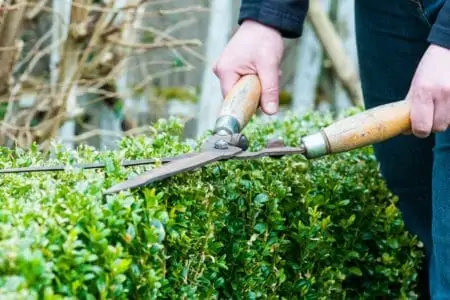
When you start your search for hedge shears, you’ll be met with hundreds of options, making it difficult to know which shears to choose.
I spent hours researching dozens of hedge shears, scouring the market for honest customer experiences and expert advice. After studying each product’s blade and handle material, handle length, weight, and features, I put together a list of the seven best hedge shears that will give you beautiful hedges.
Alongside my top picks, I’ve included seven in-depth reviews so that you know exactly what to expect from each tool. It’s essential that you have a good pair of hedge shears to keep your hedges looking prim and proper. So dive in and find the hedge shears that will transform your garden.
- High-quality materials for versatile cutting
- Soft cushioned vinyl grips
- Teflon coating & carbon steel blade
- Serrated edges for good grip
- Durable self-sharpening design
- Sharp blade end to end
- Shock-absorbing bumpers
- Adjustable blade tension
- Non-stick coating reduces friction
- For personal or professional use
- Extendable handle from 28 to 41.5 inch
- Rust & sap-resistant blades
- Ensures precision cuts to improve hedge health
- Shock-absorbing bumpers reduce fatigue
- Extendable handle from 25 to 33 inch
- Used by professional gardeners
- Comfortable & ergonomic handles
- Lightweight at 1.5 pounds
- Ergonomic soft-grip handles
- Non-stick carbon steel blades
- Lightweight at 1.8 lbs
Review Methodology: At Oh So Spotless, our comprehensive analysis and hands-on experience with hedge shears enable us to provide you with trustworthy assessments and reviews. Our experts meticulously evaluate and compare products based on criteria such as performance, design, durability, and user experience. We gather quantitative data, track results, and measure each product against industry benchmarks to identify key decision-making factors. Our findings demonstrate what sets the best hedge shears apart from their competitors, as well as highlight important design choices and their impact on users. By addressing the ten most essential aspects of hedge shears, including blade material, handle length, cutting capacity, weight, grip comfort, ease of use, safety features, price, and overall effectiveness, we ensure that our recommendations are supported by factual evidence and professional expertise.
The Best Hedge Shears of 2024
I’ve spent hours researching genuine customer reviews, expert advice, and dozens of products. With that in mind, I’ve put together a list of the seven best hedge shears, complete with a comprehensive review.
Get ready to meet hedge shears that will trim away your garden’s imperfections.
Oara Garden Hedge Shears
Most Ergonomic
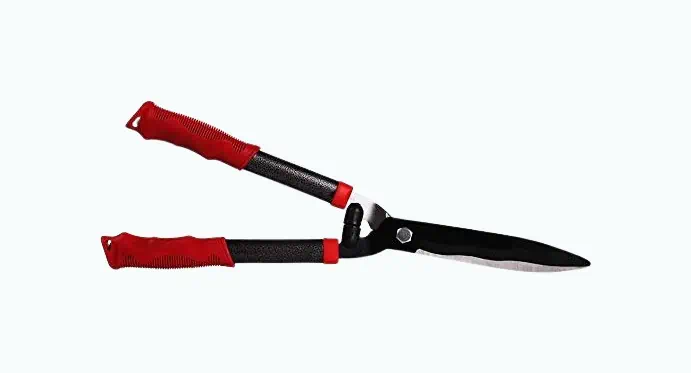
Just looking at these shears, I can tell how comfy the handles will be. If you’re looking for an ergonomic handle on your garden hedge shears, check out these from Oara.
The handles are quite short, which may seem like a drawback, but it actually offers you more control. The ergonomic shape and length let you get closer to your hedges so you can achieve the best cutting angle and ultimate control.
Secondly, the handles have a brilliant, soft vinyl grip. This cushion provides comfort and support while you’re cutting. Combine that with the shock-absorbing bumpers, and you won’t experience the vibration and fatigue that other shears may provide.
Besides the great handles, the blades are also top-notch. The carbon steel blades have a nice sharp edge for effortlessly cutting through various types of branches. This includes hedges, boxwood, shrubs, and other pruning plants.
The carbon steel also has a Teflon non-stick coating for a beautiful glide as you cut. Think no friction, no corrosion, and no resistance. Plus, it curbs dirt and sap, keeping the blades super clean.
Guess What
These blades can cut up to one inch in diameter, which is super generous for hedge shears!
Pros
- High-quality materials make for versatile cutting abilities.
- Soft cushioned vinyl grips for comfort.
- Teflon coating over carbon steel blades.
- Budget-friendly price point.
- Up to one-inch cutting diameter.
- Shock-absorbing bumpers minimize vibrations.
Cons
- Some customers wished they were sharper.
- Handle is short at 11 inches long.
Product Specs
| Blade material | Carbon steel with Teflon coating |
| Handle material | Vinyl cushioning |
| Handle length | 11 inches |
| Weight | 2.05 pounds |
| Extra features | Shock-absorbing bumpers, Teflon coating, one-inch cutting diameter |
Our Ratings
User Experience
Fiskars Power Lever Hedge Shears
Best Power Hedge Shears
You might be wondering: what are power shears? Power shears feature power-lever technology.
This means that they have multiple pivot points instead of just one. In return, this gives you extra — sometimes double — the cutting power than other hedge shears.
So, if you want something with a bit more oomph, power shears may tick your boxes.
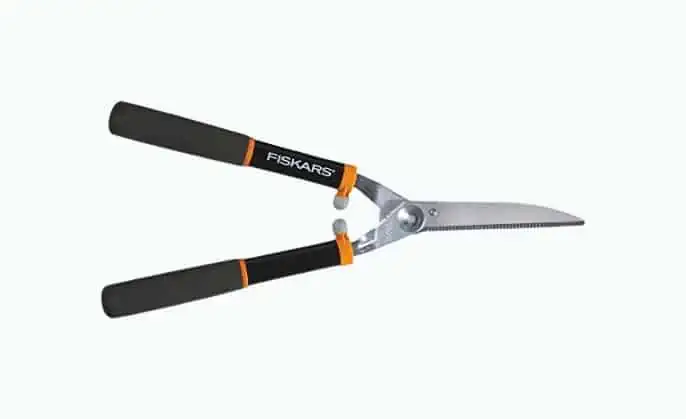
These Fiskars shears have compound lever technology to provide extra leverage and more cutting force. The blades are made from precision-ground steel, finished with a serrated edge that grips branches and self-sharpens at the same time. This provides a quick, clean cut, all while keeping the blade sharp.
The blades have a smooth, low-friction coating to ensure each cut is smooth and crisp. Customers also love the shock-absorbing bumpers, which limit vibrations and fatigue.
Last but not least, these awesome shears have strong steel handles that won’t break or bend under pressure. Plus, they’re finished with a non-slip grip for your comfort and control.
Pros
- Suitable for hedges and decorative shrubs.
- Serrated edges provide a good grip.
- Self-sharpening design for durability.
- Blade is sharp from end to end.
- Low price point.
- Double the power as single-pivot shears.
Cons
- Not rust-resistant.
- Not good for heavy-duty or thick cutting.
- 11-inch handles are short for some.
Product Specs
| Blade material | Steel |
| Handle material | Steel with non-slip grip |
| Handle length | 11 inches |
| Weight | 2.88 pounds |
| Extra features | Serrated edges, self-sharpening, power gears |
Our Ratings
Personal Perspective
Steve & Leif Hedge Pruning Shears
Best Lightweight Hedge Shears
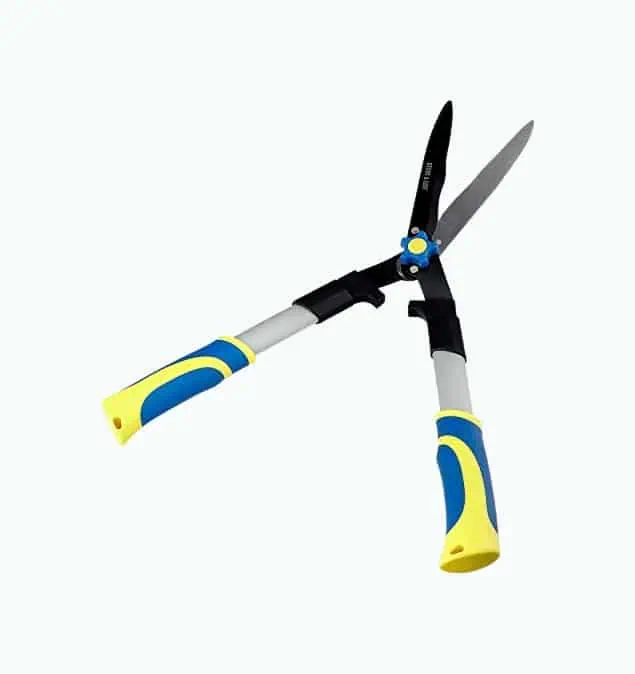
Lightweight shears are often easier for some customers to use. Heavier shears can make trimming your hedges a whole lot more cumbersome and difficult. These shears are on the lighter end of the market, weighing 1.5 pounds.
The reason they’re lightweight is because of the aluminum handles. While these handles are still strong and durable, they’re also nice and lightweight.
The handle also features soft grips to improve comfort and control. They even have touchpoints that will reduce blisters — every gardener’s dream!
Besides the nice handles, this also has a wavy blade made from rust-resistant, low-friction stainless steel. It’s strong and durable but slick enough to make effortless cuts and resist sticking. Of course, being a wavy blade, this is best for thick branches.
A unique feature of these shears is the ability to adjust the blade tension. A bolt on the blade can be adjusted to change the blade’s tension. This allows you to prune different types of plants, making this a very versatile tool.
Pros
- Shock-absorbing bumpers to reduce fatigue.
- Adjust the blade tension for various types of plants.
- Lightweight and comfortable handles — reduces blisters.
- Non-stick coating to reduce sticking.
- Low friction and rust-resistant blades.
Cons
- Not suitable for old, dead, or dry branches.
Product Specs
| Blade material | Non-stick stainless steel |
| Handle material | Aluminum with soft grip |
| Handle length | 13 inches |
| Weight | 1.5 pounds |
| Extra features | Shock-absorbing bumpers, adjustable blade tension |
Our Ratings
Community Feedback
ARS Extendable Hedge Shears
Best Extendable Hedge Shears
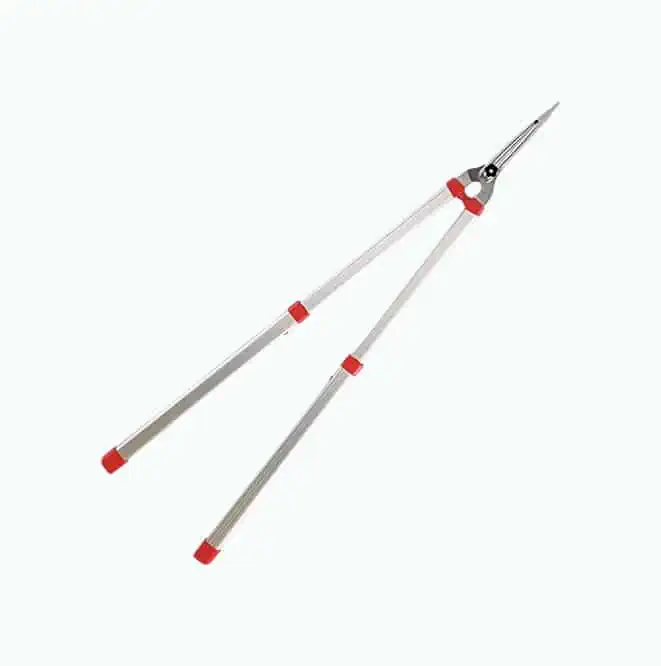
While I have a few extendable hedge shear recommendations, this is one of the best on the market because it is so flexible. It spans from 28 inches all the way to 41.5. This long length increases your flexibility in hard-to-reach areas and very high hedges, shrubs, and trees.
Just keep in mind that there are three locking points between 28 and 41.5 inches. So, you can’t completely customize where you extend it to. You can lock it at 28, 35, and 41.5 inches.
That said, I think you’ll enjoy the super lightweight handles with the push-button springs. These springs lock into place so your handles are safe and secure while you use them.
The blades are hard-chrome plated, which is pretty unique compared to some of our other recommendations. This plating ensures a high-strength cut each time you use it. The blades are also slightly curved, which allows a quick, clean cut without issues. So overall, this is a super easy product to use.
The blades are also rust and sap-resistant, so they stay high-quality and are a breeze to clean.
Pros
- Suitable for personal or professional use.
- Extendable handles from 28 to 41.5 inches.
- Rust and sap-resistant chrome-plated blades.
- Great for high and deep shrubs and hedges.
- Chrome-plated blades for high cutting force.
Cons
- The cutting blade is quite short at six inches.
- Feels a bit flimsy.
Product Specs
| Blade material | Chrome plated |
| Handle material | Aluminum |
| Handle length | 28 to 41.5 inches |
| Weight | 2.16 pounds |
| Extra features | Extendable handles |
Our Ratings
First-Hand Impression
Tabor Tools Telescopic Hedge Shears
Easiest To Use
Have you ever bought yourself a garden tool only to be left frustrated by it and all the ways it challenges you? Gardening can be tricky. That’s why experts suggest tools that make it easier rather than more of a challenge. This includes the Tabor Tools hedge shears.
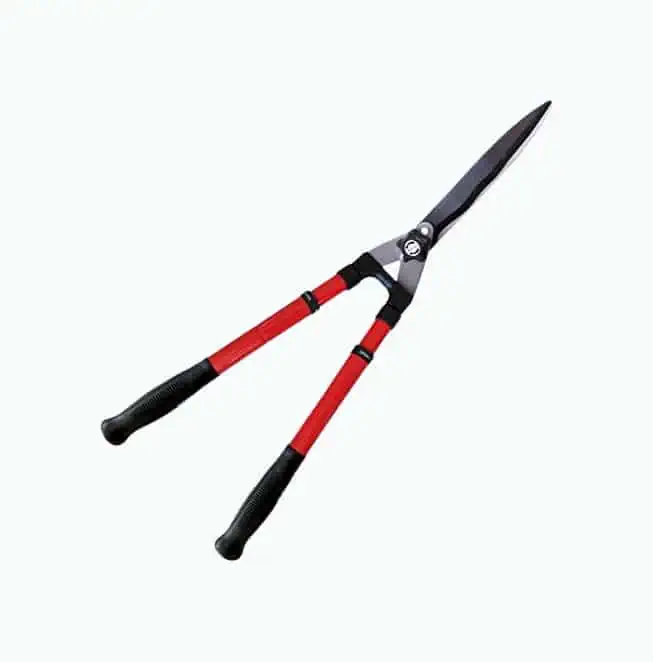
These shears are easy to use due to a few key features. Firstly, the handles are extendable. This allows you to get into hard-to-reach places or hedges directly in front of you.
Adjust the handles from 25 to 33 inches, depending on the task at hand. Once you have added the length, activate the lock feature to secure the handles in place. No slipping or sliding. Just easy cutting!
Another feature that makes it super easy is the tension control knob. When you have dense leaves, don’t struggle against the shears; work with them instead.
Lastly, the low-friction super sharp blades are worth pointing out. They make each cut feel effortless as the blades glide through the branches.
Pros
- Ensures precision cuts that improve plant health.
- Shock-absorbing bumpers to reduce fatigue.
- Adjustable blade tension for versatility.
- Extendable handles from 25 to 33 inches.
- Low price point.
- Sharp, wavy blades make precise and healthy cuts.
Cons
- The handle isn’t very secure, and the blade sometimes slips out.
- 3.24 pounds — a bit too heavy for some customers.
Product Specs
| Blade material | Carbon steel |
| Handle material | Steel with non-slip grip |
| Handle length | 25 to 33 inches |
| Weight | 3.24 pounds |
| Extra features | Shock-absorbing bumpers, adjustable handles, adjustable blade tension |
Our Ratings
User Experience
Okatsune Precision Hedge Shears
Best Heavy-Duty Hedge Shears
These heavy-duty shears make cutting hedges, branches, and shrubs super easy. It’s been designed with many important features to ensure it’s high-quality and super effective.
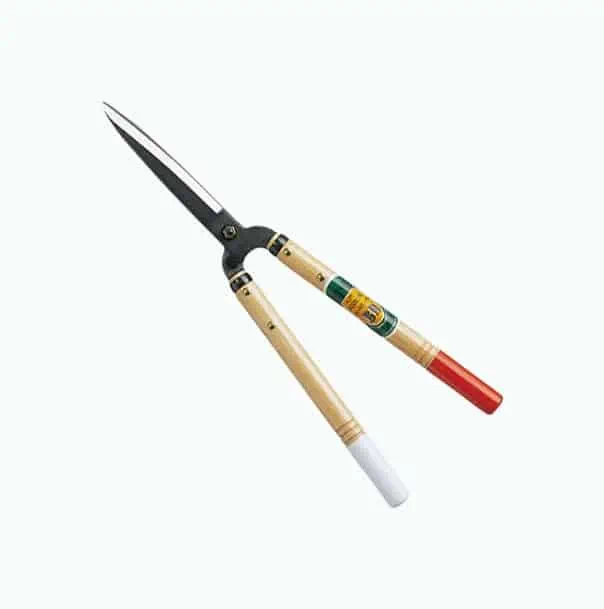
For one, the Izumo Yasuki steel blades are heat-treated, hammer-forged, and polished to ensure maximum durability. This is a premium-grade material that’s durable, sharp, and able to handle a variety of tasks.
Next up is its very light weight at 1.5 pounds. If you’re choosing a heavy-duty model, it’s likely you’ll be using these for a long time. That’s why I recommend choosing a comfortable option that won’t wear you out as you work. These soft handles give a nice grip, ultimate control, and total comfort.
The ergonomic design combined with the easy hold means these are a favorite among many customers.
Pros
- Used by professional gardeners.
- Durable quality.
- Comfortable and ergonomic handles.
- Lightweight at 1.5 pounds.
- Beautiful design with white oak.
- Makes clean and healthy cuts thanks to the Japanese steel.
Cons
- The tips of the blades are incredibly sharp; users must stay safe.
- The wood may rot, and the blades may rust.
Product Specs
| Blade material | Izumo Yasuki steel |
| Handle material | Japanese White Oak |
| Handle length | 21 inches |
| Weight | 1.5 pounds |
| Extra features | Hot hammer-forged blades |
Our Ratings
Personal Perspective
Colwelt Hedge Clippers
Best Budget Pick
Hedge shears are available at a wide range of prices, but you don’t need to blow all your cash on these tools. You can get a perfectly useful pair of shears for a decent price. That’s what brings us to this recommendation of the Colwelt hedge clippers.
For a budget-friendly price point, you’ll get these great 21-inch long hedge shears. Spend a few extra dollars, and you could treat yourself to the same model with extendable handles!
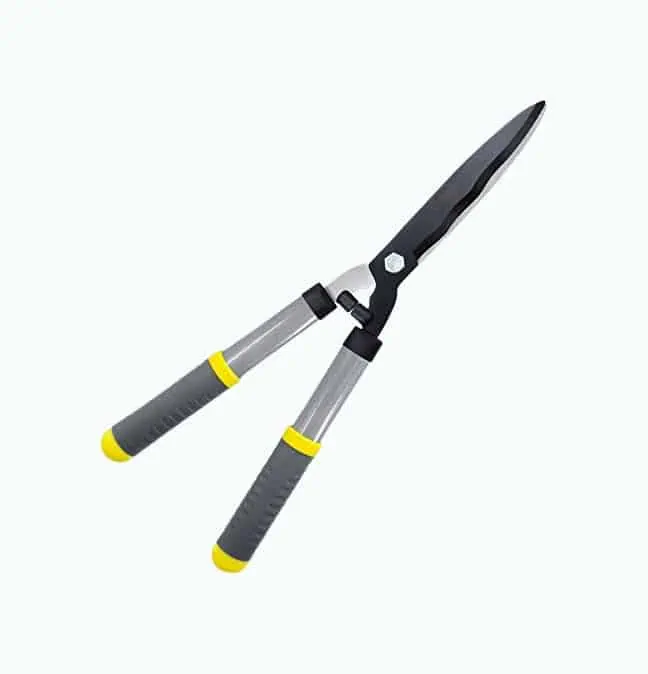
Another great feature about these is that they’re super lightweight, weighing only 1.8 pounds. That should make it very easy to navigate around your garden without tiring.
Customers also love how versatile these clippers are. They’re suitable for shaping boxwood, shrubs, topiary plants, and, of course, hedges. So, no matter what you have in your garden, these might be just the tool to spruce the place up!
The reason they’re so versatile is the wavy blades. They are suitable for a wider variety of stems. Plus, the carbon steel blades with non-stick coating ensure extreme sharpness, effortless cutting, and durability. And the big bonus: no sticking and easy to clean!
Pros
- More affordable than other hedge shears.
- Ergonomic soft-grip handles.
- Carbon steel blades with non-stick coating.
- Nice and lightweight for long periods of gardening.
Cons
- Some customers found they dulled very quickly.
- Reports of the blades bending.
Product Specs
| Blade material | Carbon steel with non-stick coating |
| Handle material | Steel with soft-grip |
| Handle length | 10 inches |
| Weight | 1.8 pounds |
| Extra features | Shock-absorbing bumpers |
Our Ratings
Community Feedback
| Product | Best | Blade material | Handle material | Handle length | Weight | Extra features |
|---|---|---|---|---|---|---|
| Oara Garden Hedge Shears | Ergonomic | Carbon steel with Teflon coating | Vinyl cushioning | 11″ | 2.05 lbs | Teflon coating |
| Fiskars Power Lever Hedge Shears | Power Hedge Shears | Steel | Steel with non-slip grip | 11″ | 2.88 lbs | Serrated edges, self-sharpening |
| Steve & Leif Hedge Pruning Shears | Lightweight Hedge Shears | Non-stick stainless steel | Aluminum with soft grip | 13″ | 1.5 lbs | Adjustable blade tension |
| ARS Extendable Hedge Shears | Extendable Hedge Shears | Chrome plated | Aluminum | 28 – 41.5″ | 2.16 lbs | Extendable handles |
| Tabor Tools Telescopic Hedge Shears | Easiest To Use | Carbon steel | Steel with non-slip grip | 25 – 33″ | 3.24 lbs | Adjustable handle & blade tension |
| Okatsune Precision Hedge Shears | Heavy-Duty Hedge Shears | Izumo Yasuki Steel | Japanese White Oak | 21″ | 1.5 lbs | Hot hammer-forged blades |
| Colwelt Hedge Clippers | Best Budget Pick | Carbon steel with non-stick coating | Steel with soft-grip | 10″ | 1.8 lbs | Shock-absorbing bumpers |
How To Choose the Best Hedge Shears
These details are important to consider before making your final purchase. Knowing the difference between blade types, handle styles, and other factors will ensure you choose one that ticks all your boxes.

Blade
When it comes to the blade, consider the type, material, and length.
There are three main blade types: straight, wavy, or serrated. Straight blades are best for trimming small and soft branches. Wavy blades are great for thicker branches exceeding a quarter of an inch. And serrated blades are the best for thick and stubborn foliage.
As for materials, the most common ones are stainless steel, high-carbon steel, and non-stick.
Stainless steel is a great choice as it’s rust- and corrosion-resistant. High-carbon steel is very strong, durable, and easy to sharpen. Non-stick blades reduce the buildup of sap and other sticky materials on the blades. It’s down to personal preference what one you choose.
Lastly, consider the blade length. This usually spans from six to 12 inches. Six-inch blades are best for shorter hedges, lower than your shoulder. A 7- or 8-inch blade is versatile and can suit most hedges. Then, 9- to 12-inch blades are best suited for taller hedges.

Handle
Choosing a good handle is the key to a comfortable experience with your new tool.
Firstly, consider the length. This can span from about eight to 42 inches if you choose extendable shears. Some people prefer shorter handles because it gives them more control. Others prefer longer ones so they can get into tighter spaces.
On that note, you may want to consider an extendable handle, especially if you have multiple different hedge heights to trim. This increases your flexibility.
Lastly, consider how ergonomic the handle is. Is it contoured to fit your hands? Does it have padding for extra grip and comfort? These are important details to note.
Weight
Hedge shears can range from just under two pounds to about 3.5 pounds. All of my recommendations are fairly lightweight, but if you want to ensure you have something that doesn’t weigh you down, I suggest looking for one less than 2.5 pounds.

Design
Some brands have spent extra time investing in the design of their product. Key features to look out for include:
- Shock-absorbing: This reduces vibrations as you cut, preventing fatigue and pain as you work.
- Ergonomics: As mentioned, some shears are more ergonomic than others, which aids your comfort as you trim.
- Gears: Some hedges have a geared cutting mechanism, which provides more leverage as you cut. This is suitable if you have a lot of thick or dry branches. The hedge shears are typically two to three times more powerful than hedge shears without gears.

Cutting Capacity
Hedge shears usually all have a similar cutting capacity: about ½ inch in diameter. You can always check the product description to see if it specifies something other than this.
But if you are curious whether the shears will work for your hedge, it’s best to consider the blade types — straight, wavy, or serrated. This tends to work better than searching high and low for a cutting capacity.

Availability of Spare Parts
Hedge shears probably won’t last forever, but sometimes it’s possible to repair with spare parts rather than buying whole new shears.
Check the product guarantee to see if the manufacturer will provide spare parts. In general, better-known brands will ship out spare parts, so you shouldn’t be left without your shears for too long.

Budget
The price of hedge shears typically ranges from about $30 to $60. Some hedge shears can cost over $100, though! Others go as low as $20.
Whatever your budget is, you should be able to find the right shears for you within your price range.
Hedge Shears FAQs
Are Serrated Hedge Shears Better?
For thick and stubborn foliage, serrated shears are better. However, if you are cutting small, soft branches or thicker branches, serrated shears aren’t going to be suitable.

How Do You Sharpen Hedge Shears?
Serrated shears must be professionally sharpened.
Other types of hedge shears can be sharpened with a three-cornered saw file. Gently move it along the blade’s sharp edge, following the original bevel.
How Do You Maintain Hedging Shears?
Here are some tips for keeping your hedge shears in beautiful condition:
- Remove residue: Remove any sap or sticky residue after each use.
- Proper storage: Store them somewhere clean and dry to prevent rust.
- Keep ’em clean: Clean after each use. Make sure they’re 100 percent dry before storing.
- Oil up: Oil them occasionally.
- Remove build-up: Use a stiff brush to remove build-up on the blades.
- Keep ’em sharp: Keep the edges nice and sharp.

What Is the Definition of Hedge Clippers?
Hedge trimmers are specific tools for clipping and cutting back hedges. They look a bit similar to scissors but are much larger and sharper.

How Thick of a Branch Can a Hedge Trimmer Cut?
A hedge trimmer can cut a branch up to 3/4 of an inch. Any thicker, and you will need a more powerful cutting tool, like a chain saw.

Can You Use a Chainsaw To Cut a Hedge?
You can use a chainsaw to cut a hedge, provided that you use the shortest bar and the chain is sharp. A chainsaw is not the most precise instrument, but it will successfully trim hedges.