A gas pressure washer is a huge decision and, often times, a big investment. If you need help figuring out where to start shopping but know you want a super powerful tool to provide unmatched cleaning, I can help.
I’ve put together a list of the seven best gas pressure washers so you can find your dream power tool. This is backed by hours of research into genuine customer reviews, studies, and expert advice. I looked into each product’s specs, including pressure, water flow rate, construction, and warranty, to ensure you don’t miss details.
Keep reading to learn about seven exceptional pressure washers, as well as a comprehensive buying guide that will help you avoid shopping mistakes.
- Top tier durability
- Easy to maneuver
- It can handle almost anything
- Onboard soap tank
- Intense blast removes stubborn stains
- Easy transportation
- Five quick nozzle tips
- Large foam spray can
- Works on various terrain

- Lightweight and portable
- 25-foot hose
- On-board storage
- Durable construction
- Ergonomic design
- Axial cam pump
- Easy to use
- Secure grip for spray gun
- Quick change nozzle tips
- Flexible washing
- Onboard soap tank
- Axial cam pump
Review Methodology: At Oh So Spotless, we understand the importance of trust when it comes to finding the best gas pressure washers. Our team of professionals conducts thorough research, analysis, and hands-on evaluations to compare and rank products based on essential criteria such as performance, power, efficiency, and ease of use. We assess design choices and their effects on users, using our experience and expertise to provide you with data-driven, factual findings. Our reviews identify key decision-making factors, such as water pressure, flow rate, reliability, and durability, to help you make an informed choice. By sharing first-hand evidence and quantitative measurements, we ensure that our recommendations truly reflect the best gas pressure washers on the market.
The Best Gas Pressure Washers of 2024
I have spent hours researching real customer reviews, expert advice, and my own insight to create a comprehensive list of the seven best gas pressure washers on the market. After looking at each product’s specs, PSI, GPM, and weight, I narrowed it down to my top picks.
Blast away dirt, grime, and stains with one of these amazing pressure washers.
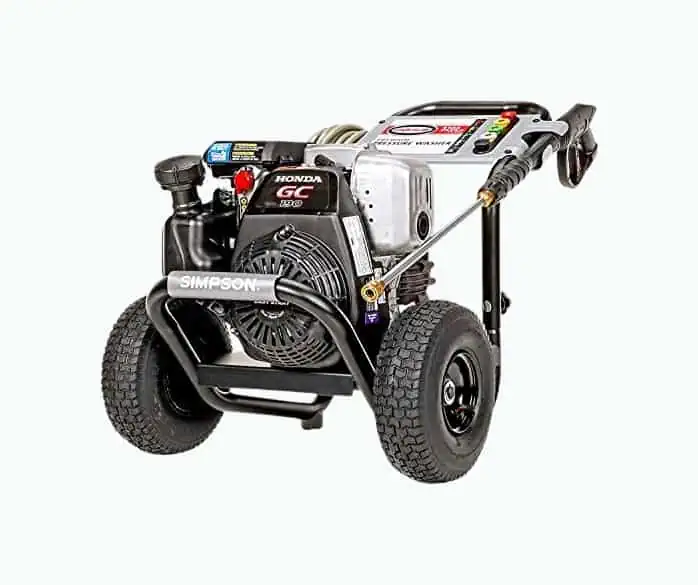
Simpson MegaShot 3100 PSI Pressure Washer
Best for Concrete
Gas pressure washers are the best power washing tool for concrete since this surface can handle very high water pressure. I recommend at least 3000 PSI for washing concrete, so this one from Simpson is an awesome choice.
With a residential engine from Honda, a 3200 PSI, and a 2.5 GPM, you won’t be disappointed with the cleaning power of this pressure washer. Take your concrete sidewalks, driveway, and garage floor from dirty to delightful super quickly!
It works on other surfaces besides concrete. You can use this for cleaning bricks, vehicles, patios, garden furniture, and more.
What We Like
Top Tier Durability
It is commendable that this product is so durable, particularly given its steep cost. The large fuel tank means that the pressure washer can run for a long time. And the engine itself is sturdy, durable, and easy to operate.
The OEM technologies pump requires less maintenance, and the crankcase does not require oil replacement. Last but not least, the hose is made of high-quality material, non-marring, and flexible, which can handle all sorts of heavy-duty use.
Easy To Maneuver
Just one look at this device, and you can tell it will be super easy to maneuver. It is very well-balanced, so won’t tip over when you push it. The large 10 inches wheels also make it easy to navigate over various terrains.
It Can Handle Almost Anything
Put this pressure washer to the test and see what it can do. It’s designed to remove dirt and mold so that you can say goodbye to nasty residue on surfaces. This includes siding, decks, garage floors, brick patios, and of course, concrete. You can also use it on vehicles, boats, RVs, outdoor furniture, lawn equipment, and grills.
Assemble and Kickstart Easily
Get this unit up and running in no time. Once it arrives, it’s easy to assemble and even easier to start, thanks to the Honda engine.
What We Don't Like
Too Mighty for Some Jobs
3200 PSI is very strong. Sometimes this can be too strong for certain surfaces, even those that Simpson has approved. Just be sure to test in an inconspicuous area with the widest nozzle from a few feet away to check for evidence of damage.
Poor Quality Handle
The handle on this machine doesn’t get a lot of love. A few customers reported that the spray handle isn’t sturdy enough for the pressure of the machine. It can break under the vibrations and the use of the machine, rendering your unit useless until you get a repair or replacement.
Product Specs
| PSI | 3200 |
| GPM | 2.5 |
| On Wheels? | Yes |
| Weight | 66 pounds |
| Warranty | 2 years engine, 1-year pump, 5 years frame, 90 days accessories |
Our Ratings
User Experience
Westinghouse WPX2700 Gas Pressure Washer
Most Durable
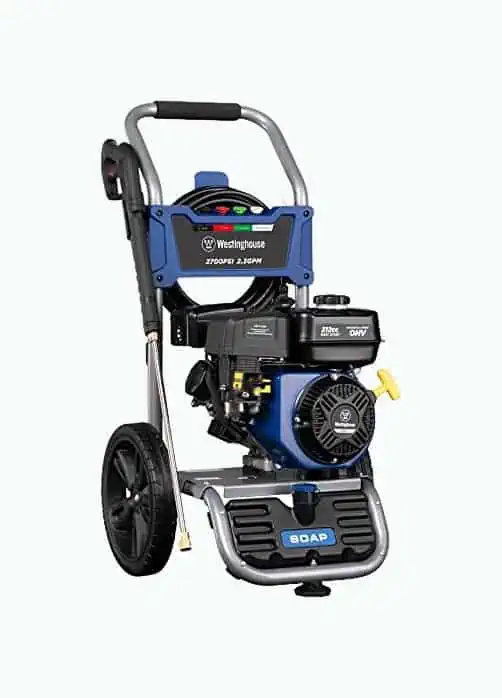
Thousands of happy customers back this durable option. It’s a heavy-duty pressure washer with a long-lasting, maintenance-free axial cam pump designed to be durable and convenient.
A robust steel frame with abrasion-resistant materials also protects the main components. This frame is also very easy to clean, which will help to increase the lifespan.
If you’re looking for something to last a long time, this is one to consider. Plus, with a PSI of 2700, it can tackle most jobs without being too harsh on your surfaces.
What We Like
Onboard Soap Tank
It’s a good day when you find a gas pressure washer with an onboard soap tank! With the capacity of ½ gallon, this allows you to add detergent, which can make cleaning a whole lot easier.
Intense Blast Cuts Through Stubborn Stains
This has an intense blast, especially when using the zero-degree nozzle, to help cut through grease, grime, and other stains.
Easy Transportation
This pressure washer is very easy to transport, thanks to the 12-inch never-flat wheels and the sturdy frame. Plus, the hose is abrasion resistant, so even if it’s trailing on the ground, it won’t get damaged.
Durable Construction
As mentioned, this is a durable option. Thanks to the maintenance axial camp pump, this will last a long time with minimal maintenance.
What We Don't Like
Overheats Easily
The engine can get hot and overheat. This can stop the pressure washer from operating until it’s cooled down, but it can also cause damage to the hose since the two elements are in contact. Overheating is usually caused by using it on a hot day, leaving in the sun, or using it without breaks.
May Leak Oil
Quite a few customers noted that their pressure washer leaked oil. This normally happens pretty early on after buying the product, so you should notice this in time to get it fixed under the warranty.
Product Specs
| PSI | 2700 |
| GPM | 2.3 |
| On Wheels? | Yes |
| Weight | 70 pounds |
| Warranty | Between 1-3 years, depending on the cover you need (1) |
Our Ratings
Personal Perspective
Teande 4200PSI Gas Pressure Washer
Best Commercial Option
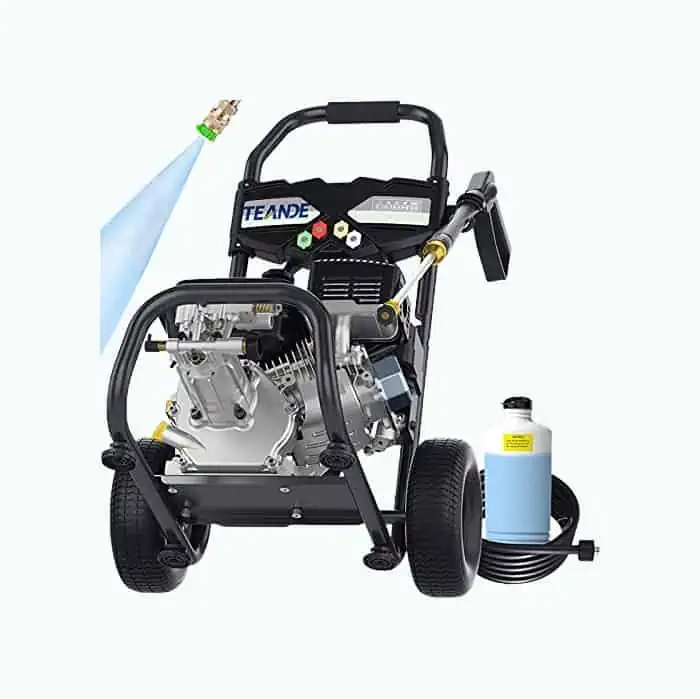
Do you need a pressure washer you can put to use in commercial areas? Maybe you have a building site to clean up, or a car business, or something else entirely. This is a top choice, in our opinion, since it’s durable, great for heavy-duty work, and has a high PSI of 3200.
Power is one of the big things to note about this pressure washer. Besides the high PSI, it has a super great GPM of 2.6. This fantastic flow will blast away stubborn stains, leaving you super satisfied.
When you’ve got many tasks at hand, you need something this efficient. The fuel burns completely, so you get 90 percent more cleaning power than an electric pressure washer.
What We Like
Five Quick Nozzle Tips
The more nozzle tips, the more versatile the pressure washer. This one comes with five: 0, 15, 25, 40 degrees and a soap nozzle so you can use the pressure washer for various tasks. Try cleaning homes, buildings, vehicles, boats, decks, driveways, patios, frames, and more.
Large Foam Spray Can
This pressure washer comes with an extra-large foam spray can. Add your favorite pressure washer detergent, and you won’t run out for a long time. This allows you to do bigger jobs without interruption.
Works on Various Terrain
With the sturdy frame and large wheels, this is easy to move around even on tricky terrain. The 10-inch pneumatic wheels help out with maneuverability. So no matter where your client is based, you can bring this gas pressure washer with you.
High Power for Quick Cleaning
This runs at 3200 PSI and 2.6 GPM, which is fantastic, especially if you want to use it for running your business. The high power cleans 50 percent faster than many competitor products.
What We Don't Like
PSI In Question
While many customers are completely happy, quite a few unsatisfied customers are questioning the PSI. They say it doesn’t feel like 3200 PSI, but slightly lower.
Complex Starting Process
While this has an easy pull cord, there is a long starting process. You need to turn the machine on, activate the trigger and accelerator, then the choke and fuel lever, before finally pulling the cord to start it. Pretty complex!
Product Specs
| PSI | 3200 |
| GPM | 2.6 |
| On Wheels? | Yes |
| Weight | 18.3 pounds |
| Warranty | Two years |
Our Ratings
Community Feedback
A-iPower APW2700C Gas Powered Pressure Washer
Best Budget Choice
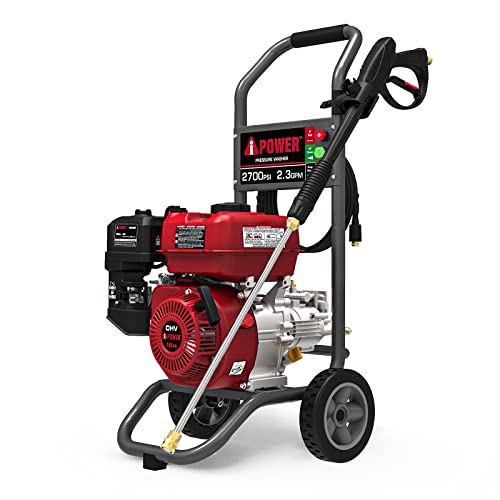
As mentioned earlier, gas pressure washers are expensive. But if you’re looking for something lower than the average price, the A-iPower APW2700C is an excellent, top-quality option.
This pressure washer has a PSI of 2700, making it great for use around the home. It’s designed for cleaning decks, sidewalks, patios, porches, driveways, vehicles, and siding. So you can get every job done with this awesome appliance.
It has a connect wand with a 0-degree and 25-degree tip, so you can use it for blasting away dirt or more gentle cleaning. It also comes with soap nozzle tips for a wider degree of cleaning options.
What We Like
Lightweight and Portable
Weighing only 57 pounds, this is a pretty lightweight gas pressure washer. Plus, with the sturdy frame and large wheels, it’s straightforward to maneuver this and take it where you need to.
25-Foot Hose
The long 25-foot hose gives you a lot of flexibility. It’s long enough to reach a range of spots without having to carry the main body with you.
On-Board Storage
This comes with onboard storage, so you never need to get creative with how you store the nozzles, hose, cord, and other elements.
Low Oil Sensor
Know exactly when it’s time to refill the oil tank. This unit includes a low oil sensor, so you never run out of oil and burn out the engine.
What We Don't Like
Only Includes Three Nozzles
Typically, a pressure washer includes four nozzles, but this only includes three: zero degrees, 25 degrees, and a soap applicator. This limits the amount of surfaces you can clean with this unit.
Hose Too Close to Engine
The hose is too close to the engine and exhaust. Since the engine and exhaust get really hot, this ends up being an issue and can damage the hose.
Turns Off When Moving
When transporting this pressure washer while it’s turned on, it often turns off. This is frustrating if you’re just trying to move the frame around your car.
Product Specs
| PSI | 2700 |
| GPM | 2.3 |
| On Wheels? | Yes |
| Weight | 57 pounds |
| Warranty | One year |
Our Ratings
First-Hand Impression
Simpson Clean Machine Pressure Washer
Best for Home Use
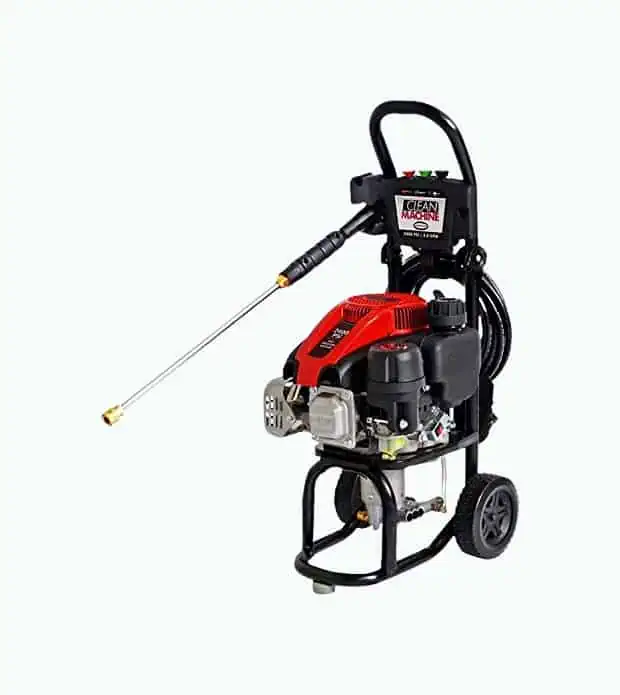
For jobs around the home, check out this Simpson gas pressure washer. At only 2400 PSI, it can clean a range of messes while still being gentle enough to use on most surfaces, including siding, garden furniture, and vehicles.
It’s also a super lightweight appliance at only 39.7 pounds. It’s very compact, too, so overall, it’s easy to maneuver and store. This makes it a brilliant choice for home use, even if you don’t have a lot of space, since it won’t take up too much room.
Use this handy machine to take your patio, siding, outdoor areas, furniture, and cars from zero to hero. And without the risk of chipping paint, causing cracks, or damaging anything.
What We Like
Durable Construction
This is a fully assembled appliance with a sturdy steel frame to give you peace of mind. It’s also powder-coated to ensure corrosion resistance. Last, but not least, it includes a fold-down handle that allows you to quickly and conveniently store it.
Ergonomic Design
This compact pressure washer is ergonomically designed to give you an easy and comfortable experience.
Axial Cam Pump
The axial cam pump by OEM Technologies is a great feature on a pressure washer. It’s a maintenance-free pump, giving you one less thing to worry about.
High-Quality Hose
I love when brands use abrasion-resistant hoses. Often, your hose will trail on the ground as you clean, which can cause damage. But not on this unit: the hose is non-marring, abrasion-resistant, and flexible, ensuring that it lasts a long time.
What We Don't Like
Only Three Nozzles
This unit only includes three quick connect nozzles: zero degrees, 25 degrees, and a soap applicator. This limits the areas you can clean, as zero and 25 degrees might be too strong for some surfaces.
Small Gas Tank
Some customers find the gas tank is too small. It runs for about 40 minutes before needing some more gas put into it. When you’re planning to spend your Saturday doing some deep outdoor cleaning, this can add to a lot of gas stops.
Watch Out for Leaks
Quite a few customers complained of leaks. Some had to do with the oil leaking from the engine. Other complaints had to do with leaks from the water inlets.
Product Specs
| PSI | 2400 |
| GPM | 2 |
| On Wheels? | Yes |
| Weight | 39.7 pounds |
| Warranty | 2 years engine, 1-year pump and frame, 90 days accessories |
Our Ratings
User Experience
Generac 2900 PSI Pressure Washer
Best Portable Pick
Many of our suggestions are nice and easy to transport since most are on wheels. Still, this is a top choice if you’re looking for a portable pressure washer.
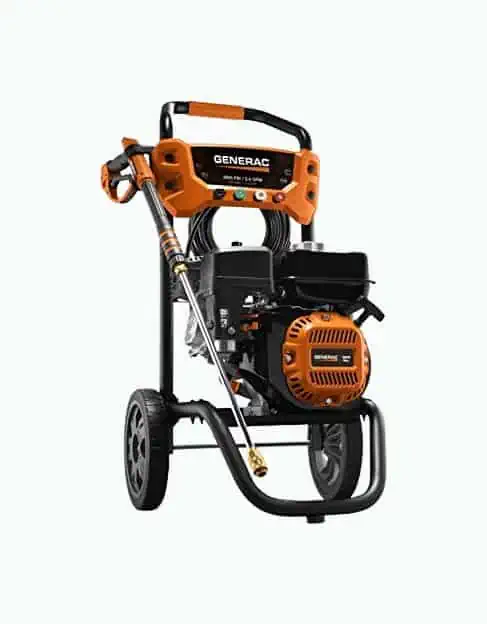
It is one of the lightest gas pressure washers on the market, weighing only 50 pounds. This makes it easy to take with you as you deep clean your outdoor areas. The frame is also economically built with a very sturdy outline, handle grip and large wheels.
As for pressure, it has a PSI of 2900, so it’s nice and strong, but it will still be quite gentle on your surfaces.
What We Like
Easy To Use
Have you ever used a pressure washer that was just a pain to operate? This comes with an easy-pull trigger to improve the whole experience. It reduces finger fatigue and makes the experience all the more comfortable.
Secure Grip for Spray Gun
The spray gun doesn’t just dangle down while you transport it. There’s a very secure grip area to hold it while you move or store the pressure washer.
Quick Change Nozzle Tips
This comes with four quick-change nozzle tips. They’re easy to change over, making it super easy to switch them up depending on the task at hand. The options are 0 degrees, 25 degrees, 40 degrees, and soap.
2900 PSI at 2.4 GPM
This unit’s PSI and flow rate are fantastic, especially for home use. At 2900, it’s great for deep cleaning. You can also use it for commercial properties, too, and you’ll still be impressed.
What We Don't Like
Struggle To Get It Running
A lot of customers had trouble getting this thing up and running. Either it wouldn’t start upon arrival, or it would take a while. Customer service isn’t that great, so many customers had to solve the issue using their own money.
Not Very Durable
Some customers had this for a year before it stopped working; others could use it several times. It’s not always the engine that gives out, too. The frame isn’t the most durable, the wheels can come loose, and sometimes the nozzles get misshapen and can no longer fit.
Product Specs
| PSI | 2900 |
| GPM | 2.4 |
| On Wheels? | Yes |
| Weight | 50 pounds |
| Warranty | 3 years |
Our Ratings
Personal Perspective
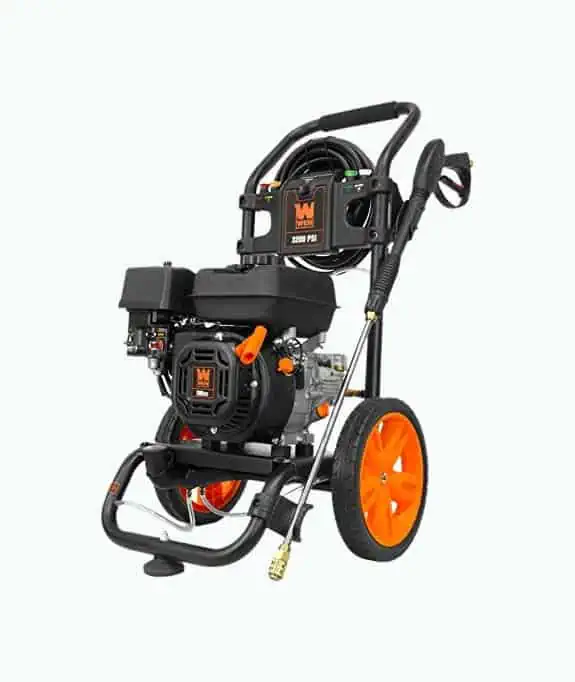
WEN PW3200 3200 PSI Pressure Washer
Best for Concrete
Gas pressure washers are the best power washing tool for concrete since concrete can handle very high water pressure. I recommend choosing at least 3000 PSI for washing concrete, making this WEN model a superb choice.
With a four-stroke engine, a 3200 PSI, and a 2.5 GPM, you won’t be disappointed with the cleaning power of this pressure washer. Take your concrete sidewalks, driveway, and garage floor from stained to spotless in a super short space of time!
It works on other surfaces besides concrete. You can use this for cleaning vehicles, RVs, boats, siding, and more.
What We Like
Long-Range Washing Ability
With the power of a 30-foot hose and 12-inch wheels, it’s never been easier to clean every inch of your driveway. The long hose gives you added reach. Meanwhile, the wheels make it super easy to transport this anywhere you need to go.
Onboard Soap Tank
Use the added power of detergent with no extra bother, thanks to the onboard soap tank. You can pour up to 32 ounces of detergent into the machine and enjoy the extra cleaning power.
Powerful Axial Cam Pump
This power tool comes with an axial cam pump. You’ll love the super powerful spray, thanks to this pump. It also ensures the machine will last a while. It’s a very durable construction.
Four PSI Options
This product is available in four different max PSI options, including 2800, 3100, 3200, and 3400. So if you want something a bit stronger or a bit more gentle, you can choose a different model.
What We Don't Like
Starting Issues
Some customers had issues starting the pressure washer the first couple of times. Once it had broken in, it was a lot easier to start. However, other customers found that this continued each time they used it. It’s perhaps not the most reliable.
Cheap and Short Hose
Many customers disliked the included hose as they found it very cheap and too short. A few people upgraded the hose to a different model.
Product Specs
| PSI | 3200 |
| GPM | 2.5 |
| On Wheels? | Yes |
| Weight | 67 pounds |
| Warranty | Two years |
Our Ratings
Community Feedback
| Product | Best | PSI | GPM | On Wheels? | Weight | Warranty (Years) |
|---|---|---|---|---|---|---|
| Simpson MegaShot 3200 PSI | For Concrete | 3200 | 2.5 | Yes | 66 lbs | 90 days to 5 years |
| Westinghouse Gas Pressure Washer | Durable | 2700 | 2.3 | Yes | 70 lbs | 1-3 years |
| Teande 4200PSI Gas Pressure Washer | Commercial Option | 3200 | 2.6 | Yes | 18.3 lbs | 2 years |
| A-iPower Gas Pressure Washer | Budget Choice | 2700 | 2.3 | Yes | 57 lbs | 1 year |
| Simpson Clean Machine | For Home Use | 2400 | 2 | Yes | 39.7 lbs | 2 (engine); 1 (pump & frame) |
| Generac 2900 PSI Pressure Washer | Portable Pick | 2900 | 2.4 | Yes | 50 lbs | 3 years |
| WEN PW3200 | For Concrete | 3200 | 2.5 | Yes | 67 lbs | 2 years |
What Can You Clean With a Pressure Washer?
Wondering what jobs a gas pressure washer can handle? Here’s a list of some things you can clean with it:
- Concrete, such as sidewalks and driveways.
- Decking.
- House siding.
- Cleaning in and around pools.
- Grills.
- Outdoor furniture.
- Trailers and boats.
- Cars and trucks.
- Fencing.
- Outdoor steps.
- Garage floors.
- And more!
Warning
Always be careful when using a gas pressure washer, as the PSI — or force — is much stronger than electric pressure washers. It’s easier to damage more fragile surfaces such as furniture, vehicles, and siding.
Benefits of Gas Pressure Washers
When comparing gas and electric pressure washers, they both have their pros and cons. But let’s look at some of the awesome advantages of a gas option.
- They’re super powerful: The PSI is much higher on a gas pressure washer, making them super effective. This can speed up your cleaning time, clean better and help with stain removal.
- Use them anywhere: You can use them residentially or commercially. These are heavy-duty appliances, so gas is the way to go if you want something you can use at home or work.
- High flow rate: pressure washers have a higher water flow, which is rated at gallons per minute (GPM). This allows you to use much more force than an electric pressure washer.
- They’re very durable: They’re made with higher quality parts due to the increased water pressure, so they often last longer.
- Portable: Portable pressure washers usually come on wheels, making them easier to maneuver than non-wheeled electric pressure washers.
How To Choose a Gas Pressure Washer
If you’re liking the sound of a gas pressure washer, it might be time to buy one. Before you do, consider these important factors to help you choose the best one for your specific needs.

Portability
While you won’t find cordless or super lightweight gas pressure washers, you can still find ones that are more portable than others.
I recommend getting something that’s in a sturdy frame on wheels. That way, you can easily move it from one place to another.

Weight and Ergonomics
Check how much the pressure washer weighs. It’s pretty heavy, ranging from about 18 to 70 pounds.
But the ergonomics will make a difference. The weight shouldn’t be an issue if it’s on wheels in a user-friendly frame.

Water Pressure
The water pressure is measured in PSI — pound per square inch. Most gas pressure washers start around 2400 PSI but tend to be in the 3000-4000 range. The higher this number, the more force the pressure washer will have.
You should also check the GPM — gallons per minute. This number reflects the amount of water that can come from the unit. Again, the higher this number, the stronger the pressure. This is usually between two and three GPM.

Safety
Consider any safety precautions that the pressure washer has. This may include a child safety lock, automatic shut-off, or other cool features.

Extra Features
What extra features does the pressure washer have? Does it come with any accessories, extra nozzles, or an oil alert system? It’s worth checking this out so you know how much use you’ll get out of the pressure washer.

Warranty
Last but not least, check the warranty to see how long the pressure washer is covered in case of damage, breakdowns, or accidents. My recommendations range from 90 days up to five years. I’ll let you know what the warranty is for each product.
FAQs

Are Gas Pressure Washers Better Than Electric?
Deciding if gas pressure washers are better than electric models is complicated. Gas versions require more maintenance, and they are heavier, noisier, and more expensive. However, they are also more powerful.
It’s down to personal preference and what you need to use the unit for. Electric models are better for the environment, easy to transport, and great for residential use.

How Long Do Pressure Washers Last?
A pressure washer should last up to 500 hours, which is roughly ten years if properly maintained and used following the manufacturer’s guidelines.

What PSI Is Safe for Washing Cars?
The correct PSI considered safe for washing cars is 1,200 to 1,900. You should also consider the gallons per minute rate (GPM). For the pressure washer to work effectively, you need 1.4 to 1.6 GPM.

What PSI Do I Need To Clean My Deck?
Knowing what PSI you need to clean a deck depends on the material used. A composite deck should have a PSI of 500 to 600, whereas hardwood can cope with 1,200 PSI.

How Long Can You Run a Gas Pressure Washer?
You can run a gas pressure washer for about thirty minutes, which is much longer than five to ten minutes for an electric version.
Choosing Gas
When you choose a gas pressure washer, you’re really taking the power up a notch. All of our choices are between 2400 and 3300 PSI, so they’re strong, powerful, and sturdy enough to handle the tasks at hand.
Whether you’re looking for something to use commercially or residentially, have we got options for you! When shopping, just be sure to consider the main details: PSI, GPM, portability, weight, and of course, the warranty.