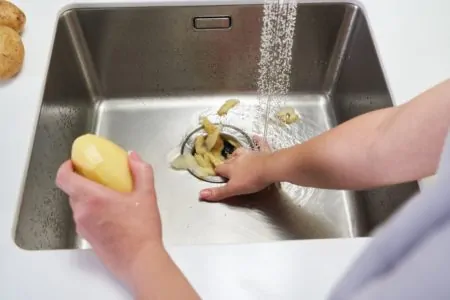
A garbage disposal is a convenient and quick way to dispose of food waste. This handy kitchen gadget can save you time by shredding up food particles so it can fit through the pipes. But the real question is: what size garbage disposal do I need?
We’ll help you to find the right size of garbage disposal for your needs and your kitchen. The last thing you need when buying an expensive garbage disposal is accidentally ordering in the wrong size.
Our guide will answer your top questions, and give you some key facts about garbage disposal sizes.
Key Takeaways
- Measure space under your sink and choose garbage disposal size based on horsepower (HP) for your family size.
- Garbage disposal sizes range from 1/3 HP (for 1-2 people) to 2 HP (for 8+ people or commercial properties).
- Check dimensions, connection size, and grind chamber capacity to ensure compatibility with your sink and kitchen.
- Properly maintained garbage disposals can last around 10 years; clean weekly and avoid putting harmful items inside.
Will Any Garbage Disposal Size Fit?
Unfortunately not. Garbage disposals are not usually universal — but a few are. If you’re looking at specific sizes, and not universal disposals, you’ll need one that fits your sink. The best way to determine this is to hire a plumber to investigate.
Generally, this involves measuring the connection size from your drain to the garbage disposal unit.
Although garbage disposals aren’t universal, they do come in all kinds of sizes, so you’ll definitely be able to find one that fits your sink.
Can You Put a Garbage Disposal on Any Sink?
Although a garbage disposal might fit your sink, that doesn’t mean it’s compatible. A plumber will be able to tell you if your sink is compatible with garbage disposals.
You must also check if your community allows for garbage disposals. Not all areas have sewage systems that are compatible with food waste.
If you’re curious about sink sizes, garbage disposals do work on all kinds of sinks. This includes single sinks, or on one half of a double sink. You may have to plan your purchase accordingly, depending on the type of sink, drains and system you have.
What Size Garbage Disposal Do I Need?
There are a few different garbage disposal size details you must measure to find the right one for you.
Motor Size
To measure a garbage disposal motor, look at the horsepower (1). This calculates the garbage disposal capacity.

1/3 HP
These are the cheapest garbage disposals. They are pretty low powered, so we don’t recommend them for families bigger than two people.

1/2 HP
This is the most common size of garbage disposal and it has good power behind it. It’s good for small families that cook frequently, but may be a problem if you have guests over, or do a big dinner.

3/4 HP
This is the recommended size for most families. It’s got great power, and it comes in a range of prices to suit most budgets. It’s not a huge price difference from the 1/2 HP, but you do get a lot more grinding power.

5/8 HP
This is the next size up from 3/4 — it’s strong enough to grind up most foods, even tough ingredients. A lot of these options have sound seal technology to keep the grinding quiet. However, these units are slightly bigger so make sure you have enough space.

1 HP
This is the best size for big families or if you’re in a commercial setting. These garbage disposals can grind pretty much anything. Of course, that means these units are a bit more expensive.

2 HP
If you have a larger commercial property, or a really huge family, we recommend going for a 2 HP. These are the most powerful out of all the sizes, and will grind anything you feed it (within reason).
Family Size
It’s easier to measure your garbage disposal needs by your family size. Here’s how we recommend shopping for your garbage disposal depending on who’s in your household.
- ⅓ HP — one to two people.
- ½ HP — two people.
- ¾ HP — three to five people.
- ⅝ HP — three to six people.
- 1 HP — five to eight people or commercial properties.
- 2 HP — eight people or more, plus bigger commercial properties.
Kitchen Space
Check underneath your sink to see how much space you have. If you’re limited on space, you should check the dimensions of the garbage disposal unit you’re looking at. This might mean going for a unit with a smaller HP.
If you have unlimited space, you should be able to find a unit in any HP to fit underneath your sink.
Unit Size
Measure the length, width and height of the space under your sink, as well as the unit, to make sure they’re compatible.
Connection Size
Check the connection size of the unit and if it will fit your kitchen sink drain. If it does, great. If not, choose a different unit or get an adapter to connect the two pieces. As mentioned, some units claim to be universal — but always investigate this before purchasing.
Grind Chamber
The grind chamber is where the food goes to be ground up, then disposed of. Check the capacity of the ground chamber — this should be measured in ounces. Some go all the way up to 40 ounces of food, but smaller and regular chambers can carry anywhere from 26 ounces upwards (2).
No matter what your capacity is, never exceed this as you could damage your garbage disposal.
Can I Replace Garbage Disposal Myself?
If you already have a garbage disposal installed, it can be pretty easy to replace your unit. However, we don’t recommend this unless you have some plumbing or electrical experience.
- Turn off the power to the disposal at your service panel.
- Disconnect the drain trap from the discharge tube.
- If your dishwasher is connected to the disposal, disconnect that, too.
- Release the disposal from the mounting ring. You may have to use a screwdriver, but some can be removed by turning it loose.
- Remove the electrical cover plate and disconnect the disposal from the power supply.
- Remove the snap ring. The mounting assembly will come off the sink’s flange.
- Use a screwdriver to remove the nut holding the mounting assembly.
- Remove the flange and the plumber’s putty from the sink.
- Apply the plumber’s putty to the new flange and install it in place.
- From below, place a gasket over the flange, then a second flange, then the mounting ring.
- Hold all of these items in place while inserting the snap ring. You may need a second person to help with this.
- Tighten the screws.
- If hooking to a dishwasher, knock the plug out of the unit. If not, skip this step.
- Remove the electrical cover plate on the unit.
- Connect the wires, following the manufacturer’s instructions.
- Replace the cover plate.
- Align the disposal with your mounting ring. Turn the tabs clockwise until the disposal locks into place.
- Turn the power back on.
- Fill the sink with water. Test for leaks.
Take Note
How Long Does It Take to Install a Garbage Disposal?
If you’re hiring a professional, it should take a maximum of two hours. However, if you’re doing it yourself and don’t have relevant experience, it will most likely take at least a couple of hours. This also depends on the brand you choose and how easy it is to install their unit.
FAQs

How Long Do Garbage Disposals Last?
Garbage disposals should last for around 10 years if properly maintained according to the manufacturer’s instructions and used as intended.
When Should a Garbage Disposal be Replaced?
Your garbage disposal should be replaced if it is approaching the end of its useful life or you struggle to eliminate bad odors emanating from the disposal.

What Size Drain Pipe Do I Need for a Garbage Disposal?
The size drain pipe you need for garbage disposal is 3.5 to 4 inches. Garbage disposals are designed to fit universal sinks, typically using the same size pipes and brackets.

Which Side of the Kitchen Sink Should the Garbage Disposal Go?
A garbage disposal can go on any side of the kitchen sink. It’s best to place it on the side of the sink that sees the most food waste.

What Should Not be Put In Garbage Disposal?
There are several items you should not put in a garbage disposal, including cooked pasta, coffee grounds, paint, and bones. Other foods like oatmeal are also damaging to your garbage disposal.

How Often Should a Garbage Disposal be Cleaned?
You should clean garbage disposal weekly, although when you finish using it, you should run cold water for 30 seconds to flush it clean.
Guiding Your Garbage
This guide is here to help you choose the best unit for your garbage, your family, and the amount of food you’ll feed your disposal. Remember to consider the actual size of the unit to ensure it fits under your sink.
Once you have your dimensions, we recommend shopping by HP. Use our handy guide to find the right HP for your family size. Otherwise, you could find yourself with an overflowing or jammed garbage disposal!