Does leaf-blowing exhaust you? These power tools can be heavy. That’s where a backpack leaf blower can alleviate some stress and discomfort.
Backpack leaf blowers are more comfortable to wear, especially for longer periods of time. They’re fantastic for both commercial and residential use. If you’re in the market for one of these, I’ve compiled a list of the seven best backpack leaf blowers, accompanied by in-depth reviews.
After studying genuine customer reviews, expert advice and applying my own insight, I’ve rounded up seven favorites. Whether you need something with a harness, something for commercial use, or a cordless option, I’ve got you (and your back) covered.
- Eco-friendly (for a gas option)
- Controls are all in one place
- Adjustable tube length
- X-torq engine is more eco
- Low vibrations increase comfort
- Super high power (up to 251mph)
- Two-stroke engine
- Control the speed
- Lightweight and comfy
- Large force, large tank
- Generous 5-year warranty
- Comfortable to wear
- Cruise control feature
- Powerful brushless motor
- Variable speed settings
- Durable brushless motor
- Turbo boost clears heavy debris
- Lightweight at 14 pounds

- Easy engine startup
- Great for big jobs
- Flexible handle
Review Methodology: At Oh So Spotless, we pride ourselves on providing thorough analysis and assessment to help you choose the best backpack leaf blower for your needs. Our team of professionals conducts hands-on research, comparing various models based on performance, power, comfort, noise level, and fuel efficiency. We gather data and evaluate products from a user’s perspective, sharing quantitative measurements and identifying crucial decision-making factors. By ranking the top choices, we provide an in-depth review that highlights design choices and their effects on users, backed by first-hand experience and evidence. Trust our expertise to guide you in selecting the perfect backpack leaf blower for your outdoor cleaning tasks.
The Best Backpack Leaf Blowers of 2024
We spent hours researching information about backpack leaf blowers before creating this list. We studied expert advice, dozens of products, and real customer reviews. Once we knew what to look for, we researched each product and what it had to offer.
With that in mind, here are seven fantastic backpack leaf blowers, what you can expect, and the pros and cons to consider. Blow your leaves away with these incredible tools.
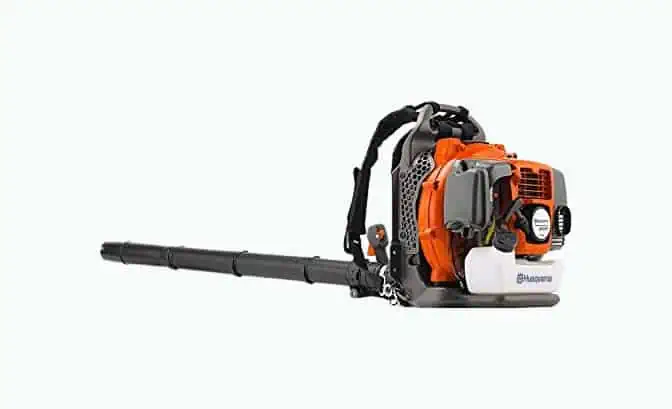
Husqvarna 350BT 2-Cycle Gas Backpack Blower
Includes the Best Harness
The Husqvarna 2-cycle gas backpack blower is one of the most popular and reliable on the market. It includes an excellent harness, making it comfortable to wear for long periods of time.
The ergonomic harness system has a padded harness and hip belt to take the strain off you while you work.
What We Like
Eco-Friendly (For a Gas Option)
While an electric leaf blower will always be more eco-friendly, this is a smart choice for a gas model. It reduces harmful emissions by up to 60 percent. It is also more fuel-efficient by 20 percent.
Controls Are All in One Place
On the machine, the controls are all in one place, making it easier to operate. Customers appreciate this user-friendly and clever design.
Adjustable Tube Length
Adjust the tube length, making it longer or shorter, depending on your task. This detail makes it a convenient device for a variety of jobs.
Power Blowing Power (180MPH)
We recommend choosing a device that runs at 100mph, but this one goes the extra mile — or 80! With a power of 180mph and 692 CFM, you will be wowed by this device’s force.
What We Don't Like
Difficult To Start
You may find this is a difficult machine to start up. Some customers found it hard to pull, saying it took a few tries to get it going. This can be frustrating, especially if you’re in a hurry.
Some Elements Fall Off
There are a few design flaws in this backpack leaf blower. Sometimes, random parts will just fall off! Some customers said it was the gas cap (which is pretty dangerous), and others had issues with the exhaust pipes.
Product Specs
| Type | Gas-powered |
| Run Time | About one hour and 15 minutes |
| Air Volume | 692 CFM |
| Speed | 180 MPH |
| Weight | 22.5 |
Our Ratings
User Experience
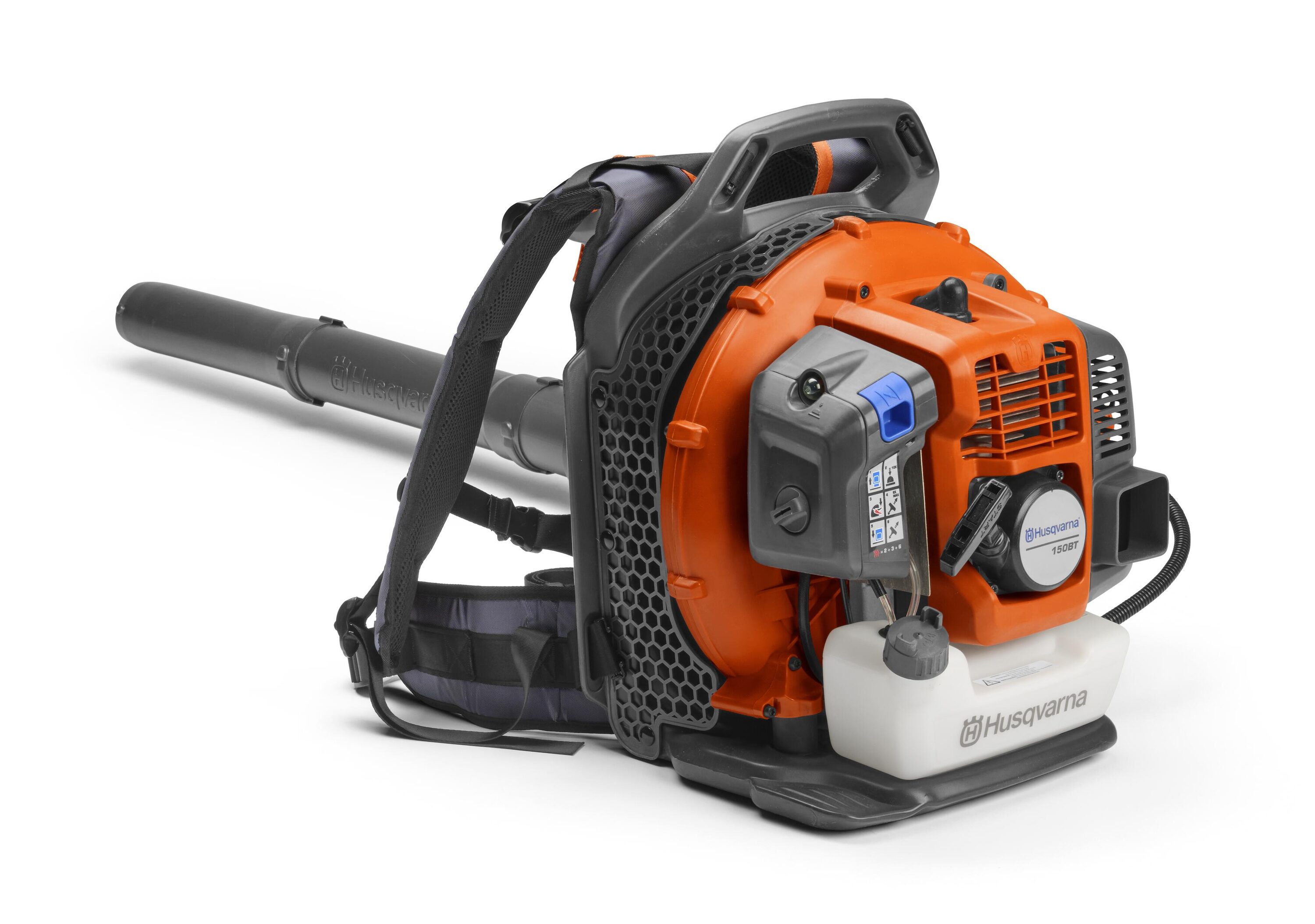
Husqvarna 150BT 2-Cycle Leaf Blower
Best 2-Cycle Leaf Blower
Specifically, looking for a two-cycle leaf blower? This is one of the best.
The engine is suitable for both customer and professional use and requires less maintenance since you can combine oil and fuel, and it will lubricate and run your engine.
Besides that, it has a CFM of 692 at 251 MPH. This ensures great power so you can get jobs done in a decent length of time.
What We Like
X-Torq Engine Is More Eco
Husqvarna’s top priority is that its products are as eco-friendly as possible. Even though this is a gas-powered machine, it’s environmentally conscious. It reduces harmful emissions by up to 60 percent and is more fuel-efficient by up to 20 percent.
Low Vibrations Increase Comfort
Do you ever wear a backpack leaf blower and feel like all your insides are vibrating? Well, that’s not an issue anymore. Thanks to the “lowvib” technology, this blower has dampeners between the engine and chassis, which minimizes vibrations.
Super High Power (Up To 251MPH)
Talk about power! This is one of the most powerful units on the market. Running at 215MPH and 692 CFM, this will clear your leaves in no time.
Variable Speed Settings
You can adjust the speed on this unit, so you don’t always have to utilize full force. Once you’ve chosen your speed, you can lock it in place with the cruise control setting, ensuring your experience is smooth sailing.
What We Don't Like
Expensive Price Point
Some customers found the price too high for what you get. It’s not the most powerful on the market, and it takes a longer time to move some bigger piles of leaves. For the price, check the stats for what you’re looking for.
Stalls at Full Power
A few customers reported that this unit stalls when they get to full throttle. If you want to utilize high power, be aware that you may have some start/stop issues.
Product Specs
| Type | Gas-powered |
| Run Time | At least 1.5 hours |
| Air Volume | 692 CFM |
| Speed | 251 MPH |
| Weight | 22.5 |
Our Ratings
Personal Perspective
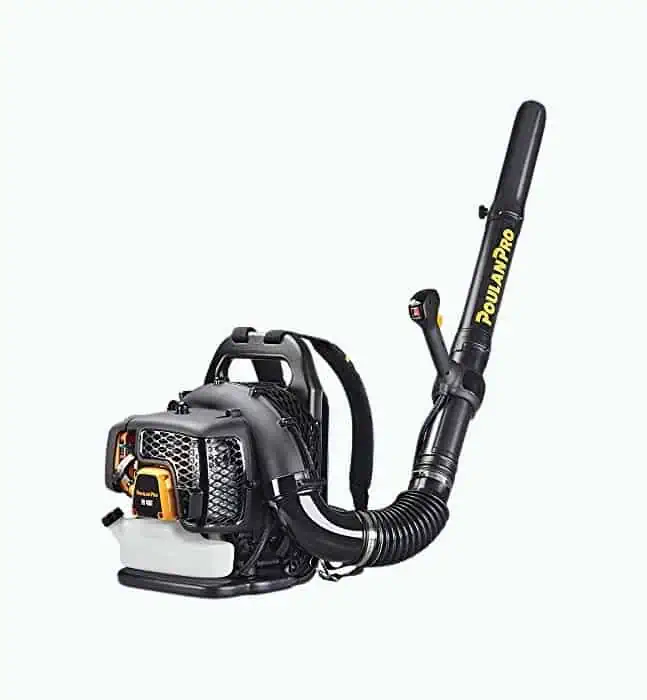
Poulan Pro PR48BT 2-Cycle Blower
Best Gas Option
Eliminate all leaf messes with this amazing gas-powered backpack leaf blower. Running at 475 CFM and 200 MPH, this gets the job done quickly, efficiently, and properly.
Thanks to the 48 cc two-cycle engine, this leaf blower can clear wet, damp, moist, heavy leaves, grass, and other garden debris. And all for a very fair price!
What We Like
Two-Stroke Engine
Two-cycle and four-cycle engines both have their pros and cons. But I like that this is a two-cycle engine.
The main difference is that you use both gas and oil that powers and lubricates the engine simultaneously. This means you don’t have to do as much maintenance to the machine.
Control the Speed
This comes with variable speed settings so you can easily choose the best speed for your job. But on that note, you can employ cruise control so it maintains your chosen speed so you can just get on with the job.
Lightweight and Comfy
Weighing only 22 pounds, this is one of the lighter gas-powered backpack leaf blowers available. Not only that, but it’s fitted with a load-reducing harness to minimize strain and increase comfort. The bottom line is even if you wear this for an eight-hour shift, it shouldn’t exhaust you.
Durable Build and Frame
You can rely on this machine for a while to come. It’s made with heavy-duty and durable materials that can stand various conditions and, of course, the test of time.
What We Don't Like
Struggles To Reach Full Power
Something to remember is that quite a few customers are saying this thing struggled to reach full power. So while it’s designed to go to 475 CFM, can it? Some say yes, some say no.
Hard To Start
Some customers found it really difficult to start up. It’s quite stiff, and you definitely have to put some force into getting the thing to start! It’s a good muscle workout, though.
Product Specs
| Type | Gas-powered |
| Run Time | About one hour |
| Air Volume | 475 CFM |
| Speed | 200 MPH |
| Weight | 22 pounds |
Our Ratings
Community Feedback
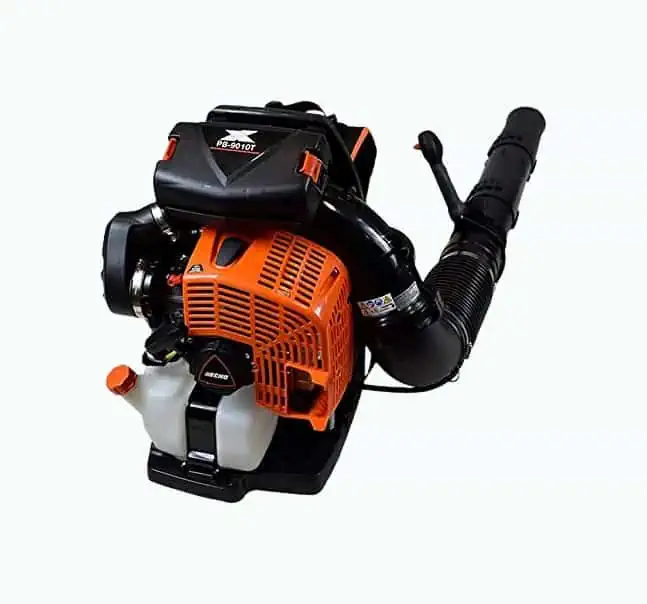
Echo PB-9010T Backpack Blower
Best Commercial Backpack Leaf Blower
A gas-powered leaf blower is a great option if you want to use it for work or your business.
The Echo blower is a fantastic option in that department. It has incredible power, ranging up to 1110 CFM, which is just awesome!
The MPH is 220 making this an overall heavy-duty leaf blower that can handle large areas and big messes.
What We Like
Large Force, Large Tank
Compared to other leaf blowers, this just has better specs. The blowing force is 18 percent more powerful than other commercial leaf blowers. The fuel capacity is 56 percent better, which means it will run longer on one tank of gas.
Generous Five-Year Warranty
For personal use, the warranty is five years. For commercial use, it’s two years. Overall, this is very generous and assures you that you will get your money’s worth.
Comfortable To Wear
Whether you’re wearing this for a couple of hours or for your 9-5 job, don’t fret because it’s super comfy to wear. The wide cushioned straps mean it’s easy to wear all day long. Even in the hot summer months, you’ll love it thanks to the fan intake, which prevents your back from getting too warm.
Suitable for Dusty Environments
Dust can often wear down a power tool as many filters can’t handle the fine particles. But this one has a large pleated paper and foam filter, making it suitable for dusty environments.
What We Don't Like
Large Obstructive Tube
You’ll notice that the tube on this machine is large and obstructive. It’s not suitable for clearing debris in tight corners or gutters. You can’t adjust the tube, and removing it from the machine is hard.
Noisy Machine
The Echo PB-9010T has a reputation for being loud. Customers were unimpressed by the noise level, so make sure you wear ear protection.
Product Specs
| Type | Gas-powered |
| Run Time | Not specified |
| Air Volume | 1100 CFM |
| Speed | 220 MPH |
| Weight | 26.7 pounds |
Our Ratings
First-Hand Impression
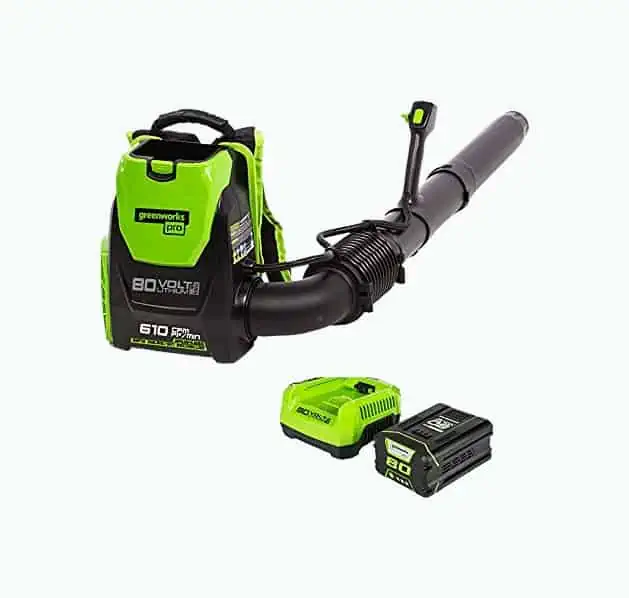
Greenworks 80V Cordless Backpack Leaf Blower
Best Cordless Backpack Leaf Blower
Most backpack leaf blowers these days are cordless since you don’t need to plug in a gas option.
But this is the best of both worlds: cordless and not gas-powered, so you’re still protecting the environment.
While it is a little pricier than other options, you’re getting a powerful tool with some cool features.
What We Like
Cruise Control Feature
Customers love the cruise control feature on this leaf blower that allows you to maintain your chosen speed. This gives you ultimate control over your jobs, putting your mind at rest while you go about your task.
Powerful Brushless Motor
This has the same energy as many gas-powered leaf blowers. All without the nasty fumes. Thanks to the brushless motor, this is comparable to other popular gas-powered options on the market.
Variable Speed Settings
Take this across multiple speeds all the way up to 180 MPH — which is crazy powerful. If you don’t want to use this full flow, you can choose another speed, lock in cruise control and enjoy the journey!
Move Wet and Dry Leaves
As someone who lives in a constantly wet climate, I’m excited to hear about this unit’s power! It can move wet and dry leaves, so no matter what weather conditions you’re facing, you can still clean up your yard.
What We Don't Like
Annoying Trigger
The trigger on this machine is sensitive and finicky. It’s not the easiest to use, as it’s not very sturdy, which can be annoying when you’re trying to get the job done. Now you have another little factor to think about.
Battery Life Issues
While the battery takes 45 minutes to charge, it only lasts for around 10 to 15 minutes. Therefore, this is best suited for small jobs as it would take multiple recharges to clean medium to large yards.
Product Specs
| Type | Battery-powered |
| Run Time | 10-18 minutes |
| Air Volume | 610 CFM |
| Speed | 180 MPH |
| Weight | 14.6 pounds |
Our Ratings
User Experience
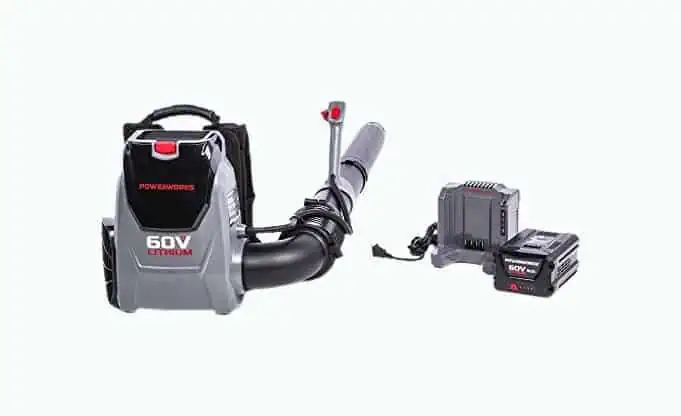
PowerWorks 60V Backpack Blower
Best Battery-Powered Blower
Do you care for the environment? You may want to opt for a battery-powered leaf blower over gas. If so, this is a great option.
It comes with a 60-volt 5Ah lithium-ion battery that works for 27 minutes on the highest power setting and even longer on lower power settings.
What We Like
Durable Brushless Motor
The brushless motor provides great power, awesome force, and a long lifespan, all without the need for gas. Therefore, you’re getting a good quality leaf blower without harming the environment.
Turbo Boost Clears Heavy Debris
Blast away even the most stubborn leaves and grass with the handy turbo boost. This shoots out 540 CFM at 140 MPH to help you clear the way quickly and efficiently.
Lightweight at 14 Pounds
At only 14 pounds, this is nice and lightweight. Therefore, it’s comfortable to wear for long periods, even if you’re not the strongest person around.
Variable Speed With Cruise Control
You are in control of the speed of this unit. You can adjust the speed up to 140 MPH and lock it in place once you’ve chosen your settings.
What We Don't Like
2.5-Hour Charge Time
Many batteries nowadays have a one-hour charge time, which takes 2.5 hours. While you do get a decent length of run time, it’s quite a long length of time for charges.
High Pitched Noise
If you’re sensitive to noises, cover your ears when using this machine. It’s loud and high-pitched, which can cause headaches for some users.
Product Specs
| Type | Battery-powered |
| Run Time | 27 minutes on high |
| Air Volume | 540 CFM |
| Speed | 140 MPH |
| Weight | 14.8 pounds |
Our Ratings
Personal Perspective
Makita EB5300TH Gasoline-Powered 4-Cycle Backpack Blower
Best 4-Cycle Backpack Leaf Blower
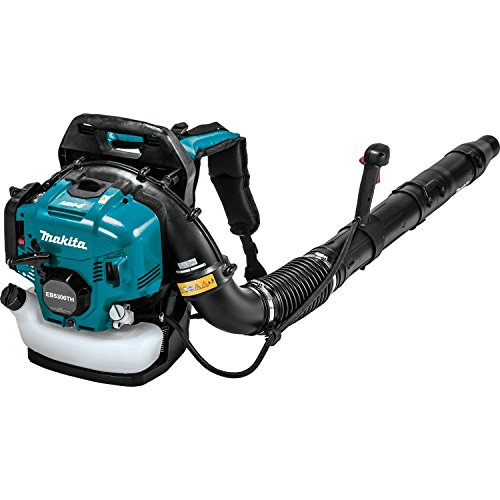
Some people prefer a four-cycle engine. These engines have separate gas and oil reservoirs that produce lower emissions. So if opting for gas but still wanting to protect the environment, four-cycle engines are a little better in that department.
What else is so special about this leaf blower? It’s powerful enough to tackle big messes and piles without any hassle.
What We Like
Easy Engine Startup
The automatic engine decompression enables an easy startup. When you want to get down to business, an easy start engine keeps customers happy.
Great for Big Jobs
This heavy-duty machine is ideal if you have big jobs to tackle or live in a tree-crowded area. The specs — 184 MPH and 516 CFM — mean that no pile of leaves and debris is too big.
Flexible Handle
This is a very thoughtful feature of this leaf blower. Its long flexible handle can easily be adjusted without using any tools.
Anti-Vibration Technology
When wearing a backpack, the last thing you want is lots of vibrations. This can make you very uncomfortable after a little while. Thankfully, this power tool has anti-vibration mounts between the engine and frame to ensure the user’s comfort.
What We Don't Like
Strap Issues
While many satisfied customers don’t have this problem, a few customers find difficulty adjusting the shoulder strap, making it uncomfortable to use.
Product Specs
| Type | Gas-powered |
| Run Time | Not specified |
| Air Volume | 516 CFM |
| Speed | 184 MPH |
| Weight | 19.62 pounds |
Our Ratings
| Product | Best | Type | Run Time | Air Volume | Speed | Weight |
|---|---|---|---|---|---|---|
| Husqvarna 350BT 2-Cycle Gas Backpack Blower | Includes the Best Harness | Gas | 1.25 hours | 692 CFM | 180 MPH | 22.5 |
| Husqvarna 150BT 2-Cycle Leaf Blower | 2-Cycle Backpack Leaf Blower | Gas | 1.5 hours | 692 CFM | 251 MPH | 22.5 |
| Poulan Pro PR48BT 2-Cycle Blower | Gas Option | Gas | 1 hour | 475 CFM | 200 MPH | 22 lbs |
| Echo PB-9010T Backpack Blower | Commercial Backpack Leaf Blower | Gas | N/A | 1100 CFM | 220 MPH | 26.7 lbs |
| Greenworks 80V Cordless Backpack Leaf Blower | Cordless Backpack Leaf Blower | Battery | 10-15 mins | 610 CFM | 180 MPH | 14.6 lbs |
| PowerWorks 60V Backpack Blower | Battery-Powered Blower | Battery | 27 mins | 540 CFM | 140 MPH | 14.8 lbs |
| Makita EB5300TH Backpack Blower | 4-Cycle Backpack Leaf Blower | Gad | N/A | 516 CFM | 184 MPH | 19.62 lbs |
Are Backpack Leaf Blowers Better Than Handheld?
Some prefer them, while others like handheld units. The main advantages of backpack leaf blowers over handheld ones include:
- More power: They are generally more powerful, which means you can do more in less time.
- Evenly distributed weight: While they are heavier, the weight is more evenly distributed because you’re carrying it on your back.
- Tackle more coverage: They are more suited for bigger projects rather than smaller areas.
Just keep in mind that they are significantly more expensive, often by $200.
Types of Backpack Leaf Blowers
Let’s look at the differences between gas-powered and battery-powered backpack leaf blowers.
Backpack leaf blowers tend to be gas-powered. They are more powerful and last longer since they run on fuel rather than battery power.
If you have more than ½ acre to cover, I recommend a gas tank over a battery-powered option. Likewise, a gas-powered option may be right for you if you have a smaller area but a lot of leaf dropping due to crowds of trees.
Pros
- They are more powerful than battery-powered leaf blowers.
- They last longer since it runs on fuel rather than battery.
- Superb for larger yards since it works faster.
Cons
- They’re more expensive long-term since you need to top up on fuel and oil.
- They aren’t eco-friendly since they emit fumes.
Battery-Powered
Battery-powered backpack leaf blowers are a lighter, more eco-friendly option. They’re better suited for smaller areas, under ½ an acre, or where there aren’t as many trees (resulting in fewer leaves). The main issue is that the battery doesn’t last super long, falling anywhere between 15 and 75 minutes.
The good news is that while they aren’t as powerful as gas, they’re not far off. So you can still tackle chores quickly with a battery-powered leaf blower. Just don’t forget to factor in the time it takes to charge the batteries.
Pros
- Since they run on batteries, they’re more eco-friendly.
- They are still very powerful.
- You may find a few options that are a bit more budget-friendly.
Cons
- They aren’t good for big areas or larger messes.
- Battery life often poor, running for as little as 15 minutes between charges.
How To Choose the Best Backpack Leaf Blower
What details should you look at when choosing a backpack leaf blower?

Type
Decide if you want a battery-powered or gas option. Consider the pros and cons of each before buying.
You will also find a few corded electric options. These require a power source, so they minimize your flexibility.

Run Time
It’s very important to consider the run time. The larger the area, the longer you’ll want the power to last. Battery-powered options usually run between 15 and 90 minutes, with the majority being between 30 and 60 minutes.
As for gas leaf blowers, they should last between 1.5 to three hours, depending on the power you use. So if you have a larger yard, a gas leaf blower is a more convenient option.

Air Volume
Air volume is measured in cubic feet per minute (CFM). This detail tells you how much air moves through the machine. In simpler terms, it lets you know how efficiently the unit will move leaves.
The higher this number, the better the machine. I recommend looking at one that’s at least 400 CFM.

Speed
The speed of a leaf blower is measured in miles per hour (MPH). I recommend getting one at least 100 MPH, but this number may be significantly higher in the top gas-powered options.
Consider options with adjustable speed settings, as they enable you to modify the speed to match the specific task you are working on.

Weight
Next up, consider the weight. Since you may be carrying this around for hours at a time, you’ll want to ensure the weight suits you. This varies from person to person, but for context, backpack leaf blowers may be between 10 and 30 pounds.
Top Tip
Consider if the harness is high-quality. This will make sure the weight is well-distributed. So even if you choose one on the heavier side, it shouldn’t be uncomfortable to wear.
Backpack Leaf Blower FAQs

Are Backpack Leaf Blowers Worth It?
Definitely. They are easy to use since they leave your hands free to operate the nozzles.
You will find many options on the market, meaning there’s something for everyone. Of course, they can be quite expensive, ranging from about $150 to $700, so you need to decide if it’s worth the investment for your yard.

What Is Better in a Leaf Blower — CFM or MPH?
They’re both important, but if we had to decide, CFM is more important. This measures the power over the speed. If you have a high CFM, you’re guaranteed to be able to get through heavy-duty messes more quickly.

What Does BT Mean for Leaf Blowers?
BT means that the throttle is located on the right hand of the tube. BF means it’s on the left hand.

How Do You Use a Backpack Leaf Blower?
You use a backpack leaf blower the same way you use a standard one. You must ensure dry conditions and that you position yourself to guide the leaves where you want them to go. The only significant difference is that you wear the engine on your back rather than pulling it around with you on a frame.

What Is the Lightest Backpack Blower?
Knowing which is the lightest backpack blower is tricky because there are so many models available. However, one of the lightest is the POWERWORKS model, weighing just 14 pounds.

What Is a Good CFM for a Cordless Leaf Blower?
A good CFM for a cordless leaf blower is considered to be 200 to 400. However, some larger models have a CFM of 1,000+, making them amazing for larger tasks and commercial uses.