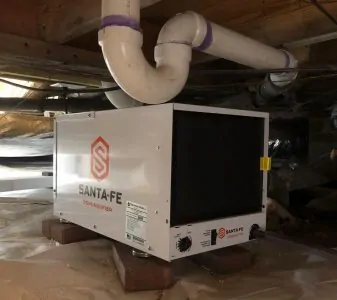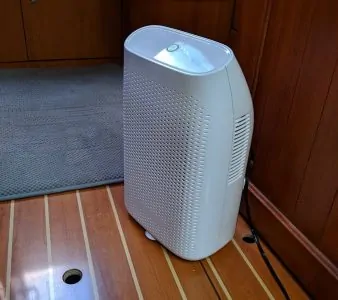
Living in a humid area can affect your indoor air quality. As humidity levels rise indoors, health hazards such as mold and mildew will soon appear. A study showed that relative indoor humidity could even affect the occurrence of respiratory infections as well as allergies (1).
It’s essential to keep indoor humidity to a minimum level to avoid health issues and mold. One of the most effective ways to do so is by utilizing a dehumidifier. These devices will remove excess moisture from the air, leaving you with a comfortable home environment where mold and mites can’t live.
But which one to choose? We spent hours researching various products, customer reviews, and expert advice. We looked at each device’s features and ability to round up the four best 70 pint dehumidifiers.

- Excellent for large areas
- Smart features
- Continuous draining option
- Two optional modes
- Intelligent control panel
- Washable filter
- Fits most homes
- Suitable for large rooms
- Improves air quality
- Large water reservoir
- Easy to operate
- Creates a comfortable environment
Review Methodology: At Oh So Spotless, we provide comprehensive analysis and hands-on experience to deliver the most reliable information on the best 70 pint dehumidifiers. Our professional research and assessment process includes evaluating products based on criteria like performance, energy efficiency, noise level, and user-friendliness. We compare and rank dehumidifiers using quantitative data and first-hand tests, focusing on key decision-making factors that set each product apart from its competitors. Our team evaluates design choices and their effect on users, sharing our findings to help you make the best choice for your home. Trust our expertise in selecting the ideal 70 pint dehumidifier that meets your needs, backed by thorough reviews and evidence.
The Best 70-Pint Dehumidifiers of 2024
Finding the best 70-pint dehumidifier for you requires more thought than simply choosing the highest rated. Our expert team combed through the most popular dehumidifiers on the market. Each unit was judged on how well it performed and how easy it was to use. These are our top picks.
Waykar 80 Pints Energy Star Dehumidifier
Best Features

I know what you’re thinking, why list an 80-pint humidifier? However, it wouldn’t hurt to add just a little more. Besides, it has one of the best feature. The Waykar 80-pint dehumidifier is a favorite of many homeowners. First, it can cover large areas at a time.
It also has a substantial water reservoir, so you can go longer without emptying it. You get multiple handy features such as auto-restart, auto-swing, and auto defrost.
It’s easy to move around thanks to the four universal wheels and suits any type of room. The dust filter is easily removed and cleaned. The unit is also affordable in the long run since you won’t have to buy expensive replacements.
What We Like
Excellent for Large Areas
This dehumidifier can handle vast areas of up to 5,000 square feet. It effectively removes excess moisture of up to 80 pints a day. Set the unit to your desired setting and maintain a pre-set humidity level.
Smart Features Increase Usability
We love the features you get with this unit; they help increase efficiency while making it easier to operate. Among the features, you get a 24-hour timer, visible water level indicator, auto-shutoff, and LED display. The auto-restart makes sure your settings are saved after a power outage.
Cleanable and Reusable Filter
As the dehumidifier removes moisture from the air, dust will inevitably get caught in the filter. However, instead of removing and replacing the filter, Waykar enables you to clean it. Quickly remove the dust filter when the alert notifies you.
Continuous Draining Option
With this unit, you get a 1.14-gallon reservoir and the option of connecting a garden hose for continuous draining. This enables you to run the unit without worrying about a full reservoir. This is excellent for a humid basement where you might want to run it for 24 hours or more.
What We Don't Like
Shorter Automatic Function Lifespan Than Expected
Most customers concluded that the automatic shut-off feature never works for so long than expected. For the price, this is pretty disappointing. While you can add an extended warranty, the automatic one only covers one year.
Product Specs
| Room Coverage | 5,000 square feet |
| Fan Speed | Two |
| Dimensions | 9.84 x 13.39 x 21.86 inches |
| Weight | 31.53 pounds |
| Reservoir Capacity | 1.14 gallons |
Our Ratings
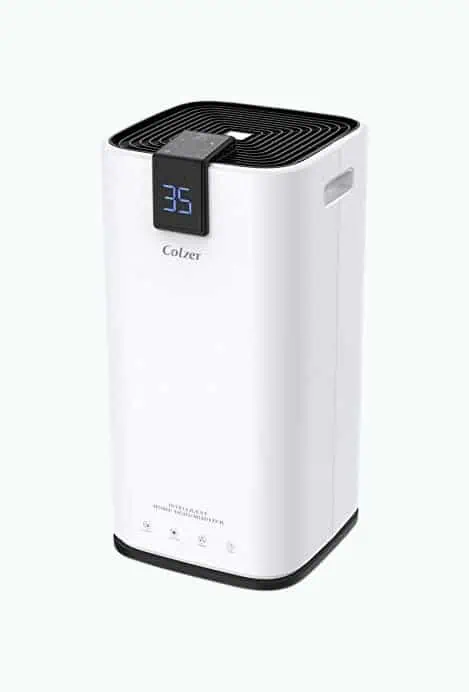
Colzer 70-Pint Portable Dehumidifier
Best Portable Dehumidifier
For a compact and portable dehumidifier, we highly recommend this one from Colzer.
It has a beautiful design that doesn’t look as out of place as other units.
Additionally, it comes with multiple settings and options to help increase efficiency and make it easier to operate. When needed, you can use the included hose for continuous draining.
What We Like
Two Optional Modes
The two optional modes make this unit much more versatile. One is a regular dehumidifying mode, whereas the other is a “dry-clothes mode.” When in this mode, you can effectively dry your clothes even in highly humid weather
Intelligent Control Panel
Thanks to the LED display, we love how easy this unit is to operate. You can control humidity via the setting button, check the humidistat and see humidity levels. When needed, you can set your ideal levels and adjust the fan speed to the desired level or set the 24-hour timer.
Washable Filter
Sooner or later, the filter will need to be cleaned as dust and dirt build up. You can quickly get this done by removing the filter and washing it with warm water. If it’s only slightly dirty, simply use the vacuum to remove loose dust and debris from the surface of the filter.
Automatic Drainage
The full tank alert will notify you when the tank becomes full, so you don’t have to open it to check. You can also place the unit near a drain and use the included 6.6-foot hose to drain continuously.
Portable and Compact
This dehumidifier is slimmer and easier to move around compared to other units. It has a tall design that easily suits any room. Thanks to the four universal wheels, you can quickly move the unit between rooms.
What We Don't Like
Noisy, With Rattling Sounds
Although this unit is highly effective, it can be noisy. Customers have commonly complained about rattling noises.
Might Not Live Up to Expectations
While this is a 70-pint dehumidifier, customers found that it was closer to the performance of a 50-pint option. While other customers were beyond satisfied, this is something to keep in mind.
Product Specs
| Room Coverage | 4,000 square feet |
| Fan Speeds | Two |
| Dimensions | 11.4 by 11.4 by 23.8 inches |
| Weight | 29 pounds |
| Reservoir Capacity | 1.18 gallons |
Our Ratings
Personal Perspective
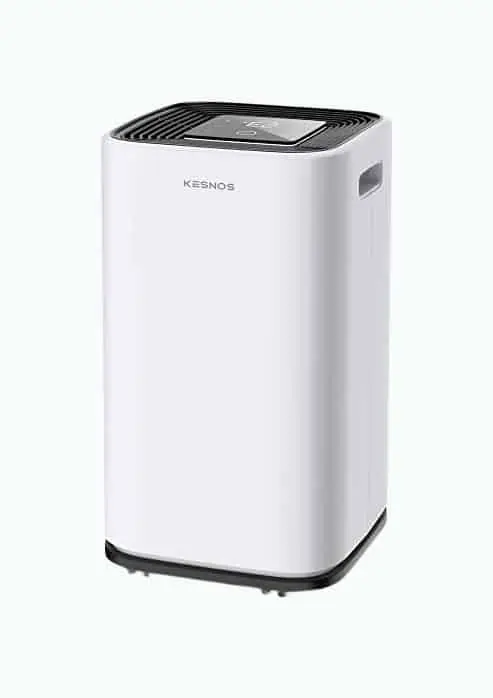
Kesnos 70 Pint Dehumidifier
Best Compact Dehumidifier
If you need a compact dehumidifier that can do large areas at a time, this is for you.
The Kesnos 70-pint dehumidifier is not only powerful, but it’s also eco-friendly. It features multiple settings that allow you to save energy.
The large reservoir can hold most of the moisture of the day. If needed, you can hook up the optional hose for unlimited use on particularly hot or humid days.
What We Like
Compact Design Fits Most Homes
Dehumidifiers can be pretty cumbersome, making it difficult to find a suitable location without them being in the way. However, the Kesnos 70-pint dehumidifier is compact and fits almost anywhere.
It weighs 31 pounds but is fitted with caster wheels to help you move it around wherever needed.
Suitable for Large Rooms
This powerful dehumidifier has a set of two fan speeds to suit the room. It can do large areas of up to 4,500 square feet in one go.
You can easily control and monitor the unit by checking the LCD interface. It allows you to check the humidistat, adjust the fan speed or set the 24-hour timer.
Improves Air Quality
Kesnos fitted this dehumidifier with an innovative filtration and evaporation system. This keeps moisture levels to a minimum while preventing mold, mildew, and other allergens like dust mites. It will also help prevent asthma attacks, creating a safe space for you and your family.
Eco-Friendly Features
If you’d like to become more eco-friendly, this unit is for you. The Ivation 70-pint dehumidifier has several “green” features. These include an auto-shutoff that saves energy, a timer, and a cleanable filter.
Optional Hose
This dehumidifier is fitted with a 1.18-gallon reservoir, but you also get an optional hose for unlimited use. Don’t worry about emptying the reservoir, as it will drain automatically.
What We Don't Like
Doesn’t Last Long
Despite being an excellent dehumidifier, it, unfortunately, won’t last for long. Most customers reported that it failed after a year, whereas others only got six months of use.
Noisy and Distracting
The thing about 70-pint dehumidifiers is that they can be loud. Customers found this one pretty distracting.
Product Specs
| Room Coverage | 4,500 square feet |
| Fan Speeds | Two |
| Dimensions | 11.81 by 11.81 by 22.83 inches |
| Weight | 31 pounds |
| Reservoir Capacity | 1.18 gallons |
Our Ratings
Community Feedback
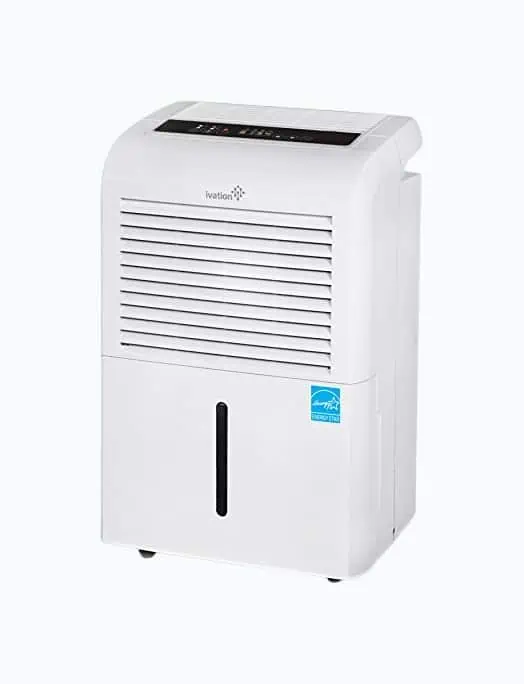
Ivation 70-Pint Energy-Star Dehumidifier
Best Reservoir Capacity
If you’re living in a very humid area and need something that can keep up, this is it. This dehumidifier works effectively and efficiently. Depending on your needs, you can set it to one of two fan settings.
Plus, it has a 2.25-gallon capacity, allowing it to work for longer.
It has various features, such as a 24-hour timer, full tank alert, and filter cleaning alert. The filter is easily removed and cleaned when needed.
Despite the heavy size, it’s easy to move around thanks to the large wheels. We love that it has a long six-foot power cord, so you get more freedom as to where you can place it.
What We Like
Large Water Reservoir
If you live in an area with high humidity levels throughout most of the year, this is for you. This dehumidifier has an extra-large reservoir that can hold up to 2.25 gallons. It can work for longer — compared to other units — without your having to empty the tank.
Easy to Operate
Similar to the other Ivation unit we reviewed, this one also has an LCD interface. Setting your desired levels, fan speed, and even the 24-hour timer is easy. When the reservoir is filling up, or the filter needs to be cleaned, you’ll get notified on the display.
Creates a Comfortable Environment
This dehumidifier will effectively remove up to 70 pints of moisture a day. It will create a much more comfortable living space for you and your family as it helps to prevent mold and mildew.
Easy to Maneuver
At 45 pounds, this dehumidifier isn’t light, but it’s still easy to move around. It’s fitted with four large swivel wheels that enable you to roll it to the right location.
What We Don't Like
Some Features Don’t Work
This dehumidifier has many cool features, such as a timer and a sensor. But customers found that they didn’t work, and if they did, they stopped working shortly after setup. If you’re relying on this for the features, you might be disappointed.
Raises the Room Temperature
If you live in a hot area, the temperatures are already unpleasant. This device can raise room temperatures, creating an even warmer environment.
Not the Most Durable Option
Some people found that this unit lasted a few months, while others found it lasted a few years. It’s quite unpredictable, and the warranty only covers you for one year.
Product Specs
| Room Coverage | 4,500 square feet |
| Fan Speed | Two |
| Dimensions | 11.1 by 15.3 by 23.5 inches |
| Weight | 45 pounds |
| Reservoir Capacity | 2.25 gallons |
Our Ratings
First-Hand Impression
| Product | Best | Room Coverage | Fan Speed | Dimensions | Weight | Reservoir Capacity |
|---|---|---|---|---|---|---|
| Waykar Dehumidifier | Features | 5,000 sq ft | 2 | 9.84 x 13.39 x 21.86″ | 31.53 lbs | 1.14 gal. |
| Colzer Portable Dehumidifier | Portable Dehumidifier | 4,000 sq ft | Two | 11.4 x 11.4 x 23.8″ | 29 lbs | 1.18 gal. |
| Kesnos 70 Pint Dehumidifier | Compact Dehumidifier | 4,500 sq ft | Two | 11.81 x 11.81 x 22.83″ | 31 lbs | 1.18 gal. |
| Ivation Energy-Star Dehumidifier | Reservoir Capacity | 4,500 sq ft | Two | 11.1 x 15.3 x 23.5″ | 45 lbs | 2.25 gal. |
70-Pint vs. 50-Pint Dehumidifiers
If you’re familiar with dehumidifiers, you’ll know that there are different sizes, and they’re categorized by pints. You can find 30, 50, and 70 pints — but what are the differences? Consumers often compare 50 and 70 pints, so we’ll focus on these.
Efficiency
A 70-pint dehumidifier is designed to remove 70 pints of moisture in an area during one cycle. Since 70-pint units are designed to draw more moisture out of the air, they tend to work faster than a 50-pint.
Depending on the condition of your room, a 70-pint unit might not need to run for long. In comparison, a 50-pint removes 20 pints less than the 70-pint. Therefore, it takes more time to work in a very humid area.
Energy Consumption
This one is a bit more complicated to compare since it also comes down to how the specific unit was designed. Larger dehumidifiers will use more energy due to their size.
However, they’re generally fitted with various features designed to save energy. This includes an auto-shutoff mode and even low settings where the unit works at a minimum.
If you were to place a 50-pint unit and a 70-pint in a large room, the 70-pint would finish quicker. This is, again, because it was designed to suit larger rooms.
However, if you were to place a 70-pint unit in a small room, it could be wasting energy since it draws so much when it’s not really needed.
Price
70-pint units are generally more expensive than 50-pint dehumidifiers. They’re larger and often come with different modes and settings. However, the price will greatly depend on the brand and its specific use.
Built-In Pump vs. Condensate Pump
While searching for a new 70-pint dehumidifier, you will come across units with built-in pumps. These are designed to move the water vapor from the room constantly.
Dehumidifiers with built-in pumps must be located near a drain or vent so the vapor can escape. If the outlet faces the room, the device will pump the moisture back into your living space.
Dehumidifiers without built-in pumps will have a collecting bucket for the vapor. These come in different capacities, and you’ll need to empty them every so often to avoid overflow.
Some consumers see this as an inconvenience since you can’t run the unit without having to empty the bucket. Many choose to buy a separate condensate pump and hose.
However, not every unit will need a pump in the first place. Some dehumidifiers use gravitational force to remove the water when the bucket isn’t in use. Most of these units will be marked as having an optional continuous drain.
If your unit doesn’t have this force, a condensate pump and hose will be necessary to remove water vapor.
Is a Built-In Pump Easier?
Yes and no; having a unit with a built-in pump will prevent you from having to do any manual work. However, these units tend to be more expensive and not as efficient as a non-pump unit.
More components could break or malfunction due to the added mechanics. Therefore, they’re not as reliable as non-pump dehumidifiers.
Finding the Best 70-Pint Dehumidifier for You
Hunting for the best 70-pint dehumidifier can be overwhelming. So if you’re unsure where to start, we’ve put together the ultimate guide to help you find the best unit for your needs.

Size
Finding the right size of dehumidifier for you and your home is crucial. We already know we need a 70-pint, but there are still different sizes.
70-pint dehumidifiers tend to be quite cumbersome, but it’s possible to find smaller, more compact designs. It’s vital to consider where the dehumidifier will be located.
For instance, if you need it in your living room, a more compact design would be desirable since it will be more subtle.
On the other hand, if you need a dehumidifier in your basement, you could go for a larger model.
Always check the dimensions to ensure it will fit nicely in your space.

Portability
Due to the often grand size of 70-pint dehumidifiers, they can be tricky to move around. You can’t simply pick it up, so it’s essential to look for a few features.
Wheels are super handy as they enable you to move the unit around effortlessly. Some dehumidifiers will also have handles to make it even easier.

Features
Newer dehumidifiers will come with various features designed for safety and convenience. Here are some of the common features you’ll find:
- Humidistat or hydrostat: This is an instrument fitted inside the dehumidifier that measures the relative humidity in the area. It passes the information back to the unit, which adjusts to suit the conditions (2). Humidistats are handy since they allow you to set the device to maintain your desired humidity level.
- Auto-restart: It can be frustrating to lose your settings due to a power outage or failure. Luckily, when your unit has an auto-restart, it will automatically save your settings and restore them when it is back on.
- Auto-shutoff: When the reservoir begins to fill up, it risks overflooding if you don’t empty it in time. However, with an auto-shutoff, the unit will automatically turn off when the reservoir becomes full.
- Full tank alert: It can be tricky to know when the reservoir needs to be emptied. But many units are equipped with a full tank alert that notifies you when it’s time to empty the reservoir.
- Clean filter alert: Because dehumidifiers draw air in, they’re equipped with filters to collect dust and debris. However, the filter will need to be cleaned periodically to ensure the unit is working optimally. Some units are fitted with a clean-filter alert, which notifies you when it’s time for a clean.
- Defrost: If the coils inside the dehumidifier freeze up, it can ruin the unit. A defrost function will quickly defrost the coils and keep the dehumidifier running smoothly. This feature is less common, but it’s necessary in cold areas.

Ease of Use
No one likes a complicated device where you must press five buttons to turn it on. We prefer units with a simple LED display and a few marked buttons so you know exactly what to press.
Make sure the unit you’re considering has an ergonomic design that makes it easier to use and empty. We also recommend finding a unit with a clear water level indicator, so you can easily see how full it is.
If your unit is equipped with a filter, consider how to remove this. Having to take the unit apart to remove a filter is highly inconvenient.
Reservoir Capacity
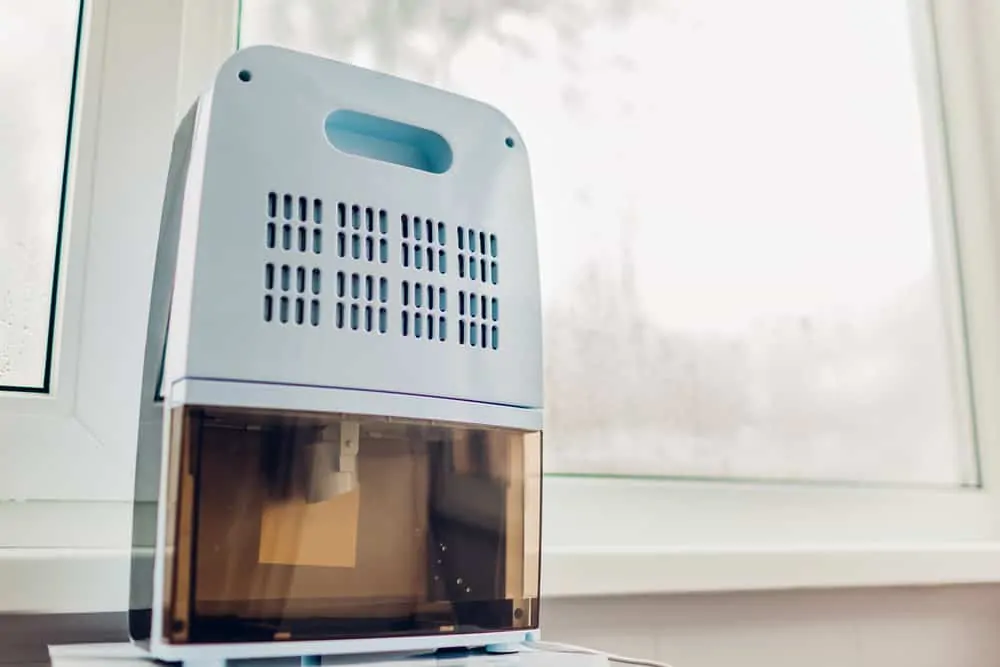
The reservoir is where the water vapor will be collected, so the capacity is crucial. Having a small reservoir means you’ll have to empty it more often. On the other hand, units with larger tanks tend to be larger in design.
A common size is around 1.5 gallons, but it can be anywhere up to and above 2.5 gallons. Consider your needs before settling on a unit.
Maintaining a 70-Pint Dehumidifier
Most dehumidifiers will have directions on maintenance and how often they need to be cleaned. Maintenance often includes removing the bucket to clean it. You can do this with regular dish soap.
The filter will also need to be cleaned, typically with a vacuum, or you can rinse it with water.
Keep In Mind
FAQs

Will a Dehumidifier Remove Mold?
No, a dehumidifier won’t kill or remove actively growing mold or mildew. It can, however, prevent future growth of mold and mildew by keeping moisture levels to a minimum.
The CDC recommends that you keep the humidity levels in your home no higher than 50 percent throughout the day (3). This will help to keep mold at bay. Most dehumidifiers can lower the humidity to levels between 40 and 30 percent.
Deal With Mold Professionally

Where Should I Place My Dehumidifier?
Place your dehumidifier anywhere in your home where moisture is causing trouble. Some homeowners purchase a dehumidifier to remove moisture in their basements. Others use it to improve the indoor environment in common living areas.

How Long Should a Dehumidifier Run Per Day?
On average, a dehumidifier should run for 12 hours per day. This timescale depends on the air moisture level, the size of the dehumidifier, and the space.

Is It Bad to Oversize a Dehumidifier?
It can be bad to oversize a dehumidifier because it can extract too much moisture from the atmosphere, creating a dry environment. Most experts recommend that the humidity in our homes should be 30 to 50 percent for a comfortable environment.

Can One Dehumidifier Do a Whole House?
One dehumidifier can do a whole house if it is of suitable capacity and correctly situated to reach every room. It also helps if your home is open plan to create better airflow.

How Many Square Feet Will a 70-Pint Dehumidifier Cover?
A 70-pint dehumidifier will cover approximately 4,000 to 4,500 square feet. However, the coverage also depends on the air’s moisture level and where you locate the dehumidifier.